
Qi Node 15: 白露 Báilù (White Dew)
The air cools, mornings are damp with dew, and activity begins to soften. This is a time for preservation—of energy, fluids, and focus. Slow down. Eat warm foods. Let stillness shape your days as Autumn deepens.

Young girl leads her grandfather by the hand
Báilù 白露 (White Dew) arrives in early September and runs until the Autumn equinox. It is the third of Autumn's six Qi Nodes, and it is named for something you can walk outside and verify. By early September, overnight temperatures across most of the continental United States fall far enough that water vapor condenses out of the air onto grass, car hoods, and porch railings before dawn. Dew formed in August too, in smaller amounts and burning off within minutes of sunrise. At Báilù it accumulates heavily enough to soak your shoes and lingers until mid-morning. The name records a threshold in the physics of the air, and the threshold is the point of the node.
The node sits between Chǔshǔ 處暑 (End of Heat), which marked the breaking of Summer's heat, and Qiūfēn 秋分 (Autumn Equinox), which will divide the year evenly between light and dark. Daylight is now contracting at close to its fastest annual rate, roughly three minutes a day at the latitude of Portland, and the loss is quick enough to notice week to week rather than month to month. Afternoons still reach into the eighties in much of the country. The change shows up at the edges of the day, in mornings that require a jacket and evenings that turn cold an hour after sunset.
In the Chinese medical reading of the year, Yáng qì has been withdrawing since the solstice, and at Báilù that withdrawal becomes the organizing fact of the season rather than a background trend. Yīn 陰 is ascending, and its character is worth being specific about. Yīn is the gathering, cooling, condensing, and inward-turning aspect of any process. The dew itself is a demonstration: water that was dispersed invisibly through warm air draws together into visible drops as the air cools. That is what Yīn does, in the atmosphere and in the body. It collects what was scattered and gives it form.
Metal, the Lung, and the Dryness of Early Autumn
Autumn belongs to the Metal phase. Metal governs contraction, refinement, and the separation of what is worth keeping from what is not, which is why the tradition associates it with the harvest (incidentally metal is also associated with grief because of its value in understanding what is me and what is not me, what persists and what is gone. See Below). Its paired organs are the Lung and the Large Intestine, and its flavor is pungent.
The Lung in Chinese medicine carries responsibilities beyond gas exchange. It governs the qì of the whole body, controls the opening and closing of the pores, and distributes fluids to the skin and the surface tissues. It is also described as the most delicate of the organs, the one most exposed to the outside, since it is the only internal organ in continuous direct contact with the air. That exposure is why Autumn is the season the Lung feels first.
What the Lung feels at Báilù is dryness. As temperatures fall, the air holds less water in absolute terms, and the drop in humidity is the reason dew forms in the first place. Dry air pulls moisture from every surface it touches, including the lining of the airways. In biomedical terms, the airway surface liquid, a thin fluid layer that lets the cilia sweep debris and pathogens up and out of the lungs, thins when inhaled air is dry. The result is the cluster of complaints that begin to surface in September: a dry throat on waking, a tickling cough that produces nothing, chapped lips, drier skin, and a greater susceptibility to the respiratory viruses that begin circulating as schools return and people move back indoors. The Chinese medical description of Autumn dryness injuring Lung Yīn and the physiological account of impaired lung function in low humidity are two descriptions of the same September.
The emotion assigned to Metal is grief. This is less mystical than it sounds. Autumn is the season in which things visibly end, and the tradition observed that people who are carrying unprocessed loss often find it surfaces at this time of year, frequently alongside the respiratory symptoms above. Clinically, the Lung and grief show up together often enough that asking about one when a patient presents with the other is standard practice.
What the Season Asks
The Sùwèn 素問 (Basic Questions), in its chapter on regulating the Shén 神 across the four seasons, gives Autumn a specific instruction: sleep early and rise early, keep the mind settled and unhurried, and gather the qì inward so that the Lung qì stays clear. Compiled circa 100 BCE to 100 CE, the advice is supposed to be practical rather than ceremonial. It describes matching the body's activity to a contracting day.
Gathering is the work of this node. Summer dispersed attention outward across social commitments, travel, projects, and long evenings. Báilù is early enough in Autumn that the contraction can be gradual, which is the advantage of starting now rather than at the equinox. The specific practice is deciding what continues into the darker half of the year and what does not, and the deciding matters more than any particular answer. People who carry every Summer commitment into November tend to arrive at Winter depleted.
Báilù also asks for protection of the surface. The pores, which opened through Summer to release heat, are still working on the old setting while the mornings have moved on. This is the mechanism behind the common September pattern of catching a cold after a cool evening spent underdressed, and it is why the classical advice is to add a layer earlier than feels necessary rather than later.
Living with Báilù
Eat with the season
Moisture is the organizing principle. Foods that hold water and release it slowly counter the dryness the season brings: soups, broths, stews, congee and other slow-cooked grains, and vegetables cooked with liquid rather than roasted dry. Barley, oats, and rice all work well in this form.
Pears are the Autumn food most directly associated with the Lung in Chinese medicine, and the association holds up on inspection, since a poached or stewed pear delivers water and soluble fiber in a form that soothes a dry throat. Apples do similar work. White and pale foods carry a traditional affinity for Metal and the Lung, which brings in cauliflower, onions, white beans, mushrooms, and daikon or other radishes. Pungent flavor belongs to Metal, so onion, garlic, ginger, and mustard greens all suit the node and have a tangible effect on airway secretions.
The last of the Summer produce is still good and still worth eating. Tomatoes, cucumbers, and melon are at their peak in early September, and there is no reason to give them up becaue they belong to Summer. The consideration is cumulative rather than per-item: a day built entirely on cold and raw food demands more of digestion than one where cool dishes sit alongside something warm. A tomato salad next to a bowl of soup is a well-built early Autumn meal. Ease off greasy and heavily spiced food, which adds heat in a season trying to cool off.
Move with the season
Favor movement that circulates without provoking heavy sweat. Walking, cycling at conversational pace, swimming, stretching, and the slower internal practices like tai chi and qigong all suit the node. Sweat is a fluid loss, and fluids are the thing this season is asking you to conserve, so the hard interval sessions that felt right in July are worth moderating now.
Move the timing earlier. Mornings at Báilù are cool and clear and the air quality is often at its annual best, and exercising in the early part of the day matches the season's own rhythm better than a late-evening workout. If you are outside in the early morning, dress for the temperature you find rather than the one the afternoon will bring.
Rest with the season
Go to bed earlier than you did in August. Half an hour is enough to start with, and the shift should track the sunset rather than the clock. Rising early still suits the season, so this is a lengthening of the night from the front end rather than a later morning.
Protect the evening from cognitive load. Finishing dinner by around seven and leaving demanding work out of the last hours gives the body a long, undisturbed window, which is when the repair work of the season gets done. Keep the bedroom from drying out. In climates where heating starts in September, a humidifier or an open bowl of water near the heat source keeps the airways from spending eight hours in dry air.
Tend your Lungs
Breathe deliberately once a day. Five minutes of slow breathing, with the exhale longer than the inhale, expands the parts of the lungs that shallow daytime breathing never reaches and shifts the nervous system toward parasympathetic tone. Doing it outside in the morning air adds nothing mystical and does add cool, clean, humid air at the time of day it is most available.
There is a traditional early Autumn practice of walking barefoot through the dew for a few minutes at dawn, then drying and warming the feet immediately afterward. It suits people who tend to run hot or hold heat in the upper body, and it is worth trying on that basis. Anyone who runs cold, or who has circulatory problems or reduced sensation in the feet, should skip it.
Attend to grief if grief is present. If something ended this year and you have not had the room to feel it, this is the season when it tends to surface, and the practical version of tending the Lung is often just giving that some space rather than working through it. A conversation, a walk, or an hour without a task will do more here than any dietary adjustment.
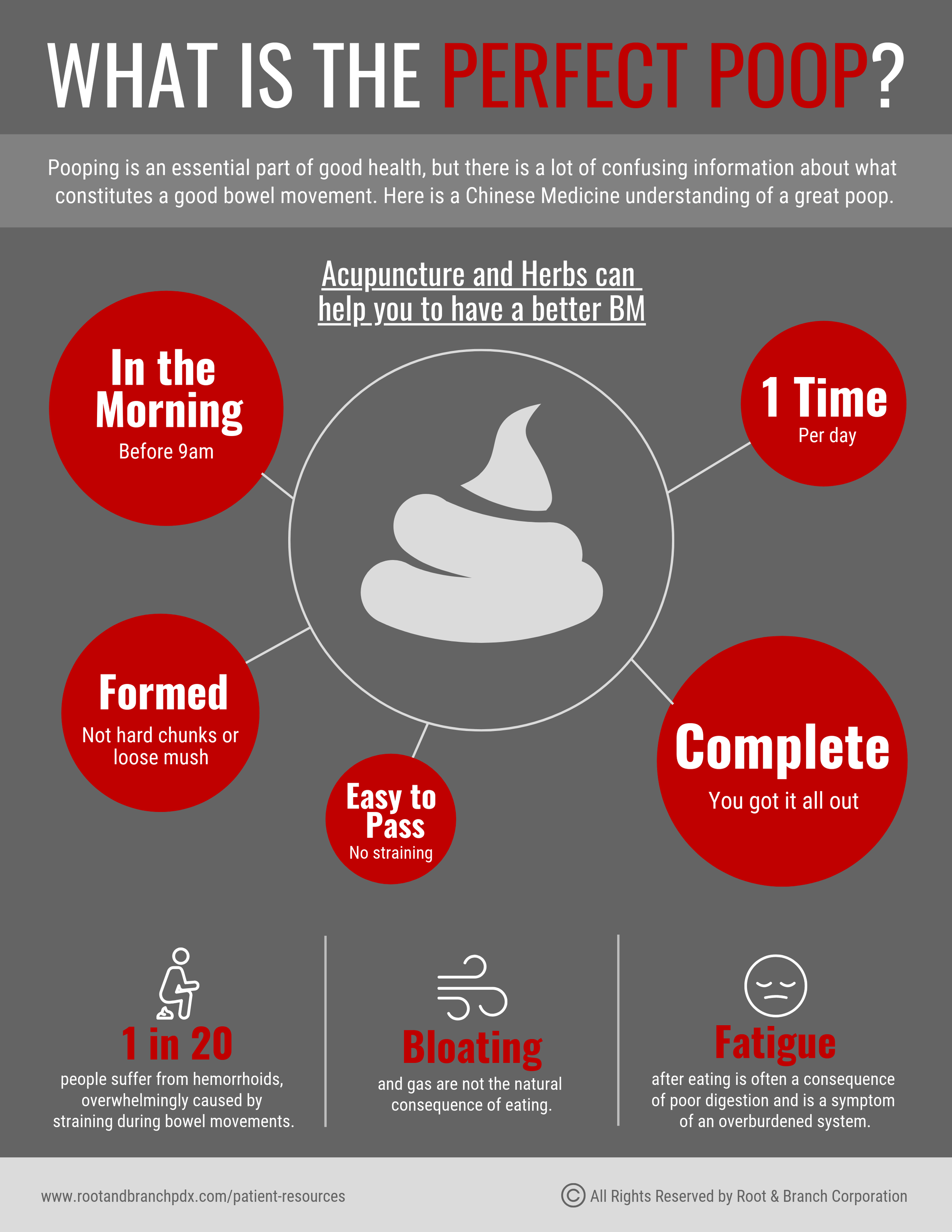
What Your Stool Is Telling You: A Chinese Medical Field Guide
Bowel movements are one of the most reliable diagnostic signals the body produces, and most adults have never been told what to look for. Chinese medicine has been paying close attention to stool for two thousand years. Here is the physiology of a good one, and what it means when things are off.
At Root & Branch we hand out an infographic in the clinic called The Perfect Poop, which is included alongside this post. It is exactly what it sounds like. Patients sometimes laugh when they first see it, which is fair, and then they take it home and read it carefully, which is the point. Bowel movements are one of the most reliable diagnostic signals the body produces, and most adults have never been told what to look for.
The Chinese medical tradition has been paying close attention to stool for roughly two thousand years. Color, form, frequency, timing, ease of passage, odor, and the relationship between what goes in and what comes out are all standard items in a careful intake.
What good looks like
A healthy bowel movement has five qualities worth naming explicitly. It is formed, complete, easy to pass, occurs in the morning, and happens about once a day. Each one is a real diagnostic signal, and each one is informative when it goes wrong.
Formed means the stool holds together as a recognizable shape without being hard or fragmented on one end and loose or mushy on the other. The Bristol Stool Scale, which any GI clinic in the country uses, calls this Type 3 or Type 4: a sausage shape, either with surface cracks or smooth. Anything harder than that suggests dryness, slow transit, or insufficient fluid in the bowel. Anything looser than that suggests either too much fluid, too fast transit, or both. In Chinese medical terms, the dry end of the spectrum tends to indicate Yīn or Blood deficiency, Heat, or stagnation; the loose end tends to indicate Spleen qì deficiency, Dampness, or cold in the digestive center. The pattern often shifts across the week or across the day, and that variability is itself diagnostic.
Complete means the bowel actually finishes its work in a single sitting. The sense that something is still up there, the urge that returns twenty minutes later, the multiple trips before the body is satisfied — all of these suggest that the descending function of the lower intestine is not operating cleanly. In biomedical terms, incomplete evacuation is associated with pelvic floor dysfunction, slow colonic transit, and sometimes structural issues that warrant imaging. In Chinese medical terms, it usually points to Spleen qì deficiency (the lifting and holding function is weak, so the conducting function downstream is uneven), Liver qì stagnation (the smooth flow is disrupted, so the bowel cannot release in one coordinated act), or Damp accumulation that makes the stool sticky and reluctant to move.
Morning is the timing claim that surprises people most. A healthy adult bowel tends to move within an hour or two of waking, well before mid-morning. There is good physiological reasoning behind this. The colon's strongest contractile activity, called the gastrocolic reflex, occurs in the hour after waking and after the first meal of the day. Cortisol peaks in the early morning, which contributes to the wake-up signal the gut receives. The Chinese organ clock, which assigns each two-hour window of the day to a particular organ system, places the Large Intestine at 5 to 7am. The two frameworks are describing the same biological reality. The body is designed to release its waste in the morning, and a system that is functioning well will tend to do so spontaneously, without coffee, without straining, and without prompting.
People whose bowels do not move until midday or evening, or whose timing is unpredictable from day to day, are usually showing some combination of irregular sleep, irregular meals, sympathetic nervous system overactivity, and a Spleen-and-Stomach system that has lost its rhythm. The fix is not a stimulant; it is a regular schedule of sleep, breakfast, and unhurried morning time, sustained long enough that the body can reset its own clock.
Once per day is the median frequency for adults. Some healthy people go twice. Some go every other day. The window of normal is wider than the median suggests, but one daily movement is a useful anchor, and significant deviation from that is worth paying attention to. Three or more times a day usually indicates Spleen qì deficiency with Dampness or, in biomedical terms, some form of malabsorption or accelerated transit. Less often than every other day usually indicates Yīn or Blood deficiency, Heat in the intestines, or Liver qì stagnation, and in biomedical terms reflects slow transit, low fiber intake, inadequate hydration, or sedentary habits.
Easy to pass is the quality most worth dwelling on. A well-functioning bowel does not require effort. The stool descends because the descending function of the digestive system carries it down, the smooth muscle of the colon coordinates its contractions, and the pelvic floor releases on cue. The person sitting on the toilet is doing very little active work. Straining is a sign that one or more of these mechanisms is off.
Roughly 1 in 20 adults in the United States have symptomatic hemorrhoids, and the overwhelming cause is straining. This is worth sitting with for a moment. Hemorrhoids are a structural injury caused by the repeated application of intra-abdominal pressure during defecation. They are not random and they are not inevitable with age. They are the predictable downstream consequence of a digestive system that is not doing its job and a person who is compensating with force. The same is true of many cases of pelvic floor dysfunction, anal fissures, and the more advanced forms of pelvic organ prolapse. The body is not meant to push that hard. When it has to, something upstream is asking for attention.
The Chinese medical physiology underneath
The center of digestion in Chinese medicine is the pairing of the Spleen and the Stomach, which together perform what the tradition calls yùn huà 運化, transportation and transformation. The Stomach receives food and begins to break it down. The Spleen extracts the usable portion, sends the clear part upward to be made into qì and Blood, and sends the turbid part downward to continue through the intestines.
This downward direction of the turbid is critical. The Stomach qì descends, the Spleen qì ascends, and the two movements together create the engine that pulls food downward through the digestive tract. When Stomach qì fails to descend, the result is reflux, nausea, burping, and bloating that rises rather than passing. When Spleen qì fails to ascend, the result is fatigue after meals, prolapse symptoms, and loose stools. The two failures often appear together because they are two sides of the same loss of directional integrity in the digestive center.
The Large Intestine sits below this center and does the final work. In Chinese medical terms it receives the turbid downward and conducts it out. Its function depends on the upstream Spleen and Stomach doing their work, on sufficient fluid in the bowel to keep the stool moving without becoming dry, and on the smooth flow of Liver qì across the abdomen to keep the smooth muscle coordinated rather than spasming or stalling.
The Lung, somewhat counterintuitively, is also part of the picture. The Lung and the Large Intestine are paired as the Yīn and Yáng organs of the Metal phase, and they share a functional relationship that classical texts describe explicitly. The Lung governs the descending of qì generally, and the Large Intestine carries out the most concrete version of that descent. Patients with chronic constipation often have shallow breathing, a tight diaphragm, and a history of holding their breath under stress. The connection is not metaphorical. The diaphragm is the major intra-abdominal pressure regulator, and breathing patterns shape the mechanical environment the bowel operates in.
The Liver regulates the smooth flow of qì across the whole system, and its influence on the bowel is constant. When Liver qì stagnates, the gut moves erratically. Cramping, alternating constipation and loose stools, urgency that does not produce much, and the strong relationship between emotional stress and bowel symptoms all reflect Liver involvement. This is the pattern underneath most cases of IBS, and we have written about it at length elsewhere.
The Kidney, finally, provides the deeper Yáng warmth that the digestive engine runs on. Older patients with chronic loose stools in the early morning, patients with cold limbs and low metabolic fire, and patients whose digestion never recovered from a long illness or a stressful period often need to be treated at the Kidney level rather than just at the Spleen and Stomach level. Without the foundational Yáng, the Spleen cannot do its work no matter how well it is supported directly.
When the signals stop matching
Two related signals are worth lingering on alongside the stool itself. Bloating and gas are not the natural consequence of eating, and fatigue after eating is often a sign of an overburdened system.
Both are signals that the descending and transforming work of the digestive center is not keeping up with what is being asked of it. Mild gas is normal. Bloating that distends the abdomen visibly, gas that produces real discomfort, and the sensation that food is sitting in the upper abdomen for hours after a meal are not normal. They are signs that the Spleen qì is depleted, the Stomach qì is not descending cleanly, or that Damp is accumulating in the middle because the system cannot transform the volume or quality of food it is receiving.
Post-meal fatigue follows the same logic. If digestion is functioning well, a meal should leave the eater settled and stable. A modest dip in alertness after a large meal is normal; the desire to lie down after a regular lunch is not. It signals that the Spleen is being asked to do more than it can manage and is borrowing energy from elsewhere to do it, which is the same physiological move that underlies the afternoon crash and the chronic low-grade fatigue many patients arrive with.
These symptoms, like the qualities of the stool itself, are diagnostic. They are not nothing, they are not inevitable, and they respond to treatment. The Chinese medical approach to digestion is not to suppress symptoms but to restore the upstream functions that produce them when they are working correctly.
Learning to read what you have
The standard cultural conversation about bowel movements is almost entirely missing. Most adults have no model of what they are looking for, no sense of what counts as a problem worth raising, and no way to track their own digestive health over time except as a vague sense that something is or is not off. The five qualities above are enough to start a conversation that most people have never had with themselves.
The body is informative if you let it be. Stool is one of the cleanest signals it produces, and learning to read it is one of the more useful pieces of self-knowledge available to anyone willing to look. When digestion is working, the signals match. When something is off, the signals will tell you, in considerable detail, what to investigate next.

The Case for Breakfast, and for Being Hungry
Modern wellness advice often treats appetite as a problem to manage. In Chinese medicine, regular morning hunger is a sign that digestion is working, and breakfast is the meal that sets the metabolic tone for the day. Skipping it asks the body to run on stores that should have been replenished.
Appetite is actually your friend
There is a version of modern wellness advice that treats appetite as a problem to be managed. Hunger is recast as a temptation, a sign of poor discipline, or evidence that the previous meal was somehow wrong. The fix is usually to eat less, eat later, or eat in ways that suppress the hunger signal entirely. A meaningful number of people now skip breakfast as a matter of principle, and a meaningful number of those people also report that their relationship with food has become more anxious rather than less.
Appetite is a good thing. Regular morning hunger is one of the better signs that digestion is doing its work. It arrives on a schedule, does not come with urgency, and goes away when you eat and stays away until the next meal. This is different from the kinds of hunger our patients more often describe: the jittery hunger that follows coffee on an empty stomach, the late-afternoon hunger that comes from a skipped breakfast catching up, or the anxious hunger that is really stress wearing the costume of appetite. Those are signs that something is off. Morning hunger, by itself, is a sign that something is working.
In Chinese medical terms, breakfast sets the metabolic tone for the day. The Spleen 脾 (pí) and Stomach 胃 (wèi), which together form the center of digestion in Chinese medicine, are at their most active in the morning hours. The classical organ clock places the Stomach's peak between 7 and 9 a.m. and the Spleen's between 9 and 11 a.m. Eating warm, substantial food during this window gives the digestive system the work it is built for at the moment it is best equipped to do it. Skipping breakfast asks the Spleen to start its day without fuel, and asks the rest of the body to run on stores that should have been replenished.
The biomedical picture lines up surprisingly well. Cortisol peaks in the early morning as part of the normal awakening response, and one of cortisol's jobs is to mobilize glucose for the day's activity. Insulin sensitivity is generally highest in the morning and declines through the day, which means the body handles the same meal more efficiently at 8 a.m. than at 8 p.m. The hormones that govern appetite, ghrelin and leptin, follow a circadian pattern that has them rising and falling in a rhythm shaped by when and how regularly we eat. When that rhythm is disrupted, by skipped meals, by erratic timing, or by eating heavily at night, the system gets noisier and the signals become harder to read. People who say they "don't feel hungry in the morning" are often describing a hunger signal that has been quieted by months or years of not being answered.
The intermittent fasting literature is not wrong about everything. There are populations and contexts in which time-restricted eating produces real benefits, and some people do well with a later first meal. The complication is that the people who do well with that approach tend to be metabolically robust to begin with, and the people who arrive at our clinic are usually not in that category. They are tired, their digestion is sluggish, their sleep is uneven, and they have often been treating their already-depleted system as if it were robust. For these patients, the prescription is usually the opposite of what the fasting protocols suggest. Eat earlier. Eat warm. Eat enough that the body has something to work with.
The "I'll just have coffee" approach is the most common breakfast in our patient population. Coffee on an empty stomach is a stimulant acting on a system with no fuel. It produces alertness by pushing the adrenal system harder, not by feeding the body, and the energy it provides is borrowed against later. Over weeks and months, the pattern produces the picture we see often in the clinic: morning tension, weak breakfast appetite, mid-afternoon crashes, evening hunger that becomes evening overeating, and sleep that does not quite restore. The fix is not to give up coffee. The fix is to put something underneath it.
What this looks like in practice
A good Chinese medical breakfast is warm, cooked, and substantial enough to register as a meal. The traditional staple is congee, a slow-cooked rice porridge that can carry whatever vegetables, herbs, meat, or eggs you want to add to it. Oatmeal cooked with a little ginger and walnuts is a great Western analog and is what many of our patients end up eating. Eggs, sautéed greens, and a piece of warm sourdough work just as well. The principle is that the food is warm and easy to digest, that it contains some real protein and fat, and that it actually fills you for several hours.
What we generally steer people away from at breakfast: cold cereals with cold milk, raw fruit smoothies (especially with ice), pastries on their own, and any breakfast built around cold and sweet without warmth or substance underneath. These foods do not damage the Spleen in any one instance, but they cool and weaken digestion over time when they are the default morning meal, and the people who eat them most consistently are usually the people whose digestion is already running cool.
Timing matters less than the meal itself, but earlier is generally better than later. Eating within an hour or two of waking aligns with the Stomach and Spleen meridian times and with the morning cortisol and insulin pattern. If your schedule does not allow for that, a breakfast at 9 or 10 a.m. is still vastly better than no breakfast at all. The goal is not to optimize the timing to the nearest fifteen minutes. The goal is to actually eat.
If you are someone who has not been hungry in the morning for a long time, the appetite usually comes back within a week or two of eating breakfast regularly. The hunger signal is responsive to feeding; the body learns to expect food at a certain time and starts producing the signal that asks for it. The first few days can feel a little forced, and that is fine. Eat something small if you do not feel hungry. Within ten days, most people are waking up actually wanting breakfast, which is the body's way of telling you the rhythm has come back online.
The wider point about appetite
Appetite, in the larger sense, is the same kind of signal. A person who is hungry for their work, hungry for time with people they love, hungry for the next book or the next conversation or the next walk, is a person whose system is functioning. Appetite for life and appetite for food are directly related and have the same physiologic basis. They both depend on the same underlying capacity for the body to want what it needs and to know when it has had enough.
The patients who eat without pleasure or intention and sleep without rest and move through their days on caffeine and willpower, are usually the same patients who skip breakfast. The two patterns reinforce each other. A system that is not fed in the morning learns to suppress its demands. A system that suppresses hunger long enough learns to suppress other appetites too. The flatness and fogginess people describe is sometimes depression, sometimes burnout, sometimes a thyroid issue, and all of those things are what happens to a body that has been told for too long that wanting things is the problem.
Breakfast is a small daily way back into that capacity. You eat in the morning because you are an animal that needs food, and because the Spleen and Stomach are ready to work, and because the day ahead will go better if it has something behind it. The hunger that returns when you start doing this is not a problem to manage but is instead the system coming back to itself.

Qi Node 9: 芒種 Mángzhong (Grain Matures)
You’ve been conserving, planning, and preparing all year. Now it is time to DO!

Close-up image of grains of wheat on the grass stalk
The Season of Awakened Action
Mángzhǒng 芒種, the third of Summer's six Qi Nodes, arrives in early June. The name translates as "Grain in Beard" and refers to the moment when wheat and barley grains develop their awns, the fine bristles that mark the final stage before harvest. In the fields, the grains that had been filling quietly through Xiǎomǎn 小滿 are now nearly mature, and the agricultural work shifts from tending toward gathering. Farmers who have been maintaining the crop for weeks now move into the more urgent and physically demanding work of bringing it in.
The node sits between Xiǎomǎn and Xiàzhì 夏至, the Summer solstice, and its character reflects the position. Yáng qì is still climbing toward its peak, the days are still lengthening, and the heat is building reliably toward its annual high. Mángzhǒng carries more urgency than the earlier Summer nodes because the agricultural window is narrowing (grain that is not harvested in time will shatter or spoil) and because the body responds to longer days and higher temperatures with more available capacity for activity. The solstice is still two to three weeks away, which means the season has not yet reached the peak heat of Xiǎoshǔ and Dàshǔ in July, and the work done now happens under conditions the body can still sustain.
Fire at full volume, with Earth in the mix
Mángzhǒng belongs to the Fire phase, the phase that governs the whole of Summer, and the Heart remains the lead organ of the season. By this point in the calendar, the Fire is burning at sustained volume. The cardiovascular system is working harder to thermoregulate, sweating increases its draw on fluids and electrolytes, sleep shortens naturally, and the nervous system runs warmer. These are the same physiological shifts that began at Lìxià 立夏, now at higher intensity.
What distinguishes Mángzhǒng from the earlier Summer nodes is the presence of Earth. The grain-ripening imagery that gives the node its name belongs to Earth, the phase associated with the Spleen, digestion, and the transformation of food into usable substance. Classical commentary on this node observes that the heat of full Summer combined with the rising humidity of the rainy season produces the damp-heat conditions that place the heaviest load on the Spleen. In clinical terms, this shows up as bloating that tracks with humid weather, heaviness in the limbs, a foggy or sluggish quality of mind, and the sensation of being weighed down despite not having done particularly heavy work. The Chinese medical framing is that the damp conditions the Spleen has to contend with are also the conditions the Fire of Summer is generating in the body, and the two together compound each other.
What the season asks of us
Mángzhǒng is the node that most directly rewards action. The planning of Spring is complete, the steady development of early Summer has accumulated enough momentum to work with, and the projects that have been waiting for their moment generally have it now. The story that has been living in your head gets written, the difficult conversation gets scheduled, the deck gets built, the garden gets the second planting. The season supports sustained work across multiple fronts in a way that the quieter seasons do not.
The risk of the node is the mirror image of its gift. When the season supports action, the temptation to push past a reasonable pace is strong, and the cost of doing so compounds faster now than at Lìxià or Xiǎomǎn. The patients who arrive in late July and August with Summer-heat patterns (insomnia, irritability, exhaustion, inflammatory flares, digestive disruption) often trace the pattern back to three or four weeks of running hard in early-to-middle June without adequate recovery. Mángzhǒng is where the work of Summer is done, and it is also where the conditions for Summer burnout are established if the pace is not managed.
Emotional heat is also a genuine feature of this node. Irritability, impatience, and short tempers appear more readily in hot weather, and brief emotional releases can actually serve a clinical function by discharging accumulated heat. The pattern to watch for is the shift from occasional release to sustained churn. Anger that comes and passes is part of a working system. Anger that settles into a baseline state damages the Heart and sets up the deficiency patterns that follow in the later Summer and early Autumn.
Living with Mángzhong
Eat with the season
Build meals around foods that support digestion under damp-heat conditions. Barley, lentils, white beans, and black beans all have a draining quality that helps the body clear accumulated damp, and barley soup is one of the simplest and most season-appropriate meals you can make. Lightly cooked seasonal vegetables, cooked grains, and simple broths remain the steady base. Bitter greens continue to suit the season, and any of dandelion, arugula, endive, radicchio, or watercress work well. Mung beans and adzuki beans are the ingredients the traditional literature most directly recommends for this season, and they are worth using if you have them, but the functional work they do is available in a normal pantry.
Meal timing matters more at Mángzhǒng than at other times of year. A substantial breakfast, a reasonable midday meal, and a lighter evening meal fits the season's energetics better than the common pattern of skipping breakfast and eating a large dinner. The Spleen functions most strongly in the morning hours, and loading the day's heaviest meal into that window gives the digestion its best chance to handle the increased load. Green tea or chrysanthemum tea through the day supports digestion and helps clear damp-heat without the stimulant load of coffee; peppermint and hibiscus also work well as cooling summer teas. Continue pairing cooler and lighter Summer foods with warm cooked elements in the same meal, as discussed in the Xiǎomǎn post, and watch the cumulative cold load across the day.
Move with the season
Move consistently and keep the sessions well within what the heat allows. Mángzhǒng supports longer walks, swimming, cycling, tài jí, and the kind of sustained outdoor activity the season invites. The important adjustments are timing and recovery. Exercise in the cooler parts of the day, hydrate with attention to electrolytes as well as water, and build genuine rest days into the weekly pattern. Midday exertion in the heat of early June puts real strain on the cardiovascular system and depletes faster than recovery can keep up.
Stretching and mobility work earn their place at Mángzhǒng because damp-heat conditions tend to make the body feel stiff and heavy. Ten minutes of focused mobility in the morning often pays back more through the day than an additional thirty minutes of cardio would.
Rest with the season
Sleep tends to shorten further and become more fragmented at Mángzhǒng, and insomnia patterns often begin or worsen in this window. Keep the sleeping space genuinely cool, eat the last meal at least two to three hours before bed, limit alcohol in the evening, and despite the lingering light, hold bedtimes closer to the sun's schedule than to the clock's. Going to bed two hours after sunset rather than four hours after tends to protect sleep quality noticeably.
A midday rest of fifteen or twenty minutes remains a genuine clinical recommendation through Summer and is especially worthwhile at Mángzhǒng when the day's pace is higher. Deep breathing into the belly before sleep helps settle a nervous system that has been running warm, and ten minutes outside in the evening light, without screens, helps the body register the transition from day to night.
Tend your Heart
The cultivation work specific to Mángzhǒng is pacing the Fire. The season supports intense engagement and is also the node at which over-engagement produces the most predictable damage. Notice when you are saying yes to invitations you do not actually want, when afternoon irritability starts tracking with skipped meals, when your mind keeps racing after you lie down, or when small provocations produce disproportionate reactions. These are Heart signals, and they are worth taking seriously before they become patterns.
Occasional emotional release belongs to the season and is not a problem. A good argument that clears the air, a real cry, or a burst of frustration that passes within the hour all serve a clinical function by moving accumulated heat. The pattern to watch for is the shift from release to rumination. Anger that keeps looping, irritation that builds across days, and the sense of being constantly aggravated are signs that the Fire has tipped from warming to burning, and the response is more rest, more stillness, and more protected time alone.
Mángzhǒng is where much of the year's most meaningful work gets done, and it is also where the conditions for late-Summer depletion are established. The solstice is still ahead, and the major heat nodes of Xiǎoshǔ 小暑 and Dàshǔ 大暑 are weeks away. The patients who move through August and September well are usually the ones who committed to Mángzhǒng fully and who also protected their recovery while doing so.

Qi Node 8: 小满 Xiǎomǎn (Grain Sprouts)
We are mid-way through the first moon of Summer and the Yang qi is driving the creation summer fruits and vegetables. It is inspiring movement and activity in people and helping all of us to feel progressive and productive.
The Season of Small Fullness

Small plant is sprouting from the soil
Xiǎomǎn 小滿, the eighth of the 24 Qi Nodes and the second node of Summer, arrives in mid-to-late May. The name translates literally as "Small Fullness" and is often rendered as "Grain Sprouts," which describes what is actually happening in the fields at this point in the year. Wheat and barley grains have formed and are beginning to fill with moisture, but they are not yet plump and not yet ready for harvest. The agricultural calendar is being specific here: the crop has committed to the year, the work of forming the grain is underway, and the harvest is still weeks away..
By Xiǎomǎn, Yáng qì is well past the threshold it crossed at Lìxià and is climbing steadily toward its peak at the Summer solstice. Yīn is correspondingly still in decline, and will continue to decline until the solstice reverses the direction. Xiǎomǎn's distinct character comes from the specific combination of rising heat with the residual moisture of late Spring. In many climates the result is the first genuinely humid stretches of the year, and in drier climates it is the last reliable rain before the Summer dry season sets in. Either way, the node marks the entry into the damp-heat conditions that will shape the clinical picture for the next two months.
From ignition to sustained burn
If Lìxià 立夏 was the ignition of Summer's Fire, Xiǎomǎn is the phase where Fire settles into steady output. The early impulsiveness of late Spring and the opening burst of Lìxià have passed, and the work of the season becomes maintenance rather than launch. Seedlings that took hold in April are now established plants putting on consistent growth. Projects that started with enthusiasm in early May need follow-through in late May. The question shifts from whether something will get going to whether it will be tended well enough to reach completion.
This is the practical meaning of "small fullness." Things are filling in but not yet full. Grains are forming but not yet ripe. The year has committed to Summer but has not yet arrived at the solstice. The node exists to mark this in-between state, and the agricultural framing of the Chinese calendar, which is organized around what the crop is actually doing, makes the marking concrete rather than abstract.
Damp heat and the work of digestion
Xiǎomǎn introduces a physiological challenge that will persist through the rest of Summer: the combination of heat and humidity that Chinese medicine calls damp-heat. As rains increase and temperatures climb, the external environment puts more load on the body's capacity to regulate both temperature and fluid. Biomedically, this shows up as increased sweating, greater electrolyte turnover, and more work for the cardiovascular system. In Chinese medical terms, it shows up as strain on the Spleen and Stomach, the organ systems responsible for transforming food and fluid into usable substance.
The Spleen in Chinese medicine is not the biomedical spleen. It is the functional system that governs digestion, absorption, and the production of qì and Blood from food. It has a specific vulnerability to dampness, and the damp conditions of Xiǎomǎn are precisely the kind of environmental stress that reveals any underlying weakness. Patients who feel bloated after meals that used to sit fine, who notice their stools becoming loose or sluggish, who feel heavy and unmotivated in the afternoons, or who develop skin issues that flare with humidity are often showing early Xiǎomǎn patterns. The clinical picture tends to intensify as Summer deepens into Xiàzhì 夏至 and the major heat nodes of July, so the work of protecting digestion now is preventive.
Summer eating is one of the places where Chinese medical theory and common sense line up in a way that needs some care to explain. With Yáng qì at its seasonal peak, digestive function has more capacity than it does at other times of year, and the body can handle cool, raw, and hydrating foods that would sit poorly in Winter. A ripe tomato salad with fresh herbs, a cucumber with salt, or a bowl of cold soba on a hot afternoon are genuinely seasonal foods, and eating them is appropriate to what the body is doing.
The problem is cumulative load rather than any single food. A tomato salad eaten with an iced drink, followed by a frozen dessert, followed by another iced drink with dinner, delivers enough cold into the digestive system over the course of a day to weaken Spleen function even in Summer. The clinical picture this produces is familiar: bloating that tracks with iced coffee habits, loose stools after meals that included cold drinks, and a heavy, sluggish feeling in the afternoons that patients often attribute to the heat itself when the eating pattern is actually the more proximate cause. The Spleen tolerates more cool food in Summer than in other seasons, and it still has a ceiling, and exceeding the ceiling reliably produces symptoms.
The practical version is straightforward. Enjoy the season's cooling foods when they are seasonal and fresh. Pair them with warm elements in the same meal when possible: a warm grain, a cooked protein, or a cup of tea with the salad. Reserve iced drinks and frozen desserts for occasional use rather than daily default, and notice how your digestion responds when you adjust the pattern. Most patients can identify their own ceiling within a week or two of paying attention.
What the season asks of us
Xiǎomǎn asks for sustained effort without overextension. The Fire of Summer is established, which means the body has the capacity for genuine work, genuine connection, and genuine activity. It also means the temptation to run hot is real, and the cost of doing so compounds over the weeks ahead. The patients who arrive in late July exhausted, inflamed, and sleeping poorly are usually the ones who treated May and early June as if there were no ceiling.
The season also asks for patience with incomplete things. Modern work culture is oriented toward completion and output, and Xiǎomǎn does not offer either. Grains are filling. Projects are developing. Relationships are deepening. None of it is finished, and none of it needs to be. The cultivation practice of this node is learning to work steadily on what is in progress without demanding that it arrive before its time.
Living with Xiǎomǎn
Eat with the season
Build Summer meals around a steady base of cooked food while making room for the cooling and hydrating foods the season genuinely calls for. Cooked rice, millet, congee, lightly cooked seasonal vegetables, and simple soups remain the foundation, and fresh tomatoes, cucumbers, melons, seasonal fruit, and cool grain salads sit comfortably on top of that base. Bitter greens such as dandelion, arugula, and endive continue to suit the season from Lìxià forward. Mung beans have a long tradition of use through late Spring and Summer for clearing heat without weakening digestion, and they work well in either hot soups or cooled preparations depending on the day.
The problem in Summer is rarely any single food and more often the cumulative cold load across a day. A cold lunch, an iced coffee, a frozen dessert, and another iced drink at dinner add up to more cold than the Spleen tolerates even at full Summer capacity, and the signs show up as bloating, loose stools, and the heavy afternoon sluggishness patients often attribute to the heat. Pairing cool foods with warm elements in the same meal (a hot grain with the salad, a cup of tea with a cold lunch) resolves most of this, and reserving iced drinks and frozen desserts for occasional rather than daily use holds the rest. Room-temperature water and warm teas such as chrysanthemum or barley tea work better for sustained hydration than ice water.
Move with the season
Move consistently and moderately. Walking, cycling at conversational pace, gentle swimming, tài jí, and yoga all suit the Xiǎomǎn energy of sustained activity. The mistake to avoid is the high-intensity midday workout in rising heat and humidity, which drains fluid and electrolytes faster than they can be replaced and adds heat to a system already working to dissipate it. Shift hard training to early morning or evening, and build in recovery days without apology.
Stretching and breath work become especially useful as humidity rises, because damp environments tend to make the body feel heavy and stiff. Ten minutes of mobility work in the morning often matters more for how you feel through the day than an additional thirty minutes of cardio would.
Rest with the season
Sleep continues to shorten naturally as Summer deepens, and a later bedtime with an earlier rise suits the season. What tends to cause trouble at Xiǎomǎn is the quality of sleep rather than the quantity, because damp-heat disrupts rest in specific ways. Waking at two or three in the morning feeling warm and sticky, falling asleep easily but sleeping shallowly, and waking unrefreshed despite adequate hours are all common patterns this time of year.
Keep the sleeping space cool and well-ventilated, eat your last meal at least two to three hours before bed, and limit alcohol in the evening, which adds heat and disrupts the second half of the night. A brief midday rest of fifteen or twenty minutes is a genuine clinical recommendation for this season and is easier to integrate than people assume.
Tend your Spleen
This is the cultivation work specific to Xiǎomǎn. The Spleen in Chinese medicine is nourished by regularity, warmth, and moderation, and it is depleted by irregularity, cold, and overwork. Eat meals at consistent times rather than skipping and stacking. Eat while sitting down rather than while driving, walking, or working. Eat warm food in preference to cold, especially the first meal of the day. These are small adjustments that accumulate into real digestive function over the course of weeks.
The Spleen is also the organ most affected by overthinking in Chinese medical theory, and the late-May timing of Xiǎomǎn often coincides with the point at which people's projects and commitments start to pile up. Worry, rumination, and mental overwork drain Spleen qì in ways that are clinically observable: bloating that tracks with stress, appetite that disappears during busy weeks, digestion that feels fine on vacation and poor at work. The cultivation practice is building in genuine mental rest, not just physical rest. A walk without a podcast, a meal without a screen, or an evening without a to-do list all do Spleen work.
Xiǎomǎn is the node at which Summer's promise begins to fill out in a real way. The grains are forming. The year is committed. What you establish here in terms of steady eating, moderate movement, protected rest, and tended digestion is what will carry you through Mángzhòng 芒種, Xiàzhì 夏至, and the heat nodes of Xiǎoshǔ 小暑 and Dàshǔ 大暑 still ahead. The season rewards patience with what is developing and steadiness with what is being maintained, which is usually more than it rewards ambition about what has not yet begun.

Qi Node 5: 清明 Qīngmíng (Clear and Bright)
Yang Qi emerges clear and bright at this time of the year, finally strong enough to start really doing things.
Clarity, Renewal, and the Brightness of Spring
From the equality of Yin and Yang during the previous Spring Equinox qi node, now Yang qi emerges as a pure and glowing pristine version of itself, fully reborn into all its active and moving glory. The lengthening days are very obvious now and there is more energy and motivation to spur new growth and the coming abundance of Summer. Yang is fully leading the calendar now. From this node until Summer Solstice, Yin will continue to fade into the background, which should remind us to be mindful of our Yin resources as they are not as abundant through the warm and energetic months of late Spring and Summer.

Classical painting of Chinese people participating in a QingMing ancestor ritual
Qīngmíng, the fifth of Spring's six Qi Nodes, arrives in early April. The name translates as "clear and bright," and it marks the point at which Spring becomes fully itself. The variable weather of March settles into more reliable warmth. The frost dates pass in most temperate regions. Trees that had been budding through Chūnfēn now have visible leaves. Grasses green out across fields and lawns. The air carries fewer particulates than at any other point in the year, which is part of where the "clear" in the node's name comes from: this is genuinely the clearest time in the atmospheric calendar, the result of spring rains washing the air and the absence of summer heat to lift dust and pollen into the lower atmosphere.
In the body, the shift is registered as more sustained energy, longer effective working hours in daylight, and the disappearance of the seasonal-affective heaviness that lingers through the early Spring nodes. Liver qì, which has been the dominant clinical concern through Lìchūn, Yǔshuǐ, and Jīngzhé, is now flowing with less resistance for most patients. The people who still struggle with Liver qì constraint at this point in the year tend to have deeper underlying patterns that warrant clinical attention rather than seasonal adjustment alone.
The festival and its meaning
Qīngmíng is one of the few solar terms that doubles as a major cultural festival in China and across the Chinese diaspora. The festival shares the name of the node and falls within its window, typically on April 4th or 5th. It is one of two major festivals organized around the relationship between the living and the dead, and the rites are specific: families visit ancestral graves, sweep them clean of winter debris, lay fresh flowers, burn incense, and tell stories of the people buried there.
The cosmological logic of the festival is worth understanding because it clarifies something about the season as a whole. The dead belong to Yīn. The living belong to Yáng. The Qīngmíng festival is structured as a formal expression of gratitude from the Yáng (living) to the Yīn (dead) for having carried them through Winter, when Yīn was dominant and the living depended on the slow accumulated wisdom and resource that the dead represent. The same families that sweep graves in the morning typically spend the afternoon flying kites, planting seeds, and gathering outside with the living. The festival's structure carries both orientations at once: thanking what has passed, and turning toward what is starting.
This dual orientation is the conceptual core of the node. Qīngmíng asks for both backward and forward attention. The reflection that was done in deep winter is honored. The projects that have been forming through early Spring are now actually started. Neither orientation crowds out the other.
Time to actually begin
If the previous Qi Nodes have been the season of planning, Qīngmíng is the node where the planning meets execution. Frost dates have passed in most regions, the soil is warm enough for direct planting, the days are long enough to support sustained work, and Yáng qì is mature enough to drive activity without quickly depleting. This is the window for actually putting plants in the ground that you have been preparing for since February, breaking ground on the renovation, starting the training program for the summer race, launching the first version of the new product, or making the first real moves on the project that has been waiting all winter.
The clinical observation worth holding alongside this enthusiasm is that the warm seasons reward steady escalation rather than abrupt onset. Patients who go from sedentary winter into full-intensity training in April tend to produce injuries that take weeks to recover from. The same is true for projects: starting too many things at once, or starting a single thing at full intensity, tends to produce burnout by late May. The work of this node is to begin in earnest while leaving room for the gradual increase that the next three months are going to ask for.
Living with Qīngmíng
Eat with the season
The dietary shift toward lighter foods that began at Yǔshuǐ has now largely completed. Heavy winter foods are out of rotation. Fresh seasonal vegetables are widely available again, and a substantial portion of the plate can be the greens, herbs, and early spring vegetables that the season produces: spinach, kale, chard, dandelion greens, watercress, arugula, asparagus, peas, scallions, fresh herbs.
Bitter and slightly sour flavors support Liver function in a real and specific way. Bitter greens have measurable effects on bile production and digestion. A small amount of vinegar or lemon in salad dressings, or a few thin slices of citrus added to water, gently supports the same function. Light herbal teas like mint, chrysanthemum, or chen pí 陳皮 (aged citrus peel) suit the season and the body's adjustments to it.
Cold and raw foods can enter the rotation more freely than at previous nodes, though iced drinks and very large salads should still be modest in frequency. Lìxià in early May is when the body is fully ready for cooler foods.
Move with the season
This is the node where the body is genuinely ready for dynamic movement. Running, cycling, hiking, swimming, and resistance training all suit this moment. The lengthening daylight supports longer sessions, and the warmer weather makes outdoor exercise comfortable.
The pacing advice is to build gradually. The first three to four weeks of more vigorous activity should be moderate in intensity, with attention to sleep, hydration, and recovery. By the time Lìxià arrives in early May, the body should be ready for the full summer intensity, but Qīngmíng itself is the ramp, not the destination.
Time outdoors is the seasonal practice. A daily walk or run in fresh air, gardening, hiking on weekends, sitting outside during meals when the weather allows. The body responds to natural light and outdoor air in ways that indoor exercise cannot fully replicate, and this is the window of the year where outdoor time is most easily available.
Rest with the season
Sleep continues to shorten naturally with the lengthening days, and most people will find themselves comfortable with seven to eight hours rather than the eight to nine that suited Winter. The transitions into and out of sleep matter more than total duration. A consistent bedtime within a thirty-minute window, and a consistent wake time within a similar window, supports the steady Yáng activity that the season is calling for.
Wind protection is no longer the daily concern it was through Yǔshuǐ and Jīngzhé. The neck and lower back can come uncovered for most of the day. Evenings can still cool quickly, so a light layer for outdoor activities after sunset is still worth having available.
Tend your Liver
This is the cultivation practice specific to Spring, and Qīngmíng is the node where it takes on its mature form. The Liver governs the smooth flow of qì and the capacity to plan and direct. With Yáng now fully established, the cultivation work is to give the Liver clear direction and steady use without overloading it.
The discipline at this node is modulation. The instinct after a long Winter and an uncertain early Spring is to grab everything that has been waiting and pursue it all at once. The seasonal reality is that healthy activity moves in gradual increases and decreases across the year, peaking at the Summer solstice in June and tapering toward Autumn. Patients who treat April as the year's full-throttle moment tend to be depleted by July. Patients who treat April as the early portion of a long crescendo arrive at the solstice with capacity intact and finish summer well.
This applies practically to everything from exercise intensity to work hours to social commitments. Start the projects. Begin the training. Plant the garden. And let the next three months of escalation happen at the pace the seasons are actually moving, rather than trying to compress them all into April.
Qīngmíng sits late in Spring's six Qi Nodes. Gǔyǔ, the final node of Spring, arrives in mid-to-late April and brings the year's most reliable rain. The pace and direction established now is what carries the body into early Summer with the energy and clarity that the warmer seasons are going to require.

Qi Node 4: 春分 Chūnfēn (Spring Equinox)
The lethargy of Winter has given way to the agitation of Spring. Learn more about how you can take advantage of the return of a more directed and potent Yang Qi
Equality of Yin and Yang

Chūnfēn, the fourth of Spring's six Qi Nodes, arrives in mid-to-late March. The name translates as "spring equinox," and it marks the point in the year when daylight and nighttime hours are equal. The Sun crosses the celestial equator on this day, and from this point until the autumn equinox six months later, the days are longer than the nights. The shift is observable in the details. Sunrise moves significantly earlier through this window, the angle of the afternoon light changes noticeably, plants that had been preparing through Lìchūn and Yǔshuǐ begin breaking the soil, and the variable winds of Jīngzhé start to settle into more consistent patterns. Yáng qì, which had been pushing upward against resistance through the first three Qi Nodes of Spring, is now strong enough to direct itself, and the rest of Spring is the season of its maturing.
What equinox actually means
The equinox is often described as a moment of balance between Yīn and Yáng, but the precise meaning of that balance is worth getting right. The equality is one of daylight and nighttime hours, not one of total Yīn and Yáng in the cosmos. Yīn remains the larger and more substantive body throughout the year, the dark ground out of which Yáng emerges and into which Yáng eventually returns. Yáng is smaller in scale but more concentrated and more active. Even at equinox, the proportions of Yīn and Yáng in the universe as a whole are nowhere near equal. What is equal, and what the equinox names, is the meeting of their seasonal expressions in the sky.
This is a useful distinction because it changes what the equinox is doing. Rather than a brief balanced peak followed by tipping into Yáng, the equinox is the moment at which Yáng has grown strong enough to operate independently, while Yīn, still vast, begins to recede into the background of the year. From this point forward, Yáng leads the foreground. Yīn does not disappear; it becomes the steady ground against which the more active phases of Spring and Summer take place.
What is available now that was not before
There is a particular relationship between Yīn and Yáng at this moment that has real clinical and personal implications. When Yīn was dominant through Winter, it was abundantly present but not easily accessible to the more active and directional faculties that Yáng governs. The work of Winter was internal: rest, reflection, the slow accumulation of insight and resource. What was gathered then was not always immediately usable; it was stored, the way a body stores nutrients or a household stores firewood.
At Chūnfēn, Yáng has become strong enough to draw on that stored Yīn deliberately. The reflection that happened in January becomes the basis for decisions in March. The conversations with family in December become the framework for projects starting now. The reading and learning of the winter become the foundation of new work. The clinical observation is that patients who used the winter well, who actually slept enough and rested enough and reflected enough, arrive at Chūnfēn with resources they can spend. Patients who pushed through winter as if it were a slightly darker version of summer arrive at Chūnfēn already depleted and tend to struggle through the more demanding seasons that follow.
This is the underlying point of treating the year as a cycle rather than a continuous stretch. Each season prepares for the next. The energy that Spring asks the body to spend was supposed to be gathered in Winter, and the energy that Summer asks for was supposed to be gathered through Spring. Chūnfēn is the first node where this becomes obvious in practice.
Living with Chūnfēn
Eat with the season
The dietary shift that began at Yǔshuǐ and continued through Jīngzhé can now move further. Heavy winter foods can largely come out of rotation. Slow-braised meats, dense root vegetables, and long-simmered stews give way to lighter cooking methods, more fresh greens, and a wider range of vegetables as they begin to come into season.
Pungent and aromatic flavors continue to do useful work. Scallion, chives, fresh ginger, garlic, mustard greens, watercress, arugula, and dandelion greens all support the rising Yáng qì and help disperse stagnation accumulated through winter. Steamed and lightly sautéed greens, simple grain bowls with seasonal vegetables, and broths with fresh herbs are well-matched to this moment.
Cold and raw foods can begin entering the rotation in small amounts, but with caution. The afternoons are warm enough to make a salad appealing, and the digestive system has adapted enough to handle modest amounts of raw food without trouble. Larger raw meals, smoothies, and iced drinks should still wait. Lìxià in early May is when the body is ready for those.
Move with the season
This is the Qi Node where exercise can resume meaningfully. The body has the resources to do more than it could at Jīngzhé, and the lengthening daylight supports more sustained activity. Brisk walking, easy running, cycling, and the early phases of resistance training all suit this moment.
The practical advice is to ramp gradually. The first three weeks of more vigorous exercise should build slowly, with attention to recovery and sleep. Pushing to full capacity in late March is one of the most common precipitating factors for injuries that show up across the summer. A reasonable rule is that workouts should leave you feeling energized rather than depleted; if a session produces fatigue that lasts into the next day, the dose is too high for now.
Gardening is the seasonal exercise par excellence at this moment. Tilling soil, moving compost, planting, and the bending and lifting that come with all of it engage the body in exactly the patterns the season is asking for. If you have access to ground to work, this is the best time of year to be working it.
Rest with the season
Sleep duration continues to shorten naturally as daylight extends, but the quality of sleep should remain steady. Going to bed within roughly the same thirty-minute window each night, and waking within a similar window each morning, supports the kind of consistent rhythm that lets the body use the rising Yáng without becoming agitated by it.
Wind protection is still worth maintaining through the end of March, particularly in the morning and evening when temperatures drop. The neck, lower back, and feet remain the most vulnerable regions. By Qīngmíng in early April, this concern fades; for now, the scarves stay close at hand.
The traditional practice for Chūnfēn is neigong at sunrise. The Sun crosses the equator on this day, and standing facing the rising sun for fifteen or twenty minutes of slow breathing is the classical practice for the node. Breathe deep into the belly and imagine the morning light gathering into the body with each inhalation. The practice is simple, and its benefit is cumulative across the weeks that follow.
Tend your Liver
This is the cultivation practice specific to Spring, and Chūnfēn is the node at which the practice becomes most clearly available. The Liver governs the smooth flow of qì and the capacity to plan and direct. With Yáng now strong enough to operate independently, the seasonal work shifts from preparation to execution.
The plans that have been forming through Jīngzhé can now be made concrete. Garden layouts get finalized and planted. The new skill or hobby that has been considered can be started in earnest. The career or business expansion that has been in the planning stage can begin its first real moves. The intellectual project, the writing, the difficult conversation that has been postponed since January — all of these have a window now that they did not have a month ago.
The cultivation discipline is to channel the rising energy toward what actually matters rather than letting it diffuse into busyness. The danger at Chūnfēn is not under-activity but misdirected activity: starting many things, finishing none, mistaking motion for progress. The Liver wants direction, and giving it clear direction is what allows it to function smoothly. A short list of two or three meaningful projects, pursued with steady attention, will produce more by midsummer than a long list pursued with scattered attention.
Chūnfēn sits at the midpoint of Spring's six Qi Nodes. Qīngmíng, the next node, arrives in early April and brings the year's first real warmth. The work established now is what carries into the more confident Yáng of mid-Spring.

Qi Node 3: 惊蛰 Jīngzhé (Insects Awaken)
Finally we can begin to feel the change in the balance of Yin and Yang in our environments. It’s still not time to go out and be super active, spending loads of time outside and getting sweaty but the change is coming. Use this node to finalize your Spring plans and get thinking about what you’ll want to do with the long days of Summer.
When the Dragons Wake
Chinese style blue dragon dyed onto silk
Jīngzhé, the third of Spring's six Qi Nodes, arrives in early March. The name translates as "insects awaken" or "the awakening of hibernating creatures," and it marks the point at which Yáng qì begins moving with real momentum. Where Lìchūn opened the gate and Yǔshuǐ brought the first rain, Jīngzhé is when Yáng qì pushes above the surface in ways the body and the landscape both register. Daytime temperatures climb consistently into the fifties and sixties across much of the temperate world. Soil temperatures rise enough for early root activity to begin. Thunderstorms return to weather patterns that had been dominated by snow. Earthworms become active in topsoil. Birds shift from winter feeding into early territorial and mating behavior. The wind picks up, and it carries a different quality from the dry cold winds of winter: gusty, variable in direction, often warmer than the air it displaces.
The same momentum that drives the season forward also drives changes in the body. Patients who have been stable through winter often notice a shift in this window: restlessness, sleep that is lighter or more interrupted, a sense of needing to do something without knowing what, and the return of patterns that had been quiet for months. The work of Jīngzhé is to help that rising qì find appropriate expression. When it does, the energy gets used. When it does not, the energy overflows into agitation or gets suppressed back into stagnation.
The dragons and the earthworms
The classical imagery for Jīngzhé centers on two creatures doing the same work at very different scales. Dragons that have been hibernating in the deep waters of high mountain lakes through winter begin to stir. Their movement cracks the ice that had held them, and their breaking free is the classical explanation for the return of thunder and lightning to spring weather. Dragons in this tradition represent the most concentrated form of Yáng qì, so their seasonal stirring is the celestial signal that Yáng has begun moving.
Earthworms do the ground-level version. As soil temperatures rise, the worms become active near the surface, and their movement aerates the soil in ways that allow seeds to germinate. The Chinese word for earthworm is dì lóng 地龍, which translates as "earth dragon." The worms and the celestial dragons are participating in the same seasonal function from different scales, and the language names them accordingly. Yáng qì is rising in the ground, in the atmosphere, and in the body.
The temptation of early Yáng
After several months of winter, the first real warmth of Yáng feels like permission to resume activity at the level it was held before the cold set in. The instinct is to plant the garden, start the renovation, return to vigorous exercise, take on the project that has been waiting since November. The body and the landscape can feel ready in ways they actually are not. Yáng qì in early Spring is young Yáng. It is establishing itself, and the cold has not fully retreated.
The patients who get into the most trouble in this window are the ones who treat the first warm afternoon as a license to abandon winter protections. They go out in shorts on a sunny day with the temperature still in the fifties. They push through a vigorous workout when their sleep has been disrupted for a week. They commit to a major project in a burst of enthusiasm that does not survive the windy March weeks that follow. The colds, sinus congestion, headaches, watery eyes, and fatigue that show up across the rest of Spring and into early Summer often trace back to a single afternoon in Jīngzhé where Yáng was treated as more mature than it was.
This is the season for planning. Lists, sketches, measurements, costing, comparison shopping, and detailed preparation are what the season actually rewards, and the work done now is what lets the bigger projects of late Spring and Summer go cleanly when their proper window arrives.
Living with Jīngzhé
Eat with the season
Continue the gentle shift away from heavy winter foods that began at Yǔshuǐ. Reduce slow-cooked meats, dense root vegetables, and long-braised dishes. Begin incorporating more green vegetables, lightly bitter greens like dandelion or arugula, and gently fermented foods like quick pickles or sauerkraut.
Pungent and aromatic flavors are well-matched to this moment because they help disperse stagnation that accumulated through winter. Scallion, fresh ginger, garlic, chives, mustard greens, and chen pí 陳皮 (aged citrus peel) all do useful work. A thin broth with scallion and ginger, or chen pí tea sipped warm through the morning, supports the rising qì without forcing it.
Cold and raw foods should still stay off the menu. The afternoons may be warm enough to make a salad sound appealing, but the digestive system is still working with winter physiology and responds better to cooked food for several more weeks. Iced drinks in particular should wait until Lìxià in early May.
Move with the season
Activity can resume meaningfully now, though it should not yet resume aggressively. Walking, gentle stretching, tai chi, qi gong, and easy bicycling all suit this moment. Move with the rising qì rather than demanding more from the body than the season can sustain.
The traditional practice for Jīngzhé is neigong facing the rising sun in the early morning. The hours just before and after dawn carry the strongest seasonal qì, and standing or moving quietly through that window allows the body to entrain to the rhythm the year is establishing. Twenty minutes is enough. Pay attention to the morning air, the changing light, and the body's response to both.
If you are returning to a more vigorous exercise practice, ramp slowly. A reasonable rule is to do roughly two thirds of what feels possible in the first week, then increase gradually over the following weeks. Pushing to full capacity in the first warm week of March is one of the most common precipitating factors for the colds and respiratory complaints we see across the rest of the season.
Rest with the season
Lengthening daylight will naturally shorten sleep duration by twenty or thirty minutes, which is fine within limits. What matters more is the quality of sleep and the steadiness of the rhythm. Going to bed at variable times, or staying up late on the first warm evenings to enjoy the change, undercuts the restorative work the Liver is doing during the early morning hours when its activity is highest.
Wind protection remains important. The neck, the lower back, and the feet are the most vulnerable regions, and the variable winds of March can drive cold into the body even on afternoons that feel warm. Scarves stay on. Wool socks stay in rotation. The clinical cost of premature exposure in this window is high enough to be worth the small inconvenience of staying covered.
Tend your Liver
This is the cultivation practice specific to early Spring. The Liver governs the smooth flow of qì throughout the body, and Jīngzhé is the node at which Liver qì most clearly expresses itself. The seasonal work happens in two registers, and both are worth attention.
The first is channeling. The energy that has been gathering is available now for the kind of detailed forward planning that the rest of the year will depend on. Garden layouts, project costings, comparative research, list-making, and the slow careful work of preparing for what comes next. This kind of focused work has access to a quality of attention in early Spring that it does not have in deep winter or high summer.
The second is noticing where rising qì meets old constraint. Sighing more than usual, small frustrations that feel disproportionate to their causes, premenstrual symptoms intensifying, tension settling in the jaw or between the shoulder blades, sleep breaking around 1 to 3 AM. These signal that Liver qì is moving against something that has been held still. The response is to identify what is being held and gently begin loosening it, rather than to push harder against the constraint.
Jīngzhé sits roughly halfway through Spring's six Qi Nodes. Chūnfēn, the Spring equinox, arrives in mid-to-late March and brings the year's first balance point between light and dark. The pace, protection, and planning that get established now are what allow the more confident Yáng of mid-Spring to arrive cleanly.
Best Time for Qi
5 am
The hours just before dawn.
Phase
Wood
Movement upward and outward.
Direction of Activity
Neigong facing the rising sun
Don’t exert yourself. Just play and experience it.

What They Came In For: Insomnia
Erin came to the clinic after months of insomnia. She’d cleaned up her sleep hygiene, but still woke night after night. With acupuncture and herbs, we helped her body remember how to stay asleep — not by forcing it, but by restoring the rhythms that allow real rest to return.
Erin came in because she couldn’t sleep.
Not just a rough night here and there — not the kind of sleep trouble that passes with a couple of early bedtimes — but deep, unrelenting insomnia that had taken over her nights for months.
She told us it started quietly. At first, she just had trouble winding down. She’d lie awake for a while scrolling her phone, or thinking through unfinished tasks, or replaying conversations from the day. But after a few weeks, it turned into something more stubborn. She couldn’t fall asleep until 1 or 2 in the morning, even when she was exhausted. And once she did fall asleep, she’d wake again — sometimes every hour. By morning, she felt like she hadn’t slept at all.
Erin described it as a kind of buzzing — like her body was on high alert all night. Her eyes would close, but her chest still felt wound tight, like something inside her was pacing the floor.
Her doctor called it primary insomnia. Nothing else seemed to be wrong. Her bloodwork was normal. Her vitals were fine. She wasn’t on any medications. They offered her a prescription for sleep aids and suggested she try to reduce stress.
But Erin didn’t want to sedate herself into sleep. She wanted her body to remember how to do it naturally — to feel safe enough to let go, quiet enough to rest.
By the time she came to us, Erin had already lost a lot to her insomnia. She used to love her morning routine — a long walk, hot tea, time to write in her journal — but now she could barely get out of bed. Her work had become harder. She felt foggy all the time, quick to tears, and emotionally raw. Her relationships were strained. Everything took more energy than it used to, and there was no rest to replenish it.
She told us, “I just don’t feel like myself anymore.”
Step One: Rebuilding the Conditions for Sleep
To Erin’s credit, she had done some research online about the negative impacts of tech on sleep and had started cleaning up her sleep habits.
She stopped bringing screens into the bedroom. No more scrolling before bed. No TV to fall asleep to. She started going to sleep at the same time every night — even on weekends — to re-train her internal clock.
She added in a few analog rituals: a warm cup of herbal tea, some gentle stretching, sometimes a few minutes with a paper journal or a novel. And most importantly, she stopped trying to make herself fall asleep. She gave herself permission to just lie there and rest, to read or breathe or be still, without watching the clock or pressuring herself to drift off.
These shifts helped. She started falling asleep a bit more easily. That heavy, wired feeling at bedtime began to soften. But the core problem — the one that made her feel truly unwell — was still there.
She was still waking up. Night after night, like clockwork, around 2 or 3am. Sometimes she could get back to sleep, but often she’d be awake for hours, mind alert and body humming. By morning, the little sleep she’d managed to get didn’t feel like enough.
That’s where Chinese medicine came in.
Step Two: Helping the Body Remember
From a Chinese medicine perspective, insomnia isn’t just about behavior or routine. Those things really matter, especially when it comes to maintaining quality sleep, but they’re not always enough to overcome the damage from persistent poor sleep. For Erin, we could see that her body wasn’t just overstimulated — it was out of rhythm. The systems that should have been quiet and replenishing at night were still active, still moving.
Her pulses confirmed what she described: her system was unsettled at night, not anchored. The internal transitions that allow sleep to come — quieting the mind, drawing awareness down into the body, releasing the day's tension — weren’t happening smoothly. She could fall asleep now thanks to better sleep hygiene, but something was still waking her up from the inside.
In Chinese medicine, we often speak of the Heart 心 (xīn) as the seat of consciousness — the part of us that governs wakefulness, clarity, and emotional tone. At night, that part is meant to be nourished and settled, so the mind can rest. But in Erin’s case, that internal quiet hadn’t been possible for some time. The Liver 肝 (gān), which is responsible for regulating movement, dreams, and transitions, seemed to be activating too early — stirring her awake before her body was ready.
With acupuncture and herbal medicine, we began to help her body recalibrate. We used points that calm and regulate the nervous system, supporting the internal downshift that should come naturally at night. We gave her a custom herbal formula designed to nourish the blood and support the quieting functions of the Heart system — not in a sedating way, but in a stabilizing one.
Over the next few weeks, the 3am wake-ups became less frequent. When she did wake, she could fall back asleep more easily. Her sleep deepened. Her mornings started to feel different — less heavy, less frantic.
Sleep returned in layers. A few good nights, then a stretch of consistency. Then — finally — a full week where she didn’t think about sleep at all.
A Return to Herself
After a couple months, Erin said something that stuck with us:
“I’m not even thinking about sleep anymore — I just go to bed, and then I wake up.”
It’s such a simple sentence, but it marked a big shift. Because by then, she wasn’t living around her insomnia anymore. She had energy again. Her moods were steadier. She had started journaling in the mornings again, taking walks before work. She had space in her life again that wasn’t filled with exhaustion.
We often say that Chinese medicine doesn’t force the body to do anything. It listens, it supports, and it reminds the body of what it already knows how to do — including how to rest.
Erin still keeps her nighttime rituals. She still avoids screens in the bedroom. But now, her body responds to those signals. Now, when she gets into bed, she knows what will happen next: she’ll rest. She’ll sleep. She’ll wake up feeling like herself again.

Qi Node 2: 雨水 Yǔshui (Rain Water)
Anticipating the rise of Yang qi and how to feel the change in the season

Yǔshuǐ, the second of Spring's six Qi Nodes, arrives in mid-to-late February. The name translates as "rain water," and it marks the point in the year when precipitation stops falling primarily as snow and starts falling as a snow/rain mix. The shift is observable in the details of the landscape. Nighttime temperatures stop dropping reliably below freezing, the ground starts to absorb water rather than shed it, early bulbs begin to swell underground without yet breaking the surface, and animals that had been deep in winter dormancy become measurably more active. The afternoon light lengthens by about twenty minutes between Lìchūn and Yǔshuǐ, and that small shift in photoperiod is enough to begin triggering hormonal changes in plants, animals, and people.
This is the first Qi Node that carries a real sense of outward movement, even a tentative one. Lìchūn opened the gate two weeks earlier, but Yǔshuǐ is when Yáng qì actually begins pushing forward in a way that the body and the landscape register. The quality of this moment is awakening rather than arrival. There is still vulnerability in it, because the warming is partial and the wind that comes with the changing weather can still carry cold.
What we see in the clinic
The transition into Yǔshuǐ is one of the more clinically active windows of the year. Patients come in with colds that linger past their expected course, flares of patterns that had been quiet through winter, and a kind of low-grade irritability that does not yet have a specific shape. The mechanism behind these presentations is consistent. The upward push of Spring qi meets whatever has been held still through the cold months, and in that encounter, stuck patterns get moved. Movement is the goal, but movement through long-held stagnation is rarely smooth.
The patterns we see most often involve the Liver and the Spleen. The Liver governs the smooth flow of qì throughout the body, and Spring is the season in which Liver qì is most active. When that activity meets pre-existing constraint, the result is irritability, sighing, premenstrual symptoms that intensify, tension headaches, and digestive symptoms that worsen with stress. The Spleen, responsible for steady digestion, often struggles in this window because the residual cold and dampness from winter is still present in tissues that are now being asked to respond to a different season. The classical formula for this kind of transition involves gently dispersing what has been held and supporting what has been depleted, which is the same approach that informs the dietary and behavioral recommendations below.
Wind and the body's perimeter
Wind in Chinese medicine is the pathogenic factor most associated with seasonal transitions, and Yǔshuǐ is one of the windows where wind exposure does the most damage. The mechanism is straightforward. When the body's defensive qì is busy adapting to changing temperature and humidity, its capacity to defend against external pathogens is temporarily reduced. Wind that catches the body in this state can drive cold, dampness, or heat deeper into the system than it would otherwise reach, which is why colds caught in early Spring tend to settle in stubbornly and produce lingering symptoms.
The practical implication is that this is not yet the season to abandon winter protections. The neck, feet, and lower back are the regions most vulnerable to wind invasion. Scarves stay on. Wool socks stay in rotation. The instinct to celebrate the first warm afternoon by going out in light clothing is one of the most common patient-reported triggers for the lingering colds we see in the weeks that follow.
Living with Yǔshuǐ
Eat with the season
Begin tapering the heaviest winter foods. The dense stews, slow-braised meats, and deeply warming roots that served the body through December and January are no longer quite matched to what the system is being asked to do. Lighten broths slightly, introduce more green vegetables, and start incorporating lightly fermented foods like quick pickles, sauerkraut, or kimchi, which support digestion without adding heat.
Pungent flavors are well-matched to this moment. Scallion, fresh ginger, garlic, mustard greens, and chen pí 陳皮 (aged citrus peel) all gently disperse stagnation that has accumulated through the cold months. Citrus peel tea or a thin broth with ginger and scallion is a classic preparation for this time of year and one that does real work. Avoid dramatic dietary changes. Cleanses, prolonged fasts, and aggressive elimination protocols ask the body to shift faster than the season is shifting, and they often produce the same kind of disordered transition the season itself can produce.
Move with the season
The body is ready for more activity than it tolerated in winter, but it is not yet ready for full Spring intensity. Walking, gentle stretching, and the early phases of practices like tai chi and qi gong suit this moment well. The goal is to begin moving qì rather than to push it. A daily walk of twenty to thirty minutes, ideally in natural light, does more for the transition than an ambitious return to a vigorous routine.
Pay attention to the body's response. If movement produces fatigue that lasts into the next day, the dose is too high. If it produces a sense of clearer thinking and easier breathing within a few hours, it is appropriately matched to what the system can handle.
Rest with the season
Sleep duration begins to shorten naturally as daylight extends, and that shortening is fine within limits. What matters more than total hours is the quality of the transition into and out of sleep. The Liver does much of its restorative work between roughly 1 and 3 AM, and patients with constrained Liver qì often wake during those hours feeling alert or agitated. If this is happening, it usually reflects the season's upward push meeting something that has been held still. Reducing alcohol, screen exposure in the evening, and late large meals helps. So does a brief walk in the early evening, which gives the Liver something to discharge before the body settles for the night.
Unusual dreams are common in this window. They are typically not a problem in themselves and tend to resolve as the seasonal transition completes.
Tend your Liver
This is the cultivation practice specific to Yǔshuǐ and the early Spring nodes that follow. The Liver governs the smooth flow of qì, and its functional health depends on having room to move. Rigid schedules, overplanning, suppressed frustration, and the sense of being held back are the conditions under which Liver qì most reliably constrains. The seasonal work is to identify where in your life you are holding more tightly than necessary and to deliberately loosen those places.
This is concrete rather than abstract. Look at your calendar for the coming month and identify the commitments that are not actually serving you. Notice where you are saying yes out of obligation rather than interest. Notice the conversations you have been avoiding, the projects you have been postponing, and the small daily frictions you have been absorbing rather than addressing. The work of Spring is to let things move, and that work begins with creating the conditions in which movement is possible.
Yǔshuǐ is early enough in Spring that the pace of this work should be gentle. Jīngzhé, the next Qi Node, arrives in early March and brings a sharper quality to the rising qì. What you establish now in terms of rhythm and openness is what will let you ride that next shift cleanly rather than being knocked off-balance by it.
Qi Node 1: 立春 Lìchūn (Spring Begins)
Anticipating the rise of Yang qi and how to feel the change in the season
Yang Qi Reemerges, A New Year Begins
It might seem strange to have a picture of an icy twig for the Qi node named “Spring Begins,” especially since the name in English comes with lots of expectations of flowers and growing plants and abundance that will come later in the year. But each season in the Chinese calendar begins when the environmental aspects of the previous season recede enough to show the next emerging layer. In this case, the might of Yin Qi reached its zenith in December during Winter Solstice, and though Winter has often felt colder and heavier since then, the truth is that Yin’s expansion after Solstice is driven by the momentum of her growth and not by the potency of her qi. By the time we reach this Qi node, that momentum has been exhausted and Yin qi begins to recede back toward is dark, moist, and nourishing core. As it does so, the retreat exposes the tiniest aspect of Yang qi that has been hibernating deep within the enveloping Yin. This exposure causes Yang to stir and marks the change in the season and setting the stage for Yang’s growth and eventual dominion over Summer.
A NOTE ON THE WEATHER:
Most people associate the seasons with the weather. It’s a totally natural thing to do and often the weather corresponds nicely to certain qualities of the season. But weather is only an aspect of cosmological qi. It is a tangible manifestation of seasonal qi but is not the qi itself. If you live in a cooler climate and you use weather as your primary guide to seasonal shift, then it would be impossible to imagine that Spring begins in February when everything is still covered in feet of snow. Similarly, it was hard for folks in warmer climates to internalize the retreat and cold of Winter solstice when, in many places, they were wearing shorts and flipflops at Christmas. Weather is only an aspect of the qi, not the qi itself. With an increased awareness of this cycle, you will be able to feel the changes in the season irrespective of the temperature or humidity outside and the attitudes and conduct that embody that season will feel increasingly natural even if its 75 degrees outside in December.
Conduct During this Node
Don’t get too excited: While Yang qi has reemerged, it is an infant — weak and dependent on the nourishing presence of Yin. Even though there is a bit more light in the evenings and even though you might feel the slightest lift in your step, it is not the time to start training for your marathon. You can begin to plan your Spring garden, buying your seeds for sowing. You can start to organize your fitness goals for summer and imagine what the training regimen might look like. You can watch some videos about that new hobby you though about over the Winter. But at its core, Spring Begins is just a marker along the annual cycle. One that tells us that change is coming but is certainly not here yet. Going to be early, slow starts to the morning, easy activity, avoiding sweating, and all the usual Winter conduct remains but you can start to get up in the morning ever so earlier.
Renew social connections: much of winter is about retreat and restoration which is often done in small family groups or alone. It was seasonal to minimize social interaction and to not over-extend and so your social interactions are at their most infrequent at the end of Winter. Now it is time to slowly reinvigorate those connections. Have a few friends over for a simple dinner together. Go to a play or a music event with a few people. Start to rekindle the interconnectivity that will help encourage the growth of Yang over the coming. Remember to take it easy though. Baby steps.
Environmental qi is now best around 3am (which emphasizes the continued importance of sleep) and physical activities should remain indoors where it is warm and free of drafts.
What to Do:

Continue with easy, non-exertive exercise
Plan your Spring garden. Buy some seeds.
Crack into your stored pickles from the Fall to access some of that delicious Summer vitality.
Call your friends for a casual dinner hang
Check in with your body and feel the very earliest shift toward lightness
Feel the excitement of the coming Yang but resist the urge to run out into the cold and do too much.

Qi Node 17: 寒露 Hánlù (Cold Dew)
Hánlù 寒露 marks the final retreat of yáng qì 陽氣 and the deepening of stillness.
As Autumn tips toward Winter, nature condenses and conserves. We are called to slow, simplify, and store. Begin rituals. Protect your fluids. Let silence shape your days. The hush before the frost has meaning—listen to it.
Yang Is in Its Final Retreat
The name is spare, but precise: Cold Dew. Hánlù 寒露 is not the frost. Not yet. But the promise of frost hangs in the air like the breath you can now see in the morning. The temperatures dip just low enough to remind you that the peak of Autumn has passed. The plants know it. The animals know it. And so do we, if we are paying attention.
This is the moment when yáng qì 陽氣—so expansive and dominant through the brighter months—begins its final descent. It has been withdrawing since the Summer Solstice, quietly, steadily. But now its presence above the surface is almost gone. What remains is the deepening strength of yīn 陰. What remains is stillness.
It is not yet Winter. But we can feel its shape forming.
The Season Withdraws
All around us, the visible world is stepping back. Leaves have begun to fall in earnest. Sap retreats into roots. Seeds harden and tuck themselves into the soil. The animal world moves underground—burrowing, storing, waiting. The bustle of Summer and even the golden exhale of early Autumn has faded into a slower rhythm. Life is no longer reaching outward. It is turning inward.
In Chinese medicine, we say that the body mirrors this pattern. In Summer, the yīn fluids are drawn up toward the surface to cool and protect us, especially through sweat. But in this phase, those same fluids begin to retreat. Moisture condenses and thickens, moving inward to preserve. For most healthy people, this shift happens without notice. But for those with latent imbalances—especially in the Lungs or digestive system—it may present as congestion, seasonal allergies, sluggish digestion, or emotional weariness.
This is not a problem to solve. It is a signal to heed.
Listening to the Silence
Hánlù 寒露 is not dramatic. It doesn’t shout. It doesn’t demand. It suggests. And the suggestion is this: continue to quiet everything.
Not stop. Not abandon. Just slow. Simplify. Feel for the rhythms that no longer serve and begin the gentle work of editing. This is the time to begin settling into rituals—not for productivity, but for stability. You don’t need to do more. You need to do less, but more intentionally.
The theme of Autumn has been quiet. But Hánlù 寒露 is something deeper. It is quiet that begins to lean toward silence. And in that silence is the opportunity to restore in a way that the brighter seasons simply do not allow.
Aligning Conduct with Cold Dew
The energy of the world is drawing down and in. Your conduct should reflect the same.
1. Let Your Mornings and Evenings Become Ritual

Now is the time to set—or reset—your daily rhythms. Begin the day with a cup of warm tea or coffee and a few moments of aimless thought. Let your mind wander without purpose. In the evening, dim the lights earlier. Put on socks. Read something old or familiar. Find a rhythm that carries you through the dark gently, not out of discipline, but out of care.
2. Solidify Inward Movement
Retire vigorous outdoor workouts, especially cardio that leads to sweating. Avoid cold winds and chilly conditions that invite xie qi 邪氣 (pernicious influences) into the body. Instead, focus on calisthenics, gentle strength training, and long, nourishing stretches. Qi gong, slow yoga, and bodyweight movement indoors are especially helpful now.
Even more important than what you do is where: indoors, away from drafts, and during the late afternoon to early evening when the qì is most balanced.
3. Conserve Your Moisture
Perspiration is no longer your ally. It is a loss of fluid you cannot easily replace during this season. Choose warm, moistening foods. Avoid raw salads and excessive spices. Congee, soup, roasted vegetables, and herbal teas will serve you better than smoothies or iced anything.
Think warmth, density, and hydration.
4. Harvest What Remains
If you have a garden, this is your final chance to bring in what’s left. Roots, greens, herbs—gather them in. If your harvest is metaphorical, the guidance is the same. What have you grown this year that still needs processing? What needs preserving? Canning, fermenting, jamming, pickling—these are not just seasonal chores, but energetic alignments.
Even restarting your sourdough mother becomes a ritual act of continuity—tying Summer’s abundance to Winter’s stability.
5. Tend the Inner World
Return to your favorite podcast or book series. Not necessarily to learn, but to nestle into something that carries you gently. Watch less news. Scroll less. Sit with stories. Sit with yourself.
This is the time to turn toward the inner harvest. What thoughts want to be tucked away for slow ferment? What projects need to be finished, not launched?
This is not the season for ambition. It is the season for practice.
Hánlù 寒露 is the last whisper before the hush. It does not yet freeze, but it reminds us that we are not far from the frost. The world is still, but not inert. It is gathering. Thickening. Preparing.
So should we.
Make your life smaller, but fuller. Make your habits fewer, but stronger. Let silence guide you to the next thing—not the next achievement, but the next depth.
The Earth is folding itself inward. Follow.

Everyday Alchemy: Bedtime as a Boundary
In Chinese medicine, sleep isn’t just rest — it’s restoration. This post explores how bedtime can serve as a boundary, not just a stop button, and offers simple, nourishing practices to support the body’s natural descent into yīn 陰. Better sleep starts with honoring the transition into night.
Creating Restorative Sleep Habits
In Chinese medicine, the day has structure. It rises and falls with light and activity in patterns that have been described in clinical terms for two thousand years, and the transition into night is one of the more consequential moments in that cycle. The decision about when and how to go to bed shapes what the body is able to do over the following eight hours, which in turn shapes how the next day starts. Most of us make this decision casually, by default, or under the pressure of whatever was happening on the screen at 11:47 p.m.
Modern life tends to treat sleep as a utility, something to be scheduled around more important activities and shortened when the day runs long. Chinese medicine treats sleep as one of the three pillars of health, alongside food and breath, and views it as the time when most of the body's serious restorative work happens. The duration of sleep matters. The quality matters more, and the quality depends substantially on how we cross the threshold into it.
Night is the time when Yīn 陰 takes precedence. Where the Yáng 陽 of daytime supports activity, thought, and outward engagement, Yīn anchors inward processes: digestion settling into assimilation, cellular repair, the enrichment of Blood, the work of dreaming, and the containment of consciousness. The Shén 神, the part of consciousness that the Heart houses during the day, retreats more fully into the Heart at night and is nourished there by Blood. When this consolidation does not happen well, the consequences show up the next day as scattered attention, low-grade anxiety, or a dullness that coffee does not quite resolve.
The Liver does much of the processing work overnight. During sleep, Liver qì 氣 helps regulate the movement of Blood, settle the nervous system, and smooth the transitions between sleep stages. The food, emotion, and experience taken in during the day are metabolized while we are unconscious. When sleep is shallow or interrupted, that metabolic work stays incomplete, which is why a poor night's sleep can leave us feeling not just tired but unsettled in ways that are hard to name.
Bedtime as a transition
Most people treat bedtime as a hard stop. One moment the phone is in hand, the next it gets tossed aside in the hope that sleep will follow within minutes. The body does not actually work this way. Yīn needs time to gather, the mind needs time to descend from daytime intensity, and the autonomic nervous system needs an unambiguous signal that it can shift out of sympathetic tone. Without that transition, lying in bed becomes the experience of waiting for sleep that has not been given permission to arrive.
A more useful frame is to think of bedtime as a boundary that begins about an hour before the lights actually go off. The hour before sleep is when the body is being told what comes next. If that hour is full of email, doomscrolling, an episode of your favorite new show, and bright overhead lighting, the body has been told that the day is continuing. If the hour is quieter, dimmer, and lower-stimulation, the body has been told that sleep is coming, and the descent into sleep tends to happen more easily as a result.
This does not require an elaborate routine. It requires consistency and a small number of clear signals.
What an evening can look like
The most important variable is timing. The body is built on circadian rhythm, and the Heart, Liver, and Kidney all carry nighttime functions that depend on regular sleep windows. Going to bed at roughly the same time each night, ideally before 11 p.m., gives those systems the regularity they need to do their work. The exact minute does not matter, but the consistency of the target hour does. People who keep a stable bedtime within a 30-minute window, even on weekends, sleep noticeably better than people who swing across two or three hours depending on the day.
Light is the next variable. Bright light, particularly the blue-spectrum light from screens and overhead LEDs, suppresses melatonin and reads as daytime to the parts of the brain that govern sleep onset. Dimming the lights for the half hour or hour before bed, switching to warm-toned bulbs in the evening, or lighting a candle in the bathroom while you brush your teeth all give the visual system a clear signal. None of this is mystical. The hypothalamus is taking direct cues from your retinas, and it responds to what it sees.
Eating is the third variable. Late meals leave the digestive system actively working when the body is trying to redirect resources inward, and active digestion tends to keep the mind active too. A two- or three-hour gap between dinner and bedtime lets the Stomach finish its work before sleep starts. If hunger is genuinely present at bedtime, something small and easily digested is better than going to bed with a growling stomach, but the better long-term move is usually to eat dinner earlier.
The fourth variable is the kind of input you take in during the wind-down hour. Violent news, rapid editing, loud soundtracks, and emotionally intense narratives all pull Shén outward and keep the nervous system in engagement mode. Sleep requires the opposite movement, an inward gathering, and the easiest way to support that gathering is to choose calmer input in the last hour of the day. A book that is mildly engaging rather than a thriller. A conversation with someone in your household rather than an argument on social media. Music that does not insist on your attention.
The fifth variable is the transition itself. Some kind of consistent sequence of small physical actions before bed seems to matter more than any specific action. A shower or a face wash, a cup of mild herbal tea, ten minutes of reading in a cool, dark bedroom, the deliberate slowing of breath as you settle in. The body learns that this sequence means sleep, and over time the sequence itself becomes part of how sleep arrives. Reading a real book in bed is one of the better-established practices because it engages the visual system in a calmer way than a screen, allows the eyes to grow heavy naturally, and provides a clear physical cue (closing the book, turning off the lamp) that marks the actual transition into sleep.
When sleep is genuinely difficult
Some people do all of this and still cannot fall asleep, or fall asleep readily but wake at 2 a.m. and cannot get back down. These patterns often point to something specific. Difficulty falling asleep is more often a Heart and Shén problem, with racing thoughts and a sense that the mind cannot find an off switch. Waking between 1 and 3 a.m. corresponds to the Liver's window in the Chinese organ clock, and tends to point to Liver-related patterns of stagnation or Blood deficiency. Waking at 4 or 5 a.m. with the inability to return to sleep often points to Kidney depletion or to the underlying patterns we see in long-running burnout. These are clinical pictures that respond well to treatment, and if a sleep problem has been going on for months, it is worth being seen rather than continuing to optimize the wind-down routine alone.
For most people, though, what looks like a sleep problem is closer to a rhythm problem. The body has not been given clear cues that the day is ending, and so the descent into sleep happens reluctantly or incompletely. The fix is rarely dramatic. A consistent bedtime, dimmer light in the last hour, an earlier dinner, calmer input, and a small repeated sequence of pre-sleep actions will resolve a meaningful portion of the cases that show up in the clinic, and they will improve sleep even for people whose sleep is already reasonably good.
What Chinese medicine offers here is mostly a frame. The day has a shape, the body works with that shape rather than against it, and bedtime is the moment when the work of the day is handed over to the work of the night. Treating that moment with a little care is one of the higher-leverage things a person can do for their own health, and it costs nothing beyond the willingness to put the phone down twenty minutes earlier than usual.

Qi Node 6: 谷雨 Gǔyǔ (Grain Rain)
The nature of Earth is to hold space and to create context. This qi node sets the stage for the coming summer and gives us insight into how we dealt with the qi of last Fall.

This is the first of the interseasonal transition nodes in the year. Each season belongs to one of the five Chinese phases of qi movement:
Spring: Wood
Summer: Fire
Fall: Metal
Winter: Water
But what of the fifth phase, Earth?
The nature of Earth is to hold space, to be the literal ground upon which everything else is built. It functions as the counterpoint to the ephemeral nature of Heaven by being solid, heavy, and slow to move. This constancy is exactly what is necessary when the qi of the seasons shifts. Moving from any one seasonal qi to another would be jarring without a stabilizing force. The upward and outward movement of Wood, for example, would be severely exacerbated by the intense vertical nature of Fire and would likely result in stronger heat pathogens, more violent storms, and irregular plant growth that could result in die-offs and less yield. All these problems are prevented by the nature of Earth, which presents at four qi nodes throughout the year, each placed between seasons so that Earth can be a neutral meeting place, a context for one season to hand off its reigns to the next season without jostling for control or position. Grain Rain is the first of such Earth influenced Qi nodes.
Of course, this node has its own flavour beyond being an Earth node. It represents the increasing warmth of Yang qi and thus infuses the growing process with a tendency to expand and to replicate. Blossoms appear everywhere, nectar-rich fruit trees call the pollinators from near and far, and the ground is abuzz with activity, promising future abundance. The booming sound of thunder forecasts a healthy coming season and functions to welcome the potency of Summer Yang Qi.
Now is the time to make your own transitions:
Graduate from school, take that new promotion, move to a new house,
play music, and dance.
Special Note: All Earth aligned transition qi nodes pose potential health problems related to Chinese medicine dampness. For Grain Rain, this usually means Wind Dampness showing as nasal congestion, dry throat, seasonal allergies, and indigestion. In many ways, your experience during this node highlights your conduct from last autumn and your investment in cultivating the qi of Spring. If you find your health to be less than optimal, this Fall will provide you another opportunity to make a shift that could benefit you next Spring. Each part of the cycle gives us insight into the way we have adapted to previous parts of the year and provides the opportunity to conform our conduct to our circumstances. Every moment is an opportunity to leverage our activity and headspace in the service of our own wellbeing.
Why You and Your Parents Don't Need To Suffer As you Age
Everything I have seen in my short but lively career as a Chinese medicine practitioner suggests that most of the negative experiences we associate with the aging process need not come to pass. But in order to understand how our experience may differ from the common definition of aging, we must look at why suffering is a possibility as we age. Once we understand the problem, then we may understand its solution.
By
Travis Cunningham MAcOM LAc
To listen to the audio recording of this article, click below.

The Curse of Aging
Does it bother you to think of yourself getting older? It bothers me. I can feel the aches and the pains already. I can feel the slow but definite decline in energy, flexibility and strength of my body. I can sense the descent of my intellect and the clouding of my memory. Fewer adventures and more routines. More trips to the doctor’s office and more need for my friends and family to take care of me. But that’s the reality, isn’t it? I mean, I guess we’re all going the same way, so why not just accept it?
If the above narrative doesn’t sit well for you, then you have made it to the right place. Somehow in the vast expanse of internet land, you made it here. Congrats!
Everything I have seen in my short but lively career as a traditional Chinese medicine practitioner suggests that most of the negative experiences we associate with the aging process need not come to pass. But in order to understand how our experience may differ from the common definition of aging, we must look at why suffering is a possibility as we age. Once we understand the problem, then we may understand its solution.

Why We Suffer When We Age
Chinese medicine relates good health to the principles of change and transformation. When we can change and transform, we can grow. And as long as the possibility of change exists within us, the opportunity for growth remains. Each new experience provides opportunities to create and re-define ourselves. And when we do so, our lives become works of art.
When we cannot change, we get stuck. When stuck-ness exists in a person — in our bodies, in our organs, or in our emotions, problems inevitably occur. Because life is dynamic and ever-changing, when we are stuck and cannot adapt to those changes, we find the spontaneous movements of life turn to hazard and harm. We coil around and protect the stuck parts of ourselves hoping that they will not be touched. We try to control our experience and keep it from changing. And when the tender places within us are inevitably approached, we suffer the reminder of dis-ease that sticks within them.
Stuckness can occur in many forms within humans. Aches and pains in our muscles, joints, and bones result from poor circulation and blood supply. Our bodies may have a hard time regulating our temperature resulting in fever and chill sensations. Or we may have shallow sleep and have less energy throughout the day. We can think of these symptoms as a kind of hormonal stuckness. We may feel our thoughts becoming sluggish or foggy with a decreased desire to learn and understand which is a distinct type of mental stuckness. Even our hearts may stop pumping so well, and we resort to medications in order to remedy organ stuckness.
Luckily, There is Hope!
The Remedy to Stuckness Is Simple…
As we move through the years of our lives, collecting a wide variety of experiences across the entirety of the emotional and physical spectrum, we have the continual opportunity to cultivate wisdom. Wisdom requires the discernment to know which actions help us toward our goals and which actions are less supportive — a key skill harvested from our life experience. However, in order for wisdom to truly form, discernment must partner with a second quality: grace.
Grace comes from the ability to be soft and open to new ways of perception and action. Grace is a fluid quality, reaching into both the physical and psychic aspects of our lives. It comes easily to us as children when we are less certain and more trusting of our innate experience. But as we age and form belief structures, grace must be continually practiced or it will begin to fade.
As we age, we tend to lose touch with our sense of grace. We move less physically and do fewer new things. We stick to our routines, eat the same foods, and see the same people. The newness of our lives lessens, and so does our flexibility in managing it. This nascent rigidity is the root of future health problems.
While it’s true that there are natural consequences to the aging process, many of the aforementioned fates need not come to pass. With simple and gradual adjustments to a person’s lifestyle, the woes of aging can be lessened or avoided by a more graceful form of living. If grace can be adopted, then we may see the benefits of aging truly shine!

The Benefits of Aging
(What No One Talks About)
The benefits of aging lie within the possibility of cultivation. Because human beings have the opportunity to cultivate wisdom through life experience, we have the potential for greater levels of happiness, satisfaction, and discovery as we age. As our years pass, we can learn to harmonize the stability and creativity of human experience. We can become healthier this way, knowing ourselves in great depth and channeling the power of this depth to serve ourselves and others.
While our physical bodies become less abundant in mass, they may become more refined in quality. We may learn to require less in order to give more. Smaller amounts of food and fewer hours of sleep may be the result of this refinement, so long as does not cost us energy and clarity. Aging well gives the possibility for our minds to open, enhancing our contemplative powers as well as our spiritual ones. As middle age passes, the possibility of becoming not just old but an elder, arises. What a fantastic opportunity indeed!
In order for humans to see the benefits of aging, we have to participate in the things that make us human. In Chinese medicine, these areas of participation are the things that we must do in order to survive - breathing, eating, sleeping, moving, and resting. Participation may be thought of as a kind of rhythm, for when activities are practiced consistently, a power comes through them that begets more significance than that of a single beat. These activities compound in their effects and give strength to one another like links in a bond. They are the basis of good health, wisdom, and grace.
Building A Foundation
In traditional Chinese arts, the foundational practices are where you start and often where you end. No matter how advanced you get within the art, good can always come from refining the fundamentals.
Breathing
As the most essential and immediate ingredient for health and vitality, breathing should be a priority. From time to time, check in with your breath and make sure it isn’t being held. Let your mind settle and let your breathing come naturally from your belly. Get out in nature by trees whenever possible and breath in that fresh air!
Eating
Keep eating as simple and as enjoyable as possible. Eat with people you love when you can. Eat at regular times. Slow down and chew your food. Eat lots of vegetables, with moderate amounts of grains and/or meats. Figure out what works and feels good in your body. Minimize overly heavy and sweet foods (but enjoy them when you do eat them). Breathe easy when you eat. Cook the majority of your foods (especially vegetables). If you have a digestive weakness, cook everything.
Sleeping
Go to bed as early as you can with consistency. Ideally, you would be asleep before 10:30 PM every night. Do the best you can with this. Sleep through the night, and make time in the day for a short nap (if possible). If you have difficulty sleeping through the night, try soaking your feet in hot water (described in greater detail below) before bed, and limit your food intake late at night.
Moving
Move every day without question. Do as much as feels good in your body. A little bit of pushing yourself in movement is good; alot of pushing is not good. Moving promotes circulation for the body and mind. Moving in natural environments is even better. Find something you like to do, and do it with regularity.
Resting
Throughout your day, plan periods of rest from your activity or work. These may be momentary at first - lasting 5 to 10 seconds. But hopefully will expand to a bit longer (15-30 minutes is about perfect). Do very little in your periods of rest. Avoid social media and mind stimulation. The basic idea for resting is to rest - not to be doing something. This practice will conserve your energy throughout the day and hopefully allow you to recycle it at night. This will both extend your life and enhance its quality.
Communing
Get your relationships in order. No, seriously! Good relationships can hold you together when you have no strength left. Bad relationships can demolish you even when you feel high and mighty. You can’t do this life all by yourself! Developing good relationships is essential to being a healthy human. If you don’t know where to start with people, try nature or animals first. Nature/Forest Therapy is an excellent place to start. Conventional therapy is also great and not only for advanced mental/emotional problems. If you need help, get yourself some help. You are a pack animal, you deserve to be with your pack.
Focusing
Humans need something to do in order to be happy and healthy. This need can be satisfied with something as elaborate as creating a non-profit to as simple as knitting a scarf. But you need something to do. And the more people feel that their work has value, the happier they tend to be. If you don’t know what your life’s purpose is, don’t worry about it! You don’t have to know all the secrets to be happy. Just start with today and do something that’s valuable to you.
Creating healthy habits in life without internalizing guilt and shame in the process is an art form.
Be easy on yourself, but do the best you can :)
How to Refine Your Health
Or
Get Back Your Health
(When You’ve Lost It)

Step One: Build Your Foundation
As stated in the previous section, building a foundation of positive participation in life is essential for both getting your health back and maintaining (as well as improving) it. This can be done in the smallest of ways to begin, and it will compound and multiply as you continue. Follow the guidance in the above section to get started. If you feel you need assistance or further evaluation before you begin, make an appointment with a qualified healthcare practitioner. You can schedule an appointment with one of our experts here.

Step Two: Increase Your Circulation
Far and away the biggest problem I see in the clinic when people come in with age-related complaints is lack of circulation. As we age, we move less and the parts of our body that rely upon circulatory actions (like the heart) get tired. These organs work less efficiently the more tired they get, and the obvious problems of blood pressure, cholesterol, and fatigue, arise.
Poor circulation robs organ systems of their health by withholding the precious resource of nutritionally-dense blood. Anxiety, depression, and insomnia are only the beginning of the list of problems that can result. Similarly, old injuries with damaged tissues receive fewer resources because of this lack of fresh blood in supply. The tissues become achy and malnourishment or even form calcifications and masses which lead to further problems.
To stop this increasingly damaging cycle and begin turning the wheel in the opposite direction, you can start by working on your circulation in fun and simple ways. The most popular way to do this is by gently increasing your activity. Traditional exercises for circulation include walking, running, biking, swimming, lifting weights, playing sports, and other like activities. Softer methods can also be useful especially when the energy of the body is low. These allow for an increase in circulation without employing a taxing effect on the body’s resources. Yoga, tai chi, or traditional stretching are excellent places to begin.

Foot Soaking
To supplement your circulation even further, you can try one of my favorite time-tested treatments for the regulation of all human cycles: soaking your feet.
Soaking your feet in warm water helps the blood to flow all the way down to the furthest part of the body from the heart. During this transit, the blood passes around and through vital organs, cleansing and nourishing them before finally settling in the feet. Afterwards, the blood returns by way of the veins and a gentle pump for the whole body has just been created.
From a Chinese Medicine perspective, transferring heat to the lower extremity is considered highly beneficial and allows the Yang Qi of the body to go into storage, making it easier to fall asleep and allowing for more restful sleep. This knowledge may even have served as an inspiration for the Chinese adage, “Keep your feet warm and your head cool.”
How To Soak Your Feet
A) Choose A Basin
Use a container large enough to accommodate both your feet and deep enough to cover your ankles. Wood is best, plastic works as well. Do not use copper or iron containers.
B) Prepare The Soak
Bring 2 quarts of water to boil in a pot or kettle
Good Medicine: You can use hot water for your foot soak and receive many benefits.
Better Medicine: You can add medicinal ingredients to increase the effect of the foot soak. Simple medicinal add-ins are epsom salts or slices of fresh ginger.
Best Medicine: For an extremely potent foot soak, ancient formulas of herbs are used to increase and specialize the effect of the soak. To find out more of the specifics, check out our foot soak catalog here.
Place 1-2 herbal pouches (or, as directed by your practitioner) into a heat-proof, non-reactive vessel and add boiling water. Steep for 10 minutes. Pour tea bag and herb liquid into soaking vessel. Add hot water as necessary to cover your ankles.
C) Add liquid herbs to Foot Basin
Pour tea bag and herb liquid into soaking vessel. Add hot water as necessary to cover your ankles. Larger basins may require more water.
D) Confirm The Soak Temperature
Extremely important for those with impaired sensation in their extremities.The temperature should be between 105-112 degrees Fahrenheit (check using a thermometer). If this temperature feels uncomfortable when first starting to soak, it is ok to work up to this temperature gradually.
E) Sit & Soak
Choose a place where you will not be exposed to drafts and disruptions. It is best to avoid television or other electronics while soaking. Use the time to sit quietly, meditate, pray, or engage in pleasant conversation.
F) Maintain Soak Temperature
It is important to maintain the soak temperature in the therapeutic range of 105-112 degrees Fahrenheit for the duration of the soak (30-45 minutes). The easiest way to do this is to use an electric kettle to add small amounts of boiling water to the soaking basin every 5-10 minutes. Please Exercise Extreme Caution: Remove your feet from the bin when adding hot water and be very careful using electric appliances around water. Always confirm the soak temperature is below 112 degrees Fahrenheit before putting your feet back in the soak.
Other Helpful Treatments For Circulation
Acupuncture
Perhaps acupuncture’s greatest asset as a treatment modality is the precision at which, it can encourage the circulation of the body. Bad acupuncture can alleviate pain and promote general circulation. Good acupuncture can harmonize the organs of the body, extract and eliminate deeply held pathogenic influences in the tissues, and clear the mind.
Chinese Herbal Medicine
Chinese herbal medicine has an entire collection of herbs that may be used to increase the circulation of the body in both micro or targeted, and macro or general, sense. While the vast majority of these herbs are plant substances, there are a few medicinals that fall outside of the traditional category of plant. My article, How Bugs Can Heal Chronic Pain & Disease is a discussion about one subset of these medicinals.
Bodywork
Whether you’re talking Osteopathic, Chiropractic, or more traditional massage therapy, a good body worker is worth their weight in gold. Good bodywork can pinpoint the problematic area in the tissues of the body and remove it, restoring flow and encouraging the health of the entire person.

Step Three: Find A Health Expert & Comrade
(Not The Internet)
While the internet is an incredible place for the sharing of ideas, it is a terrible place for editing out bad ones. I’ve seen more patients damaged by following bad internet advice than almost any other source of information or treatment out there. Please be careful when receiving advice from sources that you have no way of dialoging with. Health advice should come with a platform of participation on both ends. It should include clear directions and signs of progress or deterioration. If the advice you’re getting is vague or lacking this basic partnership, do not follow it.
On the plus side, the internet can be a great place to find health comrades or experts to work with directly. There are so many good practitioners that can assist you on your path to health, wisdom, and happiness. You just need to find them.
Which Type of Medicine Is Best For me?
Stay connected for a future article dedicated to describing the strengths and weakness of various modalities of medicine. But in the meantime, rather than focusing on the type of medicine to try, I would recommend focusing instead on finding the right person as a practitioner, for you. This person should be trustworthy, intelligent, and credentialed within the context of their given field. They should be able to communicate well with you so that you can adequately understand your situation and what they think about it. They should also have a referral team of other practitioners whom they trust, that do different kinds of work than they do. In this way, finding the right practitioner can mean finding the right network of practitioners who are available upon need.
The best way to find the right practitioner is often through the referral of others, so don’t forget to ask trusted friends and family members about who could be right for you. If you happen to live in the Portland area or in the Pacific North West in general, me and the members of the Root & Branch team would be happy to recommend a practitioner who might be good for you. Feel free to book a free conversation with one of our experts here or virtually contact us via email or phone, here.
Your Greatest Asset
One of the best things about being a human is not having to do it alone. In our culture we tend to think of our health as an individual thing, but it’s not! We exist in communities now as we always have. While it is, of course, important to cultivate the integrity of our health as an individual, it’s equally important to cultivate the health of ourselves as a people.
Please do not feel that you need to do this life alone. There are many humans as well as resources to assist you. And with such assistance, your journey of aging can be one of happiness and wisdom. Just give it some time.

How Bugs Can Heal Chronic Pain & Disease
“I hate to sound like a broken record,” said one of my teachers, “but a lot of her problem is due to blood stagnation.”
I smiled at Greg’s remark. It was a familiar piece of advice, but one that bared repeating. Greg was one of the few westerners to go to China, learn chinese, finish a P.H.D. in Chinese medicine, and then study with various doctors who had decades of clinical experience.
“But why use the bugs Greg?” I asked after glancing at the patient’s herbal formula. “What would lead you to the conclusion that we need to break the blood?” His answer began an ongoing explanation of how to use bugs effectively in herbal prescription.
By
Travis Cunningham MAcOM LAc

Ninety Percent of Chronic Pain Gone in One Week
“I hate to sound like a broken record,” said one of my teachers, “but a lot of her problem is due to blood stagnation.”
Dr. Greg Livingston and I were chatting before one of our herbal shifts at the school clinic. We were discussing the details of a diagnosis that one of our patients had been given on the shift the week before. Blood stagnation is the name of a pattern that we learn to identify and treat in Chinese medicine. According to the medicine, stagnant blood is the root of many illnesses. If blood doesn’t flow correctly, pain will result and various organ systems will become undernourished. Malnourishment and lack of flow will then cause other problems and lead to a whole host of diseases and bizarre symptoms.
I smiled at Greg’s remark. It was a familiar piece of advice, but one that bared repeating. Greg was one of the few westerners to go to China, learn chinese, finish a P.H.D. in Chinese medicine, and then study with various doctors who had decades of clinical experience. Greg got excellent results in the clinic. He consistently understood and could explain why he would give treatment the way that he did. He was one of the teachers that I had become closest to while in school. He is someone that I still consider a friend and mentor to this day.
“But why use the bugs Greg?” I asked after glancing at the patient’s herbal formula. “What would lead you to the conclusion that we need to break the blood?”
My question was linked to the way we learn to classify herbs as singular medicinals at school. The category in Chinese medicine that most of the insect medicinals are placed in, is called move the blood. The move the blood category has several gradients of intensity, the strongest of which is called break the blood. That is where the bug medicinals reside.
“Well,” he replied, “the bugs don’t necessarily move the blood any more intensely than Dang Gui 当归 (Angelica Sinensis) or Chuan Xiong 川芎 (Sichuan Lovage), what makes them unique is that they go to the luo mai.”

In Chinese medicine, when a person gets sick the disease is thought to go first into the main channels and collaterals of the body. These pathways are called the jing luo in Chinese. When the disease stays in the body for longer periods of time, it is thought to get into the tiny pathways and offshoots of the larger channels. These tiny pathways are referred to as the luo mai.
“Bugs get into tiny spaces, right?” he said, mimicking the movement of an insect with his hands. “So if you want to get into those tiny spaces of the body to get rid of that stubborn blood stagnation, you need the bugs.”
“Interesting” I replied.
Several weeks later, I was on a different clinical shift with one of my regular patients. This patient had had over ten surgeries on his abdomen leading to chronic abdominal pain. He had also been diagnosed with crohn’s disease, arthritis, and crohn’s-related arthritis. On a good day, his chronic pain was at a 5/10 intensity. On a bad day, it was 7 or 8/10. And it had been like this for years.
With weekly acupuncture, we had managed to get the scarring on his abdomen down “from the size of a dinner plate to the size of a salad plate,” he would say. Each week he would come in, we would needle around his abdominal scar in a technique known as “surround the dragon.” While progress was gradual, it was definite. Both the size of the scar and the local pain had decreased.
While our treatment had been somewhat effective, I wondered if there was more we could do to help him. That is when I remembered my conversation with Greg.
After convincing this patient to try a simple herbal formula that contained insect medicinals, we booked another appointed for the same time the following week.
As I went to greet the patient the next week, I could see he was smiling. When he got into the room, my patient said “Well, I think we’re on to something.”
“Oh yeah?” I replied, “How so?”
“Ninety percent of my arthritic pain has been gone since I’ve been taking the herbal formula you prescribed.”
“Ninety percent in one week?” I repeated, not fully believing my ears.
“Ninety percent in one week,” my patient confirmed.
The Use of Non-herbs in Traditional Herbal Medicine
In the Chinese herbal materia medica, there are a vast number of medicinals listed that we would not normally consider “herbs” in the english language. Some of these are mineral-based substances such as amber, hematite, pearl, and oyster shell. While others may come from (or be) insects or larger animals. In modern times, it can be difficult to conceive of why anyone would want to use animal-based materials for traditional herbal medicine. Isn’t there a plant-based alternative, we ask? In our time of cultural change and technological advancement, it seems like almost anything can be replaced by something else.
But if we look from the perspective of traditional people, we have to admit that animal products are different from plant or mineral-based ones. Animals are slightly different forms of life. They carry unique features of nature and bear a closer resemblance to humans than plants or minerals do. This uniqueness was noticed by ancient people, and those ancient people sought assistance from these animals in their medicine.

A Doctrine of Signatures
The doctrine of signatures is a common method of investigation inside many forms of traditional medicine. This principle suggests that what something looks like in nature, suggests what it has an affinity for in the body. Fro example, Walnuts appear somewhat like the human brain and so tend to promote brain function. Beats are red like blood and contain vitamins and minerals that create healthy blood. Examples of this principle are numerous and found constantly in different cultures all over the world.
It’s important to remember that the doctrine of signatures is not the end of an investigation, but the beginning. After a similarity is witnessed with a substance and the body, experimentation begins. And after experimentation has been exhaustively conducted, there is debate about the usage and function of each particular substance in a given context.
Far too often, we ascribe a kind of archaic simplicity to the reasoning of our ancestors. But the more we examine ancient people, the less foolish they appear to be. The symbols earlier humans used to describe life often have a multidimensional meaning and function. The non-specific nature of each symbol allows it to outline a broad type of experience without being constrained by particular details. This makes a symbol the perfect articulation for a kind of experience instead of an individual one. The doctrine of signatures is just one way that the natural intelligence of bodies and their environments manifests.
Worms for Wind
Worms move in a way that appears very similar to humans when we are convulsing (like in a seizure or stroke). Convulsions may come on without much warning and be chaotic in nature. This quality of movement and appearance is like wind.
Once the convulsions end, certain parts of the body may be closed down or opened inappropriately. Paralysis may ensue. The channels that the body uses to communicate information have become obstructed. This obstruction requires the influence of an agent that knows how to get into tiny places and unblock them. This is where the worms come in.
It’s Important to remember that the doctrine of signatures is a method of explaining the gesture of a medicinal and not necessarily a description of its physical action. The application of an insect medicinal takes place after the insect has died and been processed. In the case of Chinese medicine, our bug medicinals are most commonly put together with other herbs and then simmered in water to be taken in the form of a decoction or tea. In certain applications, they are charred and powdered for topical remedies but never used in live form.
The heading information for each medicinal was taken from Benskey’s Materia Medica (3rd Edition) unless otherwise stated. Please refer to this text for more detailed information.

Dì Lóng 地龙
Latin: Pheretima
English: Earthworm
Properties: Salty, Cold
Channels Entered: Bladder, Liver, Lung, Spleen
Functions: Drains Heat, Extinguishes Wind, Stops Spasms & Convulsions, Calms Wheezing, Unblocks the Channels, Facilitates Urination
One of my teachers in Chinese medicine school would emphasize that earthworms look a little bit like the bronchioles of the Lungs. This, he thought, gave them an affinity to deal with long-standing lung problems.
During the Spring, di long crawls through the soil and begins the aeration process for the season ahead. It’s important to note that including air, the soil is opened up for the water cycle of Spring rain. Unclogging the tight soil for air and water to flow is precisely what di long helps the human body to do; unblocking the body’s breathing and urination.
Internally, di long is most often used in post-stroke and seizure remedies to unblock the channels and help a person recover the functioning of paralyzed tissues. But di long can also be used in a variety of chronic lung problems. It makes a great combination with sang bai pi (mulberry root bark) and si gua luo (luffa) for folks who have a cough with lung weakness due to a history of suppressed lung problems (such as pneumonia during childhood).
Dosing di long does not even need to be that high! As few as three to nine grams per day is enough to make a substantial difference in a person’s case. The most common way for internal administration of this medicinal is through ingestion via decoction, powder, or pill.
Externally, di long can be ground with sugar and applied topically to treat burns and ulcerations.

Jiāng Cán 僵蚕
Latin: Bombyx Batryticatus
English: Mumified Silkworm
Properties: Acrid, Salty, Neutral
Channels Entered: Liver, Lung
Functions: Eliminates Wind, Drains Heat, Transforms Phlegm, Disperses Clumping
Jiang can is a white silkworm in its cocooned stage. Not only does the silkworm move in a similar fashion to the earthworm (like convulsions or wind), but the processing involved in preparing this medicinal for use includes stopping its growth or life by wind. Because this medicinal has been mummified by wind itself, it has an extra affinity for treating disorders that appear wind-like in the human body.
Internally, jiang can is often combined with di long to treat post-stoke and seizure disorders. It can be combined with other herbs to treat acute febrile illnesses, especially ones that include phlegm and congestion.
Jiang can separates itself from di long in two ways. The first has to do with it’s white color and acrid flavor. These two characteristics allow for the ability to treat phlegm and thick fluids in the body. One of my teachers used to say that if you crush jiang can up, it actually looks like phlegm. While one might argue that this could be the case for many herbs, it is certainly true of jiang can.
The acrid flavor of jiang can also helps to vent superficial pathogenic influence. Sensation of itching or bugs crawling underneath the skin, can be treated by this medicinal (with or without the manifestation of a rash).
The second and perhaps more notable difference in the focus of these two medicinals is that jiang can goes to the throat and treats nodules of phlegm and stagnation there. It performs this action quite well when combined with xia ku cao (prunellas spica), zhe bei mu (fritillariae thunbergii bulbus), and mu li (oyster shell).
Similarly to di long, dosing jiang can does not need to be very high! Three to nine grams per day is a more than effective dose to begin in most cases.
Yin Crawlers for Yin Problems
Some bugs happen to live and grow in the murky places of our planet. What may we deduce from this? Well, a creature who thrives in the cold, dark, and damp may have an affinity for Yin.
In ancient Chinese cosmology, Yin and Yang represent the two apparent opposing aspects of our living experience. All things may be divided into Yin and Yang. Yang can be classified by the qualities of brightness, expansion, warmth, and expression. Yin can be classified by the qualities of darkness, contraction, cold, and introspection. Both are needed for the other to exist. Both may create or destroy the other. Either may be used to antagonize the other. Studying the way Yin and Yang interact is a basic study for any of the classical Chinese arts - including medicine.
Bugs that live and grow in water have a special ability to treat problems that are water-like. These are Yin problems of the body - lack of movement, stagnation and decay of fluids, the formation of tumors and masses, and poorly circulating blood. These symptoms, while variant, often result in the creating same experience - horrible amounts of pain. For when Yin gets stuck without enough Yang, disharmony is conclusive.

Shuĭ Zhì 水蛭
Latin: Hirudo
English: Leech
Properties: Salty, Bitter, Neutral, Slightly Toxic
Channels Entered: Liver, Bladder
Functions: Breaks up Static Blood, Disperses Stagnation
As the primary example of a water bug, shui zhi crowns itself queen of the medicinals that conquer Yin pathogenic influence in the human body. As shui zhi’s nature implies, pathologies that have landed in the lower body are its specialty to work on. Shui zhi’s salty flavor enters the blood aspect of the liver, targeting patterns of static blood which have yielded masses in the abdomen.
Shui zhi is perhaps the most focused bug medicinal. In addition to its action of guiding other herbs deeply within the body, shui zhi is said to have the ability to “break up old blood stasis without damaging new blood.” (WAtR, 135) According to the revered physician Zhang Xi-Chun, the hirudo leech has an affinity for carefully finding old blood because it seeks out and consumes blood during the course of its life. Whatever the reason may be, shui zhi’s medicine seems to be the most precise and effective bug medicinal to use in the case of chronic blood stasis, especially in the presence of substantiated accumulations.
Because of the growing popularity of shui zhi as a medicinal, prices on the herbal market have begun to increase making shui zhi quite an expensive ingredient. In the interest of keeping the price of herbal medicine affordable, the practitioners at Root & Branch have discovered that adding even as little as one to two grams of shui zhi to an herbal formula per day is enough to make a huge difference in most cases. It should be noted however, that for best results, three to five grams per day is recommended.
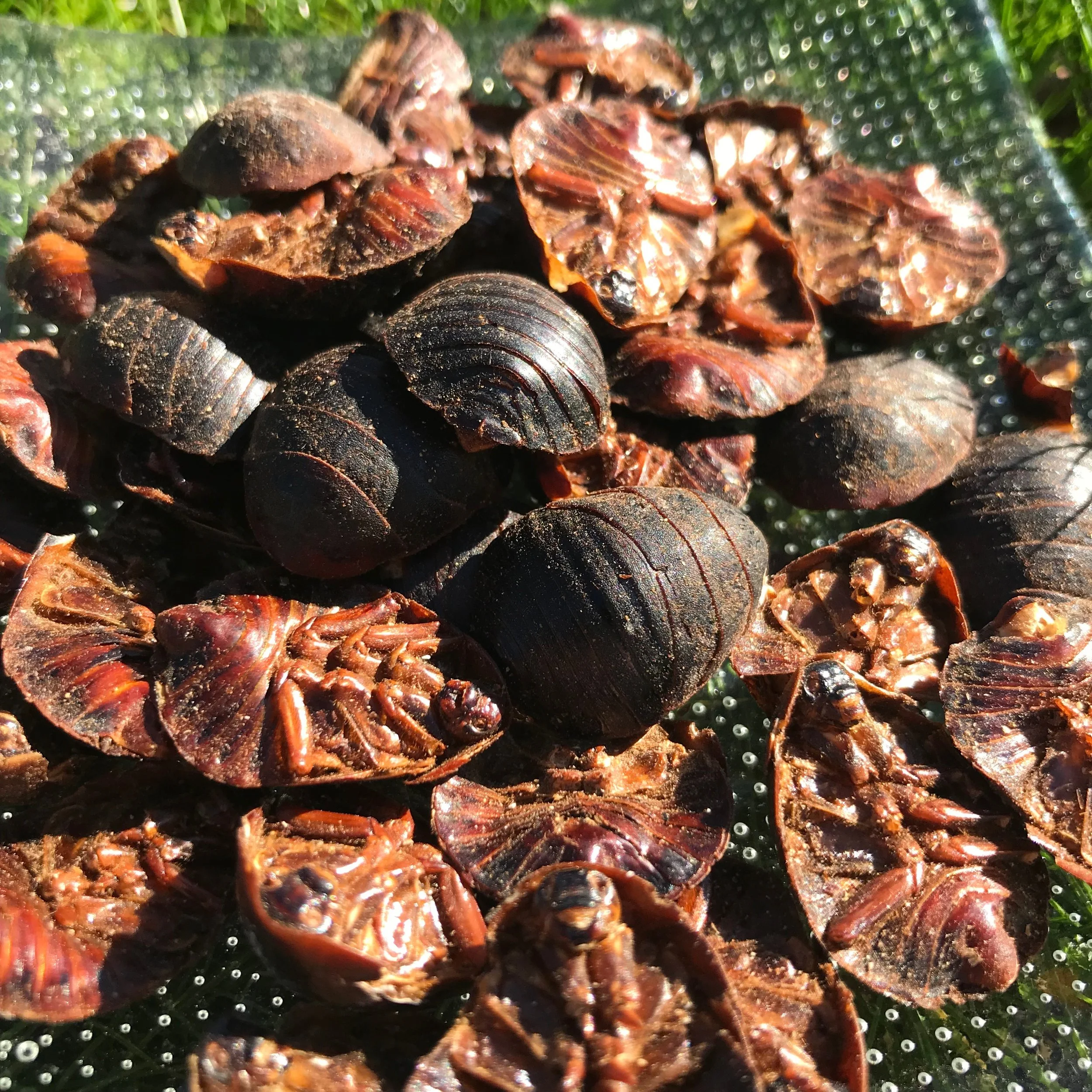
Tŭ Biē Chóng 土鳖虫
Latin: Eupolyphaga/Steleophaga
English: Wingless Cockroach
Properties: Salty, Cold, Slightly Toxic
Channels Entered: Liver, Heart, Spleen
Functions: Breaks up Blood Stasis, Renews Sinews, Joints and Bones
Salty and cold, tu bie chong lives in the ground or in the walls and floors of urban buildings. Its affinity for darkness makes it an ideal medicinal in the conquering of Yin based accumulations: static blood, masses & tumors in the abdomen.
In addition to Yin pathogenic influence, tu bie chong works exceptionally well at healing injuries, bone breaks, and sinew or tissue damage. This is because the cockroach heals itself well in life. If tu bie chong is cut in half and then re-attached, it will heal and continue to live! The doctrine of signatures suggests that this potential is activatable in medicine. This is especially the case when tu bie chong is combined with the resins of trees: Olibanum (rŭ xiāng) and Myrrha (mò yào).
The recommended dosage of tu bie chong is between three and twelve grams per day. One of the best things about this medicinal is that its cheap! For the time being, tu bie chong makes a great add-in to any herbal formula needing guidance into the deeper blood level of the body. It also makes for a good substitute for shui zhi or meng chong on a tight budget.
Yang Fliers for Fast Action
Some insects can fly and are attracted to light. They move and exhibit a buzzing sound, rapidly flapping their wings. This activity makes these creatures more like Yang. Yang is fast, agile, bright and big in its movement. It transforms turbidity and stuckness through an excited kind of Qi. While Yang transformation is successful, it normally requires a more stable partner for its transformations to be lasting.

Méng Chóng 虻虫
Latin: Tabanus
English: Horse Fly
Properties: Bitter, Slightly Cold, Toxic
Channels Entered: Liver
Functions: Quickly Breaks up Blood Stasis
Widely regarded as the most Yang bug medicinal, meng chong specializes in its fast-acting approach to transforming static blood accumulations and masses.
Meng chong flies in the air, buzzing around with a high frequency in life. When taken as a medicinal, meng chong’s bitter flavor combines with its Yang nature to quickly transform and purge accumulations. Though fast-acting, meng chong’s activity is relatively short lived. For this reason, it is normally combined with a more Yin-natured medicinal such as shui zhi to lengthen its medicinal effect.
Because of the rarity of meng chong as a medicinal, prices on the herbal market have begun to increase making meng chong quite an expensive ingredient. In the interest of keeping the price of herbal medicine affordable, the practitioners at Root & Branch have discovered that adding even as little as one to two grams of meng chong to an herbal formula per day is enough to make a huge difference in most cases. It should be noted however, that for best results, three to five grams per day is recommended.
Case Study: Chronic Cough
62 yr. Sys Male

History
Patient reported a history of chronic dry cough for ten plus years (no memory of initial onset). The cough was mild and unremarkable unless the patient would catch a cold. Once caught, the cold would move quickly into the chest and linger for as long as two or three months. The cold would typically manifest with a dry cough, extreme fatigue, and difficult to expectorate phlegm.
The patient also reported catching pneumonia when he was eight years old that was treated with antibiotics.
First Appointment
Patient caught a cold six weeks prior to the initial visit. Though the acute symptoms had mostly resolved, a dry cough and fatigue remained. The cough was bothersome throughout the day and only through the night if the patient awoke for a time. No phlegm was expectorated while coughing, but there was a sensation of fullness in the chest and the epigastrium. Patient reported a neutral body temperature, but a preference for warmth, and no sweating. “I never sweat,” he said. Patient was able to fall asleep easily, but would sometimes wake around 3 AM with racing thoughts and heart palpitations. Occasionally he would be unable to fall back asleep for several hours. The patient had to get up 2-3 times per night, on average to urinate. Appetite, digestion, and bowel movement were all unremarkable.
Tongue
Slightly pale, thicker white coat, red tip, engorged sublingual veins.
Pulse
Overall: tight, muffled, robust
Cun positions felt very muffled but robust and superficial.
Right Cun was slightly scattered, with a Yang Wei pulse indication.
Guan Positions were wiry and tight.
Chi positions were deep and weak.
Diagnosis
Wind-Cold Painful Obstruction of the chest (Bi Syndrome)
Obstruction of the upper burner resulting in clumping of the Qi
Lung Qi unable to descend
Formula
Zhi Shi Xie Bai Gui Zhi Tang (Granule)
Gua Luo Xie Bai Ban Xia Tang 60 g
Zhi Shi 8 g
Gui Zhi 10 g
Hou Po 8 g
Dosage: 6 grams 2 times per day for 7 days.
Second Appointment (one week later)
Patient reported improvement with both cough and energy level. He had expectorated some very thick yellowish phlegm throughout the week and was feeling much better. His middle of the night waking had also decreased, as did the palpitations and feeling of fullness.
Because the patient had to leave town for several weeks, I gave him two more weeks worth of the same formula and told him to get in touch with me once he was back in town.
Third Appointment (one month later)
Patient reported gradual improvement for the first week after the second appointment and then no more improvement. His cough had “gone back to normal” and was now mild, dry and intermittent throughout the day. His sleep had improved, but he would still wake up 2-3 times to urinate per night. He was slightly fatigued throughout the day. All other reviewed systems were unremarkable.
Tongue
Pale-red, dusky, thin white coat, red tip, engorged sublingual veins.
Pulse
less tight than before…
Cun positions were now deeper (about mid depth) and very scattered, but still robust.
Right Cun position still had a Yang Wei pulse indication
Middle positions had become more superficial but were mostly unremarkable
Chi positions were slightly stronger, but still deep and weak overall.
Diagnosis
Blood Stasis in the Upper Jiao
Kidney Qi Deficiency
Kidney failing to grasp Qi
Formula
Jin Fei Cao San with modifications (bulk decoction)
Xuan Fu Hua 9g
Bai Shao (Chao) 9g
Gan Cao 6g
Tao Ren 9g
Dang Gui (Chao) 9g
Di Long 3g
Sang Bai Pi 9g
Zi Wan 9g
Si Gua Luo 6g
Dosage: per day.
Result
After one week, the patient’s cough had completely subsided. I prescribed a similar version of the above formula over the next few months, slowly removing the stop cough and heat clearing medicinals and replacing them with herbs to supplement the Kidney and Lung Qi.
Six months later, the patient’s cough had not returned.
Analysis
The patient’s medical history indicated a long-standing lung weakness. This was likely due to, or aggravated by the occurrence of pneumonia during childhood. In my clinical experience, the Yang Wei pulse indication is a confirmation of this weakness.
The patient’s presenting symptoms of cough, feelings of fullness and pulse led me to believe that the pathogenic influence was stuck in the chest. Preference for warmth and lack of sweating made me lean toward a cinnamon based remedy. This case is clearly one of mixed excess and deficiency. I chose Zhi Shi Xie Bai Gui Zhi Tang to restore the functional movement of Yang Qi, dissipate clumping and expel phlegm.
Once the acute pattern of obstruction was addressed, the residual, more deeply rooted pattern of blood stasis began to show itself. The cun pulses got deeper and more scattered. The engorged sublingual veins and the continuation of the Yang Wei pulse all pointed to the need for herbs that could enter the luo mai.
Formula Breakdown
Xuan Fu Hua, Bai Shao Yao and Gan Cao were chosen as chief ingredients in the formula. These herbs were selected to liberate the Qi dynamic from obstruction and allow the descent of the Lung Qi. Xuan Fu Hua has a salty flavor and some sources say that it assists the Kidney in grasping the Qi. It is also commonly thought of as the only flower that directs downward. Bai Shao and Gan Cao make up the formula Shao Yao Gan Cao Tang, which is used moderate the spasmatic deficiency-related tendency for cough.
Tao Ren and Dang Gui were used to open the blood vessels and move the blood. These two ingredients also have a slightly moistening affect on the Large Intestine. The Large Intestine is the yang pair of the Lungs. Keeping the Large Intestine clear is a useful strategy when promoting the descent of Lung Qi.
Di long and Si Gua Luo are an herb pair used by Dr. Greg Livingston to drive the formula into the luo mai. Di long was selected because of its affinity for the lung and bladder channels - opening up the bronchioles of the lungs and promoting the smooth movement of the water passageways. Si Gua Luo is the luffa vegetable sponge. It looks like the lung’s bronchioles and is one of the only non-bug medicinals that is able to access the luo mai.
Sang Bai Pi and Zi Wan are dynamic cough medicinals used in cases of both excess and deficiency. Sang Bai Pi is sweet and cold, while Zi Wan is acrid, bitter, and warm. Together they are able to able to treat a variety of cough-related consumption patterns.
Why No Qi Tonics?
Because of the robust nature of the pulse in the cun pulse positions, I decided not to include medicinals that directly tonify the Lung’s Qi in the first formula. I felt that the salty flavor of Xuan Fu Hua and Di long were enough to encourage the movement of the Kidney’s grasping ability. In future renditions of the formula, I included various aspects of the formulas Sheng Mai San and Shen Qi Wan in order to tonify deficiency.
The Cultivation & Understanding of Traditional Medicine
Practicing a traditional medicine in modern times has many challenges. One of the biggest challenges comes when we try to communicate the difference of perspectives between the ancient and modern worlds. Perspective shapes the reasoning for action. It creates a context for why a particular medicinal would be prescribed or not. Understanding perspective is necessary before judging the method. And far too often today, we learn to judge before attaining this understanding.
Using insect-based medicinals has been one of the most valuable clinical insights for me. In the short span of my career as a Chinese medicine practitioner, I have been able to help numerous people with the knowledge that I have shared above. I am certainly no where near mastery of the art and science of Chinese medicine. Even so, I hope that the information presented in this article may be of use to practitioners who have the intelligence and skill to employ it.

Behold The Humble Ginger Root: Understated Workhorse of Good Health
Fresh ginger’s warm nature and spicy flavor make it a powerful ally at the first sign of a cold. Used early, it can help the body push out pathogens and restore balance.

Ah the ginger root — the edible rhizome of the flowering ginger plant Zingiber officinale. This increasingly common kitchen herb has many more tricks up its sleeve besides making your curries and stir-frys really sing.
Chinese Medicine assigns two types of descriptors to any sort of herb or food - Nature and Flavor.
These two categories of description tell us about the intrinsic qualities of a plant, animal, or mineral and give us insight into how to use that item either as food, medicine, or both. Fresh Ginger has a warm nature and an acrid/pungent/spicy flavor.
Items that are warm in nature have effects that fit with that word. In the case of ginger in particular, it has the ability to warm the body physically, especially throughout the digestive system and even on the surface of the skin. We often find ginger combined with foods that tend to be cooler in nature like pork or shrimp and many people have used it for generations to ease an upset stomach. In fact, it is one of the key ingredients in remedies to relieve morning sickness.
As for it’s flavor, you might see acrid, pungent, or spicy used to describe this plant because finding the exact word to translate the Chinese word xīn 辛 is a challenge. None the less, if you were to bite into a slice of fresh ginger, you would get a real sense for the potent flavor of this root.
Ginger Root as your Winter Defender
Fresh ginger’s nature and flavor give it a particularly powerful ability to prevent a nascent cold or flu pathogen from getting settled into your system and wreaking havoc. So get some fresh ginger root when you are at the store next. Store it in the pantry with your potatoes and onions so that you will be prepared this season.
Now you know the feeling: you wake up one morning and you feel a little off. Nothing super obvious but a little slower, maybe a slight ache in your neck and a tickle in the throat. You’re not sick but you feel like you might be soon.
That is the time to grab your ginger and follow these instructions:

1.) Take about 2 inches of ginger or a piece about the size of your thumb and slice into thin pieces.
2.) Put the slices into a large-ish coffee mug and cover with boiling water
3.) Let that ginger steep until the liquid is drinkable, about 5 minutes
4.) Strain out the ginger pieces and mix in a spoonful of local honey, molasses, or good quality brown sugar.
5.) Drink your spicy ginger tea with its slight sweetness until its all gone. Then immediately hop into a hot shower.
6.) Wash up in the hot water until you’ve got a slight sweat going on. Change the temp to something a little cooler. Finish up and dry off.
7.) Bundle up and stay covered through the day, especially your back and neck and if you’re outside, cover your head too. Stay out of the wind or drafty areas.
8.) Drink lots of water throughout the day and eat your veggies. Lots of ‘em!
When you get home from work or school, you can repeat this process including the hot shower. The goal here is facilitate your body’s natural pathogen fighting abilities and push the infection out through your pores. Using ginger like this at the very first sign of sickness is essential to making it work for you. Wait too long and the picture will change and you’ll need more expert help to get better.
I tried it but I’m still feeling sick!
Now sometimes, you miss the window where ginger alone is effective for stopping colds. In that case Chinese Medicine has several more tricks up its sleeve to help you get better. And one of the best parts about those tricks is that they often involve more honey, cinnamon, and dates. Treating cold and flu is definitely one of our betting tastes remedies!
If you feel like you haven’t been able to kick out that icky feeling before it took hold, get in touch with a Chinese Medicine provider in your area ASAP before that sore throat turns into something much more nasty.

Falling Leaves and Changing Winds
Travis Kern, L.Ac.
The transition from Summer to Fall is a marked one in most parts of the US. Not only do the days start to shorten and the temperatures get cooler but many people start to get excited about the coming holiday seasons. Whether spending time with family or loved ones, going on trips, playing out meaningful traditions, or just getting a few minutes of pensive reflection, the fall season reminds us all of the continuous change intrinsic to all of our environments.
Historically and still in many parts of the world, Fall is the time of harvesting and fruition; of storing away the potent Yang that has dominated these last several months so that in the coming months ruled by the dark and cold Yin, we have enough motive force to sustain our lives and activities. This process is easiest to see in the picking, processing, and canning of late summer fruits and vegetables. If you’ve ever grown tomatoes or green beans, you know that those four plants you started in May are now overfilled with ripe fruit, more than you could ever eat, and it’s time to pack their nutrients away to help satisfy your appetites come Winter.
But it is not only in food and eating that the Fall season can be experienced. Indeed, our activity and movement during this time of year also changes. Many of us know the feeling of wanting to curl up on the couch with a warm drink and watch our favourite films or read a great book. Humans start to feel slower and disinclined to make intense physical efforts. This tendency is our natural movement toward the hibernation of the eventual winter season when we need to conserve our energy and our effort because making big things happen during the cold of the coming Winter can be difficult and almost always depleting.
Fall is also the Chinese Medicine season of dryness and even though in many parts of the country fall brings increased rain, the air begins to chap our faces and lips and the ground starts to crack as the chill begins, reflecting the systemic dryness of the season. Foods that are moistening and supportive of the lung from a Chinese Medicine point of view are a must during this time of year.
The Interaction of Yin and Yang

The classic Taiji symbol has been common in American consciousness since the early 90s at least. That swirl of white and black doesn’t usually draw profound contemplation from Western people but it is indeed a powerfully simple image of a very complex idea. It would be easy to imagine that Yin and Yang have moral qualities because of our Western dualistic mindset (for more on that check out this blog post). Yet, the dark and cold qualities of Yin are not bad things just as the movement and activity of Yang are not good things. They have no moral dimension and they are both absolutely required in order for life to move forward and flourish.
What is movement with no substance or earth with no animation? The interaction of Yin and Yang form the essential elements of all things both living and not. They are descriptors of things and of changes between states of being. They can be used as all the parts of speech and each aspect gives us more insight into the complexity of existence. Profound indeed.
But it’s hot where I live. Like, all the time. In every season…
When we talk about the changes in season, the theories we expound on here are rooted in the the patterns and times of Earth’s Northern Hemisphere and a latitude roughly equivalent to central France. If you lived in Australia or Brasil, your seasons would happen in different months but they would still happen. And though most of us think of the change in season as a change in the temperature of the air, the ancient Chinese considered many more factors than the sensation of hot or cold in the air. Spring is the time when new plants sprout and grow powerfully. Summer provides the necessary sunlight to grow the bulk of our food. Fall is the time of harvest and storage. Winter is the season of conservation and contemplation. Regardless of the exact temperature of your particular locale, these qualities present themselves in every place, every year. OF course we have all experienced a warmer Christmas or a really wet autumn, but these weather based assessments are only one aspect of the season. Tapping into how you feel in your body, of what your experience is during any given month in the year is the best way to begin to sense the environmental and cosmic changes that are happening all the time.
This Moon and the Coming Qi Node
Knowing how cosmic changes affect us on our little blue planet is no small feat. I use calendar notes and updates to keep me in the loop and even then I planted my tomatoes two days after a full moon (those in the know are aghast and those that aren't, let's just say you're not supposed to plant things after a full moon). Knowing your seasons can continue to live in the broad strokes but if you are interested, the rabbit hole can go as deep as you like.

2nd Moon of Autumn
September 9th was the second moon in the fall seasonal cycle. The first moon is when the season’s movement begins and by the 2nd moon, humans start to feel the qualities we associate with the season. By the 3rd moon, the season feels in full swing.

Qi Node: Autumnal Equinox (Qiu Fen)
September 22nd marks the even divide between daytime and nighttime where the cooler days and falling leaves mark the tangible presence of Autumn
Things to Eat:
Pears and Apples
Winter Squash like Butternut and Pumpkin
Last of the veges from the garden
Sweet potatoes, carrots, and parsnips
Medium aged cheese like Brie and Roblochon
The best cuts of beef
Things to Do:
Eat lighter meals, maybe skip a dinner
Switch to darker brews of all your drinks
Start collecting your cool weather gear
Keep your neck covered when outside
Bake some pumpkin bread
Take a canning class in your area
Things to Cook:
STUFFED SQUASH WITH BROCCOLI RABE AND QUINOA

serves: 8 as a side, 4 as a main
notes: You can make your own balsamic glaze by reducing balsamic vinegar in a saucepan, but I find it easier (and usually economically advantageous) to buy a pre-made, high-quality glaze. If you have dried rosemary on hand, you could substitute it for the fresh by reducing the amount to 2 teaspoons. Last one: I used the fancy, truffled marcona almonds from Trader Joe's for the garnish here and it was spectacular.
Ingredients:
2 small-medium acorn squashes
1 ½ tablespoons olive oil, divided
salt and pepper, to taste
1 tablespoon minced fresh rosemary (from roughly 1 sprig)
½ cup quinoa, rinsed
1 cup vegetable stock
1 medium shallot, peeled and diced
1 celery stalk, diced
1 carrot, peeled and diced
1 tablespoon minced fresh sage (from roughly 1 sprig)
1 clove of garlic, peeled and minced
½ bunch broccoli rabe, tough ends of stems trimmed
3 tablespoons dried currants
2 tablespoons balsamic glaze
3 tablespoons marcona almonds, chopped
Preheat the oven to 400°F and line a large baking sheet with parchment paper.
Directions:
Cut the acorn squashes in half lengthwise. Scoop out the seeds and stringy bits with a spoon. Then, cut each of the seeded squash halves in half once more. You should have 8 evenly sized wedges once you’re done with both squashes.
Place the squash wedges facing up on the parchment-lined baking tray. Brush the squash flesh with about half of the olive oil. Season all of the squash with salt and pepper. Sprinkle the minced rosemary over top. Slide the tray into the oven and roast the squash for 35-40 minutes, or until the squash is tender.
While the squash is roasting, combine the rinsed quinoa, vegetable stock, and a pinch of salt in a medium saucepan. Place the saucepan over medium heat and bring to a boil. Lower the heat to a simmer and cook for about 15 minutes, or until all of the stock is absorbed and the quinoa has puffed up. Set aside.
In a large pot with a well-fitting lid, heat the remaining olive oil over medium heat. Add the diced shallots to the pot and stir. Cook until shallots are translucent, about 2 minutes. Add the diced celery and carrot and stir. Cook until all of the vegetables are slightly soft, about 3 minutes. Add the minced sage and garlic to the pot and stir. Chop the broccoli rabe into bite-sized pieces and add it to the pot.
Stir the vegetables to coat and season with salt and pepper. Add a ¼ cup of water to the pot and place the lid on top. Let the broccoli rabe steam in the pot for about 3-4 minutes. Then, remove the lid and stir in the cooked quinoa and dried currants. Remove the pot from the heat.
Place roasted squash wedges on a serving platter and carefully spoon the broccoli rabe and quinoa stuffing into the natural cavities of the squash. Drizzle all of the stuffed squash pieces with the balsamic glaze and garnish with the chopped marcona almonds. Serve immediately.
Recipe Credit: The First Mess
www.thefirstmess.com

Hazy Days of Summer and the Coming Change
Travis Kern, L.Ac.
Here in the Pacific NW, it takes a while for the weather to reflect the season. In fact, it's common wisdom in Portland that if you schedule an event outdoors before the 4th of July and it rains, well, you should have known better. It rains a lot here. After the 4th though, you're golden. Work and play outside to your heart's content. It will be dry, warm, and the sun will be shining. It is extra interesting to me then that the last moon of summer is today, July 12th. For the next thirty days we will experience the final moon cycle for this season that seems to have just begun. What is going on?
Understanding
Chinese Cosmology
The way that the ancient Chinese understood the universe is incredibly complex. Like all developed ancient cultures, the sages of the past looked to the stars to understand what was happening on the earth, and they took cues from the cyclical movement of the cosmos. Over millennia, this observation developed into understanding and eventually into concrete systems to explain current events, guide healthy activity, and even predict what might happen in the future. The ancient Chinese were masters of patterns and applied what they found to all aspects of life.
Based on ancient observations and teachings, the Chinese divide the year into four seasons which each have 3 moons. A moon is counted at the new moon, when the sky is dark and no moon is visible, and progresses through the full moon until the next dark sky and its new moon. This gives us 12 moons per year (roughly, there are exceptions like with everything).
Each of these moons is also divided into two qi movements or "qi nodes" that give us further insight into the movement of the qi during that part of any season. That gives us a total of 24 qi nodes for the year. Keeping track of these different movements throughout the year can help us dive more deeply into matching our food and activites to what is happening in the broader context of the season and the stars.
How Does It Work?
To create some context for all this moon and qi node stuff, let's look at some broad strokes first:
Every season's first moon is when the nature of that season is just beginning to take hold so it always still feels like the season right before. Then every season's last moon is when the season feels like it is finally in full bloom. So it takes the course of the three moons for the qi of a season to build up enough to push out into our environments. Of course one way to decide what season you are in has to do with the temperature of the air and the amount of rain or snow a place gets, but we all know that the weather is not the same everywhere in the world. But the nature of season is constant in every part of the planet, even if there might still be snow on the ground in Chicago in April. That is, there are other factors that describe any given season beyond the temperature and the amount of sunshine. We know, for example. that Spring is the season for renewal and growth (the plants come back, the flowers bloom), the Summer is a time of activity and change (it's generally warm out, the days are longer to get more done), the Fall is a time of harvest and preparation (an abundance of crops, a time to prepare and preserve for the lean months coming), and of course the Winter is a time for going slow, preserving your energy, and contemplating. And of course cuddles. Never forget about the cuddles, though they work well in any season.
Each season has is own nature that shapes what we do, what the plants and animals do, and finding harmony with that cycle is one of the paths to good living.
This Moon and the Coming Qi Node
Knowing how cosmic changes affect us on our little blue planet is no small feat. I use calendar notes and updates to keep me in the loop and even then I planted my tomatoes two days after a full moon (those in the know are aghast and those that aren't, let's just say you're not supposed to plant things after a full moon). Knowing your seasons can continue to live in the broad strokes but if you are interested, the rabbit hole can go as deep as you like.
3rd Moon of Summer
The warmth of Yang Qi is everywhere. The season is in full swing.

Qi Node: Greater Heat (Da Shu)
July 22nd marks the culmination of the summer energy and the last build up to the Full Moon, when the qi will begin to descend to Fall.
Things to Eat:
Peaches and Stone Fruits
Citrus of all kinds
Snap peas and Green Beans
Tropical Fruit
Fresh Cheeses like Mozzarella and Chevre
Fish and Seafood
Things to Do:
Eat lighter meals
Enjoy a nice lager
Sit on the back porch
Keep getting up with the sun
Bake something sweet and delicious
Start gathering your canning supplies
Things to Cook:
Fish Tacos with Pineapple Slaw and Chipotle Cream

Ingredients:
12 oz firm white fish (Hake, cod, halibut, or sole)
2 slices of fresh whole pineapple, ½ inch thick (no need to core)
1½ cups cabbage, shredded
1 lime, zested and cut in half
½ cup plus 1 tbsp sour cream
¼ cup diced onions,1/4 inch dice
2 tbsp chopped cilantro
1 tsp sugar
¾ tsp sea salt, divided
½ tsp freshly ground pepper, divided
½ tsp red pepper, divided
¼ tsp cumin
½ - 1 chipotle, finely diced (according to taste)
8 Corn tortilla's
Instructions:
1. Heat grill.
2. Season fish with ¼ tsp pepper, ¼ tsp sea salt and ¼ tsp red pepper.
3. Squeeze juice from ½ lime over fish. Set aside.
4. Place cabbage, onions and cilantro into a medium sized bowl.
5. Add 1 tbsp sour cream, juice from ½ lime, 1/2 the lime zest, sugar, ¼ tsp red pepper, ¼ tsp freshly ground black pepper, and ½ tsp
sea salt. Mix all ingredients together. Then pour over the cabbage mixture and toss to combine.
6. Place ½ cup sour cream, chipotle, and cumin into small bowl. Mix well to incorporate all ingredients. Set aside. This will be your chipotle cream topping
7. Lightly oil a piece of aluminum foil for the grill and place fish on top of foil (prevents the fish from falling through the grate).
8. Cook fish for 10- 12 minutes, turning once during cooking time, or until fish is white and flaky (time is dependent
on thickness of fish fillet).
9. At the same time the fish is cooking, place pineapple slices on open grill, the amount of time to caramelize is
about the same time for the fish,10-12 minutes. Turn once half way through cooking.
10. Warm corn tortilla's on the grill (if there is room), or wrap them in aluminum foil and place in the oven to warm at
350 for 15 to 20 minutes.
11. Once fish is done, remove from grill and cover with foil to keep warm.
12. Remove pineapple from the grill and allow to cool a few minutes for handling.
13. Cut pineapple slices away from the core and chop.
14. Add pineapple to cabbage mixture and toss to combine.
15. Assemble tacos, evenly dividing the fish, pineapple slaw, and chipotle cream onto the warm corn tortillas.
16. Serve immediately.

Chinese Medicine is NOT Energy Medicine
Chinese medicine doesn’t treat “energy” the way modern wellness often suggests. It’s not about fixing parts or channeling light—it’s about observing change, movement, and relationship within a world we’re inseparably part of.
Travis Kern MAcOM, L.Ac.

Feel the resonant, cosmic, potent, masculo/feminine, Gaia/Kwan Yin presence
Ok, ok, ok! Put down the crystals friend. I'm not insulting your sense of energy and the flow of cosmic forces through the human experience. Well, I'm not directly insulting those sensibilities, but I am questioning how we understand the language of Chinese Medicine and by extension a whole host of "New Age" concepts like energy healing, auras, chakras, vibrational medicine, and many many others. And by the way, the New Age is hardly New any more. It fact, it has it's own vocabulary, jargon, and style that gives it a distinctly dated feel.
So here's the rub: Saying that Chinese Medicine or Reiki or Yoga or Aura Atunements are energy medicine makes a significant assumption about the nature of reality -- an assumption that is based on a distinctly Western understanding of what it means to be real and extant and is heavily influenced by the moral dimensions of Christian thought, especially the sort of Christian thought that was brought to the American colonies by our ancestors. So there are really two dimensions of assumptions that I want to explore. The first has do with what is real and the second has to do with Satan waiting for your in the wilderness. Let's begin.
Primary Assumption in the term Energy Medicine: You can understand what is real and you are distinctly part of "real"
This assumption asserts that reality is a collection of solid objects that are animated by another force called "energy" or "spirit" or "vibration," and it is this other force, separate from the solid objects that it animates, that creates the activity of life. It doesn't matter which word you use to describe this separate force because they are all touching on the same idea, and they all conjure a similar image to mind -- that of the meat-filled, skin bag human excited and propelled by an ethereal, mysterious force that might be translucent like Casper, glow from the fingertips like an Xman, or pulse around the body like a rainbow disco show only visible to those with the gift.
This image presumes that human beings are composed of two opposing, dualistic natures, one of substance with little character which is plagued by base instincts and another of heavenly light and cosmic potency that is glorious and mighty to behold (if you have that ability of course). Hold on champ! We've got a problem - dualism is a fundamentally limiting perspective. Instead of understanding and knowing the infinite complexity of existence, we're stuck with only two forces to make sense of our experience.
"But that sounds just like Yin and Yang," you say! "Aren't you a Chinese Medicine practitioner? A student of Dao? How can you dismiss this idea?"
The thing is, you're almost right. It is almost Yin Yang Theory. Except that Yin and Yang are just parts of a complex system that is not based on two things. It's based on one thing: Dao. Which emanates to two things: Yin and Yang. Which begat the three things: Heaven, Human, Earth. Which birthed the four seasons and the five elements and then the ten thousand things (i.e. everything else). Yin and Yang are part of a larger constellation that is not about substance but about movement -- about change. In fact, Yin and Yang are concepts that reflect the way that things change, not what they are but how they move from one state of being to another. It is a constant question of interplay and dynamic transformation. To be one thing is to stagnate and ultimately to descend into permanent suffering.
Assuming that you can manipulate the energy of something demands that the energy of whatever you are manipulating is a component part of a mechanized whole, that it is like gas in a car or circuits in a computer. Standard biomedicine doctors are trying to fix the parts of the substance (the things they can observe and measure), and contemporary energy workers want to work with the ethereal (the things they can sense and feel). Each group is really doing the same thing -- being a mechanic who is repairing the part of the structure or spirit that is broken. But what if you are not actually made of substance or spirit? What if you're not really made at all in the way that most of us think of it. You're not a peanut butter sandwich and you're not a multi-phasic dimensional ghost. Stop assuming you can repair anything and/or stop assuming you have magic powers. I wanted to be McGyver and I wanted to be Hermione too but that ship has sailed. You can help bodies remember how to be whole and functional, but it's not because you shot invisible light and good vibes out of your forehead and fingertips, or because you replaced 1000 knees in surgery.
Now let me be clear....
You can't help bodies return to physiology and dynamic health with magic, nor can you do it with biological science. This is not a rational science apologia. The acupuncture needles aren't stimulating cytokine/immunoglobulin/heat protein cascades through your lymph/immune/cardiac/myofascial systems either. Well they might be doing those things if we could actually measure them (which we can't seem to... but one day amiright?), but that's not why it works. At least, that's not why it works within the framework of the system that created that tool. Chinese Medicine is not dependent on lab tests and petri dishes, nor is it dependent on belief or electric energetic forces. It is reliant on the observation of dynamic movements in nature, the earnest effort to understand those movements, and to apply the concepts that those changes represent to the human condition. Because as it turns out, we aren't actually separate from anything around us. We don't have dominion over all the other things on the planet. The idea that we are superior or wholly unique from everything else is part of that morality stuff I mentioned earlier. Gosh we have so much to talk about.
And I guess this explanation still isn't very clear.
How about a comparative example?
Setting: Ancient times - when people were superstitious and dumb

There are definitely bad things that live here. Maybe even a ROUS...
So here you are walking along through the woods when suddenly you realize you have strayed into the forbidden swamps of the ancestors. Here is a no-pass land, long slapped with a metaphorical verboden sign because it is well known that the spirits that live in this place cause illness and death to those that enter. Though if you are strong and young and still possessed of the good stock given to you by your own ancestors, it is possible to survive a walk through these bogs, but nonetheless, a travel pass is not recommended. Yet here you are. Suddenly bitten by a swarm of gnats and assaulted by foul-smelling air, you bolt from your position across the swamps and back home where within a day you start to feel ill.
Chills and fever take hold of you and the local healer declares that you have been possessed of a foul force from the swamps. It has broken through your charms and defenses and that you will need the smoke of healing herbs and the poultices made of tree barks to cure you. It's hard to know which spirits are the ones that are attacking you and without that info, the healing approach is in broad strokes. But you are young and from good people so hopefully the protection offered to you from your own family spirits will be strong enough to survive. You'll make it. A little worse for wear but you make it.
Setting: Contemporary Times - when people know what's real and aren't bound by ridiculous assumptions
It's just a casual walk in the woods. Good for you, right?
So you're hiking in Mt. Hood National forest when you realize that it's colder out here on the trail than you had imagined and you don't have a nice North Face fleece to cover up with. It's cool you think, punning to yourself quietly, and you carry on with your hike. You've been assaulted by a few No-See-Ums while walking along but you brought your handy bug spray so you're pretty comfortable. By the time you get back to your car though you've got a little sniffle and you hope it doesn't get worse.
The next morning you are sick. Sneezing, hacking, your through feels full of razor blades and you know you need to see the doctor. They tell you that you have a bacterial infection in your throat and lungs. These pathogens probably entered through your mouth and nose and set up shop while your immune system was depressed by the cold. These bugs are causing your symptoms, but they're not sure which one's they are. So take these antibiotics to see if it'll get rid of them and if not, you're young and strong with good genes. You'll be ok. A little uncomfortable but Ok.
Comparison: They are the same thing.
Both of these scenarios describe a similarly observable process. They both are looking at a sick person and trying to understand how that person went from being healthy to being sick. Each of them relying on a set of knowledge and a system of analysis to determine the answer to the question. Now I don't mean that one is real and one is a metaphor for something real. I mean that these stories are just using particular vocabulary to describe the same thing. Healthy becomes sick. Microbes and spirits? The same thing. Whoa snap! I know. I sound like a crazy person to both camps but seriously just sit with it a minute. Have you ever seen a microbe yourself? Have you ever seen an ancestor spirit yourself? Have you been to Havanah before? Yeah like in Cuba? But all or some of these things are real? How do you know? What is it to be real? Whew ok, lets take a step back from the post-modern, relativistic anarchy and just breathe.
In
and out
Just breathe a second, and feel the air.
I am not trying to collapse the world down on itself to say that all the things are just one thing, in fact that they are not even "things" as such, and that how you view the world, no matter which frame of reference you are using is not more or less real than any other. That, in fact, there is no sense of real because nothing is fixed, and everything that we truly understand or try to understand is a moving target. Wait, actually that is what I am doing.
The parameters of our language create boundaries around our experience by the nature of description. Can we understand things without words for them? Can we see that energy and body are not separate nor are they joined? They are the same thing moving in different spheres and observed in different frameworks. By observing a phenomenon we are intrinsically changing it (concept credit to a white guy from a while back who probably didn't actually think of it but got credit for it anyway).
Chinese Medicine isn't Energy Medicine because that is a limited and erroneous description. People don't get better because my acupuncture needles manipulated their energy flow or because your invisibly glowing hands moved their cancer out of the way or because your good vibes made The Secret come to life. It's because when we work in a sphere that is speciously described as an energy space, we are softening the edges of our own "realness" and experiencing ever so briefly the interconnected fabric of Dao. Our pattern of health and wellness is laid over the pattern of disease and disorder when those boundaries are loosened, and they interact. I don't do anything accept make the space; open my mind to the very difficult idea that what we are all experiencing is only an infinitely small fraction of what is moving in, around, and through us. The actual healing that happens is the flow and movement of existence on a macro scale. You can cut out a tumor or lay in downward-facing-dog or chant or take pills or smoke drugs to solve your ails, but none of those things is the treatment really. They are tools to accessing the pattern of things. Not a magical pattern to be stored in some grimoire or a rational pattern to be tracked by electron microscopes -- just the pattern that even gives us the framework to read grimoires and see microscopes.

A little jazz hands or maybe spirit fingers or maybe it's just waving. But the demons are waving at YOU!!
So about Satan and the forest:
If the world is dominated by two forces: body and spirit, up and down, hot and cold -- then one of the core anchors of a dualistic world view is that Good and Evil also stand in opposition to each other. God and Satan. Even if you're a polytheist or a nature worshiper, what is the fundamental relationship at play in your pantheon? My guess is probably Good and Evil. Or if you're a super modern person maybe it's Good and Apathy. Even still, this idea of good and evil is reflected in our love of spirit and energy and our derision of animal and substantive. Our society looks at our physical selves as machines in the process of decline and popular nutrition and baseless science is constantly trying to purge your body of all the toxins it has absorbed or created, all in an effort to restore your pristine, "natural" self. Your clean soul, free from the dark influences of indulgence and a lack of self-control. Take your vitamins even if you don't feel like they do anything for you because it's important to build up health brownie points for the time in the future when your skinbag starts to fray.
Satan has long been depicted as waiting in the dark forests of the Americas. Living and working through people of color and natives, warping their minds and filling them with notions of unmarried sex, demonic chanting, and the reverence for the very natural world that has been infused with disease. That same fear has been at the heart of Western empirical thought even as the very people who started the Enlightenment worked to release themselves from the shackles of what they saw as an oppressive religion. And yet, the idea of your body as flawed and impure has persisted, even among people spending time at Free Love Ashrams.
But wait, you're a free-thinking atheist (sometimes agnostic) who has spend years working and studying the Eastern Ways and you know that the world is in fact filled with poisons and horrors that must be purged.
Sure. Ok. But if you are taking a collection of plants and supplements that have words attached to them like: natural purgative, anti-inflammatory, emetic, demulscent, restorative, curative, immuno-supportive; and you are consuming these products with the aim to "purge toxins," to "cleanse the liver," or to "expel heavy metals," then you should know ahead of time which toxins and metals you are targeting and then you should have some way of measuring whether or not those things are actually happening. You are living and working in the world of biomedical, reductionist science (even if the treatment is called natural and chemical free) because you and your practitioner are thinking about your body in this substantive way -- that you are biological machine who needs its oil changed because ENVIRONMENTAL TOXINS/MOLD/FUNGUS/GLUTEN/NIGHTSHADES. But fear that these toxin monsters are lying in wait with henchman from Big Pharma and Monsanto who are all waiting to destroy you is just the Devil in a new form. It is the Puritans exacting control from 500 years in the past. Western culture has not shaken the influence of Abraham, and American culture in particular has made a new religion of fitness and health among some of the least healthy and high-strung people on the planet.
And look, I feel that tension myself every day. We are all of us in the US entwined with our past and our history. We have not left it. We have not evolved beyond it. It is our ancestry -- in Chinese Medicine terms, it is our cultural Jing. And we can't start being vegetarians until our great great great auntie has had her fill of steak.
So how how about those action items?
The only way out of the mind bend is to work to internalize every day that how we have been trained to know and understand the world is not objective. Science with an capital S is not without a point of view -- not without assumptions in the same way that our tribal or religious ancestors made assumptions about reality. The fact that you saw a video on Facebook of a virus attacking cells and injecting its DNA into those cells to reproduce is not itself evidence of an incontrovertible truth about existence. The real truth is that almost no one has seen with their own eyes what that video showed you. It was made in a computer, an example of what we believe is happening based on our observations of lots of other factors. When your doctor tests your blood for infections, they don't look at your blood in a microscope and see all those badboy microbes puttin' a beat down on your cells. It's more complicated than that and much less exact. Certainty is an armor against the scary truth that profound humans have been spouting on about for millennia: The world is largely unknowable in any concrete way and sitting with the certainty that things are the way they seem to be, is the root of inquisitions. The only certainty is that there is no certainty (concept credit to Neo or did Confuscious say? Look for a meme. I'm sure it'll be a wrong attribution).
Chinese Medicine is NOT energy medicine because there is no energy and there is no medicine. And of course both energy and medicine do also exist. Sort of. The answer is Yes and it is No. Because the answer is not what is important. It's the space between the answers and the transition from one answer to the next which gives us the only real insight into what is.