
On a Hormonal Rollercoaster?
Perimenopause brings irregular cycles, broken sleep, heat, and new anxiety, often together. Here is how biomedicine and Chinese medicine each describe the transition, what working with Root & Branch involves, and a short guided EFT tapping video for managing stress.
Your Support Team Is Waiting for You
Most women first notice perimenopause through changes they cannot quite place. Cycles that ran at twenty-eight days start arriving at twenty-two, and the next one may come at forty-five. Sleep breaks in the early morning hours, either with a wave of heat or with a mind that starts working through the next day's tasks. Irritability becomes harder to manage, word recall slips, and some women experience anxiety for the first time in their forties. Because these changes arrive gradually and unevenly, it is often unclear whether they are connected to each other or to hormones at all.
Many women spend months wondering whether what they feel is hormonal, stress, age, or something else entirely, and the usual route to an answer does not always provide one. Blood tests are often unhelpful during perimenopause, because estradiol and follicle-stimulating hormone (FSH) swing widely from one week to the next, and a single blood draw can come back in the normal range while symptoms are at their worst. For that reason, clinical guidelines in the UK advise diagnosing perimenopause in women over 45 on symptoms alone.
We see many women in this position at Root & Branch, and most of them arrive having been told, in one form or another, that this is normal and that they will get through it. As far as advice goes, its not wrong but its not exactly helpful. What most of them really want though is practical help with the changes in their lived experience. They want to sleep. They want help with temperature. They want to be less irritable and feel like they used to.
What Is Shifting
Perimenopause is the transition leading up to the final menstrual period. It commonly begins in the mid-forties and lasts several years, often four to eight, and menopause itself is defined in hindsight as twelve months without a period, at an average age of about 51 in the United States. During the transition, ovarian hormone output becomes erratic. Ovulation grows irregular, so progesterone, which is produced after ovulation, falls off early and unevenly. Estradiol swings in both directions, with some cycles producing higher peaks than a woman saw in her thirties and others producing very little. The rollercoaster image in the title is a fair description of the physiology.
Hot flashes and night sweats affect a majority of women during the transition, and in the long-running Study of Women's Health Across the Nation (SWAN), they lasted a median of about seven and a half years in total. Sleep disruption, mood changes, new or worsened anxiety, joint aches, and trouble with concentration and word recall are also common, and they tend to travel together. Stress amplifies much of this. Lost sleep raises next-day stress reactivity, and women who report higher anxiety also tend to report more frequent hot flashes, with each appearing to feed the other.
Chinese medicine's account of this transition begins in the first chapter of the Sùwèn 素问, part of the Huángdì Nèijīng 黄帝内经 (compiled circa 100 BCE to 100 CE), which traces a woman's life in seven-year cycles and places the end of menstruation at seven times seven, age 49, when tiān guǐ 天癸, the substance that initiates and sustains reproductive capacity, is exhausted. The tradition treats the years that follow as a period of consolidation, with resources that once went to the monthly cycle now held in reserve, and the same chapter is concerned with how a person reaches tiān nián 天年, the full natural span of life.
In clinic, perimenopause almost never presents as a single pattern. The most common picture involves Kidney Yīn deficiency, shèn yīn xū 肾阴虚, in which the body's cooling and moistening reserves run low and heat surfaces at night as hot flashes, night sweats, and dryness. It is often joined by xīn shèn bù jiāo 心肾不交, Heart and Kidney not communicating, the pattern behind the racing mind and palpitations that keep someone awake once she has woken. Liver qì stagnation, gān qì yù jié 肝气郁结, accounts for much of the irritability, breast tenderness, and premenstrual intensity many women notice in their forties, and Spleen deficiency, pí xū 脾虚, shows up as fatigue, foggy thinking, and digestion that has become less reliable.
Two women with the same hot flashes can have different patterns underneath, and they need different treatment. The full mix of symptoms a woman describes is what tells us where treatment should start.
What Working With Us Looks Like
A first visit at Root & Branch runs long, and most of it is conversation. We ask about your cycle over the past few years, how you are sleeping and at what hour you wake, when heat comes and what it feels like, how your digestion and mood have changed, and what you have already tried. We look at your tongue and take your pulse. We check your abdomen. If you are working with a physician, taking menopausal hormone therapy, or considering it, we want to know, and we work alongside that care.
The center of treatment is a custom herbal formula built for your pattern. A formula for Kidney Yīn deficiency with heat looks different from one for a Liver and Spleen picture, and most perimenopausal formulas address two or three patterns at once, with some herbs carrying the main work and others directing or moderating it. We typically revise the formula every few weeks in response to changes in sleep, heat, mood, and cycle. Research on Chinese herbal medicine for menopausal symptoms is still developing, with some trials suggesting benefit for hot flashes and sleep and others inconclusive. In our clinical experience, sleep is often the first thing to shift, and once sleep improves, much of the rest becomes easier to manage.
Acupuncture supports the herbs. Treatment appears to shift the nervous system toward parasympathetic activity, and many women find their mind settles during the session in a way it rarely does at home. Some studies suggest acupuncture can reduce the frequency and severity of hot flashes, though results across trials are mixed.
Dietary guidance is specific to your pattern as well. A woman with heat signs at night is usually asked to go easier on alcohol, afternoon coffee, and heavily spiced food, while a woman whose fatigue and foggy thinking point to the Spleen is steered toward warm, cooked, regular meals. Most of the recommendations use food from a regular grocery store.
Many of the women we see are also managing demanding jobs and caring for children or aging parents. We follow each patient across months of treatment and expect the picture to change along the way, which matters when symptoms shift as often as they do in perimenopause.
Something to Do Tonight
Stress deserves its own attention during perimenopause, because it feeds nearly everything else. We have recorded a short guided tapping video for the moments when it spikes: before a hard conversation, partway through a hot flash, or after waking early and being unable to fall back asleep.
The technique is Emotional Freedom Techniques, usually called EFT or tapping. You tap lightly with your fingertips on a sequence of points on the hand, face, collarbone, and upper body while naming what you are feeling, then repeat the round until the intensity drops. EFT was developed in the United States in the 1990s and is a modern technique, though several of its points sit on or near acupuncture points used in Chinese medicine.
A 2016 meta-analysis found that it reduced anxiety compared with both no treatment and active control conditions, and later reviews have reported similar results, though many of the trials are small and the mechanism is debated. Some of the effect likely comes from what tapping shares with other calming practices, including slower breathing, rhythmic self-touch, and steady attention on a feeling you might otherwise push away. Those effects help a stressed nervous system whatever the mechanism, and tapping takes a few minutes, costs nothing, and can be done in bed.
Try it once a day for two weeks, ideally at a predictable time, and again whenever stress spikes. Pay attention to how quickly you fall back asleep and how fast a wave of irritability passes. Tapping will not stop hot flashes on its own, and it does not replace treatment of the patterns underneath them. If you are experiencing persistent low mood, panic attacks, or thoughts of harming yourself, talk with your physician or a mental health professional. New depression and anxiety are common during perimenopause, and they are treatable.
If you are in the middle of this transition and have been managing it on your own, we would be glad to see you. The first visit is unhurried, and you are welcome to bring your questions, any symptom notes you have kept, and a list of what you have already tried.
Ready to have your support team step in?

Everyday Alchemy: Eating for the body you have now
Choosing the right foods for yourself is a dynamic process that lives at the intersection between appetite, season, constitution, age, and desire. Learn more about making choices that will benefit you as you age.
In the late forties or early fifties, many people notice that the way they have always eaten has stopped working. The strategies that used to reset things, eating a little less for a week, skipping a meal here and there, going lighter after a heavy stretch, stop producing the old results. Often they make matters worse. Cutting back leaves you more tired than lighter, and the change you were hoping for does not come. The same lunch that used to sit fine now leaves you heavy in the afternoon, and a day of eating light to make up for a big weekend leaves you cold and drained without making you any leaner.
The body you have at fifty is not the body you had at thirty, and it does better on different food. For a long stretch of adult life, especially for anyone who learned to eat inside a culture organized around staying lean, the aim of eating was often subtraction, some version of less, lighter, or fewer. In midlife a more useful aim is support. The questions worth asking become whether a meal holds enough complexity to protect your muscles and bones, whether it is something your digestion can handle well, and whether you are eating enough to keep your system running. For most people at this stage, that way of thinking about food works better than the one it replaces.
The Spleen and a Changing Metabolism
In Chinese medicine, digestion centers on the Spleen 脾. The Spleen here covers more than the small organ biomedicine gives that name. It stands for the whole work of transforming food into usable substance and moving it through the body, roughly digestion and the front end of metabolism taken together. When the Spleen is strong, food becomes energy and material the body can use, and a person feels well fed and steady through the day. The Spleen also has clear preferences. It does its best work with food that is warm, cooked, regular, and moderate in amount, and it is taxed by large quantities of cold or raw food, by heavy, greasy, or very sweet meals, and by eating at erratic hours or on the run.
The Spleen's capacity is not fixed across a lifetime. It draws on the deeper reserves of the Kidney 腎, which hold the body's foundational warmth, and as those reserves draw down with age, the Spleen has less to work with. A younger, stronger Spleen can handle a cold lunch eaten standing up, a late heavy dinner, and a run of erratic meals without much complaint. The same treatment lands harder on a Spleen in its fifties. What Chinese medicine describes here is the ordinary midlife experience of a body that has become less forgiving. The digestion that absorbed almost anything at thirty now registers what it is given, and a heavy late meal or a week of skipped breakfasts shows up more plainly than it used to.
The physiology runs alongside this. Two changes matter most. The first is the loss of muscle, which begins in the forties and speeds up through the menopausal transition for women in particular. The body sheds muscle unless it is actively working to keep it, and because muscle is metabolically expensive tissue, losing it lowers the rate at which the body burns energy at rest and removes one of the main places it stores blood sugar. The second is a decline in insulin sensitivity, so the body handles carbohydrate less smoothly and stores fat more readily, particularly around the middle. Together they explain why the same eating and activity that held a person steady at thirty can leave them gaining at the waist and losing strength at fifty.
The two accounts meet at a practical point. Both the Spleen and the muscle do their work when they are fed well, and both suffer under restriction. The reflex to eat less becomes counterproductive here. When intake drops too low, the body breaks down muscle for fuel, which lowers the metabolic rate further and deepens the very problem the restriction was meant to fix. In Chinese medical terms, hard dieting weakens an already declining Spleen, which leaves digestion more sluggish and the person more tired and more prone to the heaviness that comes with poor transformation. The approach that worked at thirty, when a strong Spleen and plenty of muscle could absorb a stretch of undereating, does real harm at fifty. At this stage, eating enough of the right food is what protects the muscle and keeps the digestion working.
How to Eat for the Body You Have Now
The change that matters most is to eat more protein and to spread it across the day. The aging body builds and holds muscle less efficiently than a young one, so it needs more protein to maintain what it has, and many people eat far less than would help, especially at breakfast. The practical version is to build each meal around a real source of protein. Eggs, Greek yogurt, cottage cheese, chicken, fish, beans, and lentils all work, and the aim is to have some at every meal rather than saving it all for dinner. Depending on the season and your constitution though, you’ll need to be mindful of how much cold and/or raw food you are leaning on to get those protein numbers up (looking at you yogurt and cottage cheese). A warm breakfast with protein in it does more for a midlife body than coffee and toast and way more than a processed mixture of powders and additives that folks have decided is healthy (that’s some hard side-eye to you breakfast smoothie), and it holds blood sugar steadier for hours afterward.
The next change is toward warm, cooked, regular meals, which suits the Spleen and the blood sugar at the same time. Cooked food asks less of the digestion than large amounts of raw food, and that matters more as the Spleen's capacity narrows. Meals at reasonable, regular hours keep blood sugar steadier than grazing or a long gap followed by a large late dinner. In practice this can be as ordinary as oatmeal with eggs in the morning and a warm grain-and-vegetable bowl at lunch. Cold and raw food still have a place, especially in Summer. The shift is to make warm, cooked meals the foundation of the day and let cold, raw food be the smaller part, which lines up well with steadier blood sugar too.
A couple of ordinary habits protect all of this. Not skipping meals, especially breakfast, matters more now, because skipping pushes the body toward breaking down muscle and usually leads to overeating later when the day catches up. The conditions you eat in matter as well. A meal eaten slowly and sitting down is easier to digest than the same meal eaten standing at the counter or half-attended between tasks. The Spleen does its transforming work better when the body is settled, and over months that shows up as steadier digestion and more even energy.
On the other side, a few things are worth easing back. Large amounts of sugar and refined carbohydrate spike blood sugar most sharply, and they land harder now that insulin sensitivity has dropped. Alcohol adds calories the body does not need, disturbs sleep, and encourages fat storage at the middle, so less of it helps on several fronts at once. Heavy, greasy, and very sweet meals sit poorly with a midlife Spleen and bring on the heaviness that follows overtaxed digestion. Vegetables, fruit, and whole grains fill the plate out and add the fiber that steadies blood sugar and supports the bowel.
It helps to know what to expect as you make these changes. The strongest pull will be back toward restriction. Decades of learning that the answer to a changing body is to eat less do not vanish because the physiology has changed, and the urge to cut back when the waist thickens is the one to resist. The scale is also the wrong thing to watch. Energy, strength, digestion, and the way clothes fit all shift before the number does, and sometimes the number barely moves while the body underneath it improves. These changes are gradual, because muscle and digestion both rebuild slowly. Eating this way is a long-term practice, and settling into it does more for the body you have now than any quick correction could.

The Case for Breakfast, and for Being Hungry
Modern wellness advice often treats appetite as a problem to manage. In Chinese medicine, regular morning hunger is a sign that digestion is working, and breakfast is the meal that sets the metabolic tone for the day. Skipping it asks the body to run on stores that should have been replenished.
Appetite is actually your friend
There is a version of modern wellness advice that treats appetite as a problem to be managed. Hunger is recast as a temptation, a sign of poor discipline, or evidence that the previous meal was somehow wrong. The fix is usually to eat less, eat later, or eat in ways that suppress the hunger signal entirely. A meaningful number of people now skip breakfast as a matter of principle, and a meaningful number of those people also report that their relationship with food has become more anxious rather than less.
Appetite is a good thing. Regular morning hunger is one of the better signs that digestion is doing its work. It arrives on a schedule, does not come with urgency, and goes away when you eat and stays away until the next meal. This is different from the kinds of hunger our patients more often describe: the jittery hunger that follows coffee on an empty stomach, the late-afternoon hunger that comes from a skipped breakfast catching up, or the anxious hunger that is really stress wearing the costume of appetite. Those are signs that something is off. Morning hunger, by itself, is a sign that something is working.
In Chinese medical terms, breakfast sets the metabolic tone for the day. The Spleen 脾 (pí) and Stomach 胃 (wèi), which together form the center of digestion in Chinese medicine, are at their most active in the morning hours. The classical organ clock places the Stomach's peak between 7 and 9 a.m. and the Spleen's between 9 and 11 a.m. Eating warm, substantial food during this window gives the digestive system the work it is built for at the moment it is best equipped to do it. Skipping breakfast asks the Spleen to start its day without fuel, and asks the rest of the body to run on stores that should have been replenished.
The biomedical picture lines up surprisingly well. Cortisol peaks in the early morning as part of the normal awakening response, and one of cortisol's jobs is to mobilize glucose for the day's activity. Insulin sensitivity is generally highest in the morning and declines through the day, which means the body handles the same meal more efficiently at 8 a.m. than at 8 p.m. The hormones that govern appetite, ghrelin and leptin, follow a circadian pattern that has them rising and falling in a rhythm shaped by when and how regularly we eat. When that rhythm is disrupted, by skipped meals, by erratic timing, or by eating heavily at night, the system gets noisier and the signals become harder to read. People who say they "don't feel hungry in the morning" are often describing a hunger signal that has been quieted by months or years of not being answered.
The intermittent fasting literature is not wrong about everything. There are populations and contexts in which time-restricted eating produces real benefits, and some people do well with a later first meal. The complication is that the people who do well with that approach tend to be metabolically robust to begin with, and the people who arrive at our clinic are usually not in that category. They are tired, their digestion is sluggish, their sleep is uneven, and they have often been treating their already-depleted system as if it were robust. For these patients, the prescription is usually the opposite of what the fasting protocols suggest. Eat earlier. Eat warm. Eat enough that the body has something to work with.
The "I'll just have coffee" approach is the most common breakfast in our patient population. Coffee on an empty stomach is a stimulant acting on a system with no fuel. It produces alertness by pushing the adrenal system harder, not by feeding the body, and the energy it provides is borrowed against later. Over weeks and months, the pattern produces the picture we see often in the clinic: morning tension, weak breakfast appetite, mid-afternoon crashes, evening hunger that becomes evening overeating, and sleep that does not quite restore. The fix is not to give up coffee. The fix is to put something underneath it.
What this looks like in practice
A good Chinese medical breakfast is warm, cooked, and substantial enough to register as a meal. The traditional staple is congee, a slow-cooked rice porridge that can carry whatever vegetables, herbs, meat, or eggs you want to add to it. Oatmeal cooked with a little ginger and walnuts is a great Western analog and is what many of our patients end up eating. Eggs, sautéed greens, and a piece of warm sourdough work just as well. The principle is that the food is warm and easy to digest, that it contains some real protein and fat, and that it actually fills you for several hours.
What we generally steer people away from at breakfast: cold cereals with cold milk, raw fruit smoothies (especially with ice), pastries on their own, and any breakfast built around cold and sweet without warmth or substance underneath. These foods do not damage the Spleen in any one instance, but they cool and weaken digestion over time when they are the default morning meal, and the people who eat them most consistently are usually the people whose digestion is already running cool.
Timing matters less than the meal itself, but earlier is generally better than later. Eating within an hour or two of waking aligns with the Stomach and Spleen meridian times and with the morning cortisol and insulin pattern. If your schedule does not allow for that, a breakfast at 9 or 10 a.m. is still vastly better than no breakfast at all. The goal is not to optimize the timing to the nearest fifteen minutes. The goal is to actually eat.
If you are someone who has not been hungry in the morning for a long time, the appetite usually comes back within a week or two of eating breakfast regularly. The hunger signal is responsive to feeding; the body learns to expect food at a certain time and starts producing the signal that asks for it. The first few days can feel a little forced, and that is fine. Eat something small if you do not feel hungry. Within ten days, most people are waking up actually wanting breakfast, which is the body's way of telling you the rhythm has come back online.
The wider point about appetite
Appetite, in the larger sense, is the same kind of signal. A person who is hungry for their work, hungry for time with people they love, hungry for the next book or the next conversation or the next walk, is a person whose system is functioning. Appetite for life and appetite for food are directly related and have the same physiologic basis. They both depend on the same underlying capacity for the body to want what it needs and to know when it has had enough.
The patients who eat without pleasure or intention and sleep without rest and move through their days on caffeine and willpower, are usually the same patients who skip breakfast. The two patterns reinforce each other. A system that is not fed in the morning learns to suppress its demands. A system that suppresses hunger long enough learns to suppress other appetites too. The flatness and fogginess people describe is sometimes depression, sometimes burnout, sometimes a thyroid issue, and all of those things are what happens to a body that has been told for too long that wanting things is the problem.
Breakfast is a small daily way back into that capacity. You eat in the morning because you are an animal that needs food, and because the Spleen and Stomach are ready to work, and because the day ahead will go better if it has something behind it. The hunger that returns when you start doing this is not a problem to manage but is instead the system coming back to itself.

Everyday Alchemy: Cold and Raw Cautions
Learn about ways to maximize your digestive strength by being mindful of how much cold and raw food you are eating.
On Cold Food, Raw Food, and the Digestive Fire
There is a recommendation that comes up often in Chinese medicine clinics and almost never in the rest of the food conversation in this country: go easy on cold and raw foods, and when you do eat them, eat them in the season they grow, during the part of the day when your digestion is strongest, and in a smaller quantity than the salad-bar version of health would suggest. This runs against a lot of contemporary nutritional advice, which tends to frame raw vegetables and iced drinks as categorically good and to treat any caution about them as fussy or unscientific. The Chinese medical position is more specific than that, and once you see what it is actually claiming, it tends to stay with you.
Cold and raw foods have a place. The question the tradition asks is where that place is: which foods? in which season? at which time of day? and in what quantity?
Why the Digestive Fire Matters
In Chinese medical terms, the reasoning starts with the Spleen and Stomach, the paired organ systems responsible for what the tradition calls the transformation and transportation of food. The Spleen in this sense is the functional system that takes what you eat and drink and converts it into the substances the body actually uses, which is a larger role than the small immunological organ biomedicine names by the same word. That process runs on warmth. Classical texts describe the Stomach as a cooking pot and the Spleen Yáng as the fire underneath it, and the metaphor holds up well enough that it is worth taking seriously. Food that arrives cold has to be warmed to body temperature before the digestive system can work on it, and that warming costs the Spleen something each time. A cold meal occasionally is a small cost. Cold meals as a daily habit, especially in people whose digestive fire is already low, become a pattern called Spleen Yáng deficiency. The clinical presentation includes bloating that worsens after cold foods, loose stools, fatigue after eating, cold hands and feet, and a general sluggishness that people often attribute to stress or sleep when the more proximate cause is sitting on their plate.
Raw food sits in a similar category, slightly differently. Raw plant material is harder to break down than cooked plant material, because cooking does some of the work of digestion in advance by breaking down cell walls and making nutrients more available. A healthy digestive system handles raw food well. A depleted one struggles, and the difference shows up as the same bloating and sluggishness that cold food produces, often with more gas. Raw vegetables in moderation, in the warmer seasons when the body has less thermoregulatory work to do, eaten when digestion is strongest (daylight hours), are a different proposition from a kale salad at six in the evening in February.
The physiological picture in biomedical terms lines up with the traditional framing more than you might expect. Gastric emptying slows when the stomach has to warm incoming food. Digestive enzyme activity is temperature-dependent, with most enzymes working optimally at body temperature and dropping off sharply below it. Cold liquids in particular trigger transient vasoconstriction in the gastric mucosa, which reduces blood flow to the tissue that does the actual work of digestion. None of these effects is dramatic in a single meal. They accumulate across a dietary pattern, and they accumulate faster in people whose digestion is already compromised by stress, illness, medication, or age. The Chinese medical account of why cold and raw foods burden digestion describes a thermoregulatory and enzymatic reality that centuries of clinical observation identified well before laboratory measurement could confirm it.
Season, Time of Day, and Amount
Seasonality enters the picture because what grows locally at a given time of year tends to be what the body can actually use at that time of year. Summer produces the cooling, hydrating foods a warm body wants: watermelon, cucumber, tomato, leafy greens, soft fruits. Winter produces the denser, warming foods that support metabolic function in cold weather: root vegetables, cabbages, winter squash, alliums. The contemporary grocery store has flattened this calendar by making strawberries available in January and butternut squash available in July, but the body has not updated accordingly. Eating watermelon in January asks the digestive system to cool a body that is already working to stay warm. Eating strawberries in January gives you a fruit that was picked unripe, shipped thousands of miles, and contains a fraction of the nutrients it would have in June. The seasonal guidance is practical: work with the thermoregulatory situation the body is actually in.
The time-of-day question is the one patients find most counterintuitive, because the American food calendar tends to concentrate raw vegetables at dinner. In Chinese medicine, digestive capacity follows a daily rhythm. The Stomach and Spleen are at their strongest in late morning and midday, between roughly seven and eleven for the Stomach and eleven to one for the Spleen in the classical organ clock. By evening, digestive fire is lower, which is part of why heavy or cold meals late in the day produce more trouble than the same meals at lunch. If you are going to eat a big raw salad, lunch is a better placement than dinner. If you are going to drink a smoothie made of cold fruit and ice, morning is a better placement than after work (though to be honest, smoothies are one of the biggest culprits of weakened digestion). Shifting the raw and cold portion of the day earlier is one of the simplest adjustments a person can make, and it often produces a noticeable improvement in digestion within a week or two.
Quantity is the last piece, and it is where the practice tends to resolve for most people. The traditional guidance is that cold and raw foods should make up a minor portion of the plate, alongside a cooked main. A palm-sized serving of salad next to a warm dish is different from a dinner-plate-sized salad as the whole meal. A small glass of cold water with a meal is different from a large iced drink. Cold and raw foods place a real demand on the digestive system, and that demand should be sized to what the system can comfortably meet.
Putting all of this into practice tends to look less dramatic than it sounds. A reasonable pattern for most people is something like this. Start the day with something warm, whether that is congee, oatmeal, eggs, or just hot water with lemon before breakfast. Eat raw vegetables at lunch rather than dinner, in moderate quantity, alongside cooked food. Favor room-temperature or warm water over iced water with meals, and keep ice for hot days when you are genuinely overheated. Let the season guide the plate, which in practice means eating more raw and cooling food from late Spring through early Autumn and more cooked and warming food from late Autumn through early Spring. Dinner, in particular, benefits from being cooked and warm, with soups and stews doing real work in the colder months.
The signs that the shift is helping are usually subtle, but they build over time. Digestion that had been sluggish becomes more reliable. The bloating that used to follow certain meals stops happening. Energy after eating improves instead of crashing. Cold hands and feet warm up over weeks. These are the ordinary markers of a digestive system that has been given conditions it can work with, and they compound quietly over months.
I do want to name a tension that exists in this advice though. If you are someone who has been told, possibly repeatedly, that raw vegetables and cold-pressed juices are the foundation of a healthy diet, shifting toward cooked and warm foods can feel like you’re doing something wrong. That feeling should be acknowledged and then consciously set aside. We are not interested in the moral or “correct” way of eating, from any point of view. The Chinese medical view is that raw food is a particular kind of food with particular requirements, and that eating it without regard to season, time of day, or quantity places a load on digestion that a lot of people cannot comfortably carry. The work is mostly a matter of meeting the body where it actually is, not about a universal system of the “right” way to live.
The practice, in the end, is a form of attention. You are paying attention to what the season is offering, to when your digestion is at its strongest, and to how much of any given food your body can actually use. None of this is complicated, and none of it requires giving anything up. It requires only that the question of what to eat include the question of when to eat it, and in what company, and in what amount. Those questions have answers, and the answers tend to make the body feel better. That is the whole of it.

Everyday Alchemy: The Power of Gentle Warming
As winter settles in, many bodies feel colder, stiffer, and more fatigued. Foot baths, moxa, and hot packs offer an easy way to restore warmth, improve circulation, support digestion, and make the season easier to move through.
Winter changes how the body functions in ways many people notice physically. Blood flow concentrates closer to the core, which often leaves the hands and feet colder. Muscles and connective tissue tighten more easily. Digestion tends to slow, and appetite shifts toward heavier foods. Sleep becomes more irregular for some people and deeper for others, shaped by shorter days and colder nights. These seasonal changes emerge from familiar physiological processes involving circulation, hormone signaling, and metabolism. Within Chinese medicine, cold is understood as something that influences how well the body moves, transforms, and generates warmth internally. Over time, persistent cooling can appear as joint pain, fatigue, digestive discomfort, frequent urination, or a baseline sense of chill that lingers even indoors.
Modern life encourages people to push through winter without much adjustment. Homes remain brightly lit after sunset, heating systems hold indoor temperatures steady, and work schedules rarely reflect seasonal changes. The body, however, responds continuously to light, temperature, and activity level whether or not routines acknowledge those influences. Gentle warming practices provide a practical way to support the body during months that naturally place more demand on circulation and heat production. They encourage blood flow, relax tissues that stay contracted in the cold, and support digestion at a time of year when metabolic activity tends to run lower.
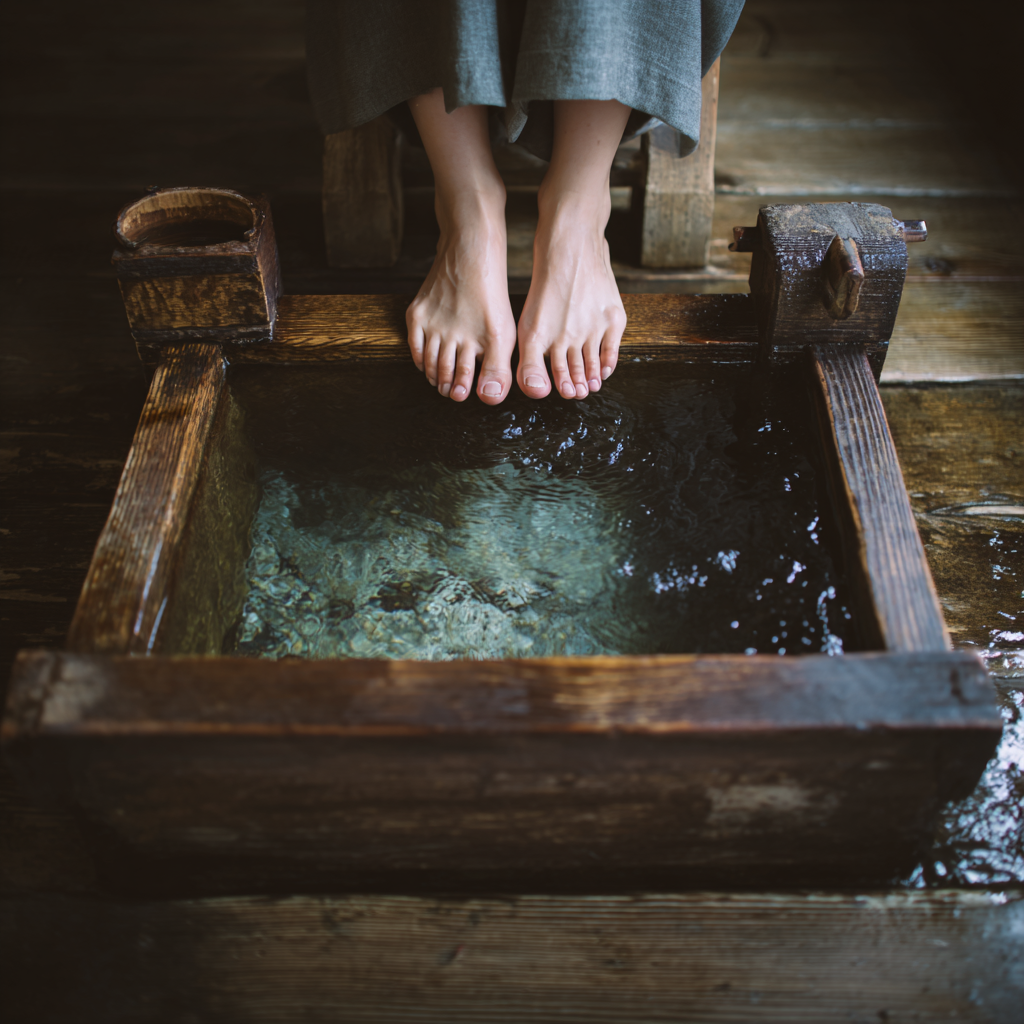
Foot Baths
Foot baths are one of the simplest ways to introduce warmth into the body in a sustained way. Immersing the feet in hot water draws circulation downward and outward, improving warmth in the extremities while easing tension elsewhere. Many people notice that their shoulders relax, their breathing deepens, and their sense of restlessness decreases after a single session. This response reflects how closely circulation, muscle tone, and nervous system activity are linked.
A foot bath works best when treated as direct care for the body rather than a symbolic or decorative act. Ten to twenty minutes provides enough time for meaningful circulatory changes to occur. Water should feel genuinely hot without being painful. Wrapping the ankles and lower legs in a towel helps retain warmth and extend its effects. In the evening, this practice prepares the body for sleep by raising core temperature and then allowing it to fall gradually afterward. Many people find that they fall asleep more easily and wake less often during the night after making foot baths part of their winter routine.
Find a foot soaking tub/bowl/pot/bucket that is deep enough to get water up to your mid-calf. You can get a decent effect from a classic ankle-deep foot tub but a deeper tub will warm you more deeply and in less time. You might also want to keep the just boiled kettle near to your soaking area so you can add little bits of hot water to the tub to keep the temperature warm throughout the soak. If you’re getting super creative: towel insulators, sous-vide circulators, and even warming trays can help to keep your soak toasty for the whole duration.
Hot Packs
Hot packs, or electric heating pads, offer similar benefits through simpler means. Placed on the low back, abdomen, neck, or shoulders, they increase local blood flow and soften tissue that tends to remain contracted during colder months. Heat in these areas improves flexibility, reduces pain, and supports circulation to underlying organs. For people experiencing menstrual discomfort, digestive upset, or chronic back tension, daily use often produces visible improvement in comfort and function.
Warmth also engages the nervous system directly. Heat encourages relaxation in skeletal and smooth muscle, opens blood vessels, and shifts breathing into a slower rhythm. These changes reflect increased parasympathetic activity, which supports digestion, recovery, and sleep. As winter progresses and dryness, cold, and reduced sunlight accumulate, many people neglect how much their nervous systems are working to maintain balance. Heat therapy offers a simple way to ease that load.
Moxibustion
Moxibustion introduces warmth through combustion rather than water or electrical heat. It involves the burning of processed Artemisia argyi near the body, allowing heat and aromatic compounds from the plant to penetrate the tissues gradually. The warmth produced by moxa reaches more deeply than most external methods. Practitioners use it to warm muscles, joints, and specific areas associated with digestion, circulation, and reproductive health. This form of heat often reaches tissue that remains cool even when covered with blankets or hot packs.
In clinical settings, moxa is frequently used for digestive weakness, chronic pain, low energy, and gynecological concerns related to cold sensitivity. People who become ill easily in winter or feel persistently chilled tend to respond especially well. The warmth develops slowly and remains after treatment ends. Many patients describe a deep internal warmth that continues for hours, sometimes longer.
Moxa also influences breathing patterns and nervous system tone. Treatment often produces slower respiration, reduced muscle tension, and a sense of physical settling. Over time, repeated treatments can improve resilience for people whose systems feel depleted by chronic stress or illness. During winter, when immune systems are under greater strain and circulation works harder to maintain warmth, these effects offer meaningful physiological support.
The General Importance of Warmth
What foot baths, moxa, and hot packs share is their direct influence on circulation and tissue tone. Cold reduces movement in tissues and blood vessels. Warming restores pliability and flow. Over time, these changes affect how nutrients are delivered, how waste is cleared, and how energy is produced. Temperature quietly shapes every aspect of internal physiology. When the body stays chronically cool, systems slow. When warmth circulates efficiently, function improves.
These practices also invite a slower rhythm into daily life. They give the body a clear signal that it is allowed to rest. During winter, when many people carry a steady undercurrent of tension, these moments of sustained warmth help reset baseline tone. A basin on the floor, a warm cloth across the abdomen, the faint scent of moxa smoke in the room. These experiences engage the body through sensation and attention rather than instruction.
People who respond most strongly to warming therapies often describe themselves as tired without knowing why, cold even indoors, or uncomfortable in their bodies in ways that defy clear explanation. Their symptoms develop gradually. Circulation thins. Digestion weakens. Sleep loses depth. When warmth is introduced consistently, these patterns begin to unwind. Energy stabilizes, limbs feel warmer, discomfort becomes easier to manage, and rest becomes more accessible.
Winter requires practical adjustments even when daily life does not permit major changes in schedule or environment. Gentle warming therapies offer support without complexity. A foot bath before bed. A hot pack during evening reading. Warm beverages throughout the day. These small interventions accumulate steadily, and their effects deepen when they become part of routine rather than reserved for moments of discomfort.
The body reorganizes itself each winter as part of its annual cycle, and sometimes, particularly in cases of age or infirmity, that reorganization can be unfomfortable if we don’t take speicfic steps to shape it to our needs. Gentle warming practices influence that reorganization directly and help us to maintain movement where stagnation might otherwise develop. They preserve warmth where cold would accumulate quietly over months.
Warmth communicates with the body in a way no instruction can. It influences circulation, muscle tone, breathing, and sleep simultaneously. During winter, these small signals add up. Foot baths, moxa, and hot packs offer a steady form of care that fits naturally into the season. They support the body’s tendency toward conservation and restoration rather than fighting against it.

Everyday Alchemy: Keep Off That Cold Floor
In Chinese medicine, cold can quietly weaken the body over time—especially when it enters through the feet. This post explores why walking barefoot on cold floors might leave you feeling more drained than refreshed, and how small changes in daily habits can help support warmth, circulation, and overall balance.
There’s something grounding about walking barefoot, especially on natural surfaces—grass, sand, warm stone. But indoors, especially during the colder months, bare feet on hard, cold floors can be more draining than refreshing. In Chinese medicine, this simple act—just standing on a cold surface—carries more weight than it might seem. That’s because of how the environment interacts with the body.
Chinese medicine has always viewed the body as part of the world around it. We’re not closed systems. The qì 氣 of the environment—its temperature, dampness, wind, and seasonal patterns—moves in and around us. When we are strong and in balance, we can adapt to shifts with ease. But when we are depleted, overexposed, or chronically taxed, even minor environmental influences can begin to take a toll.
Cold is one of the six external factors (liù yīn 六淫) described in classical texts. It is considered a contracting, slowing, and stagnating influence. When cold enters the body, it tends to cause tightness, pain, or impaired movement. It often lodges in the lower body—joints, bladder, reproductive organs—and creates symptoms like cramping, stiffness, or slowed circulation. While we usually think of cold entering through the back of the neck, the feet are also a common entry point. The channels that run through the feet connect to the Kidneys, Liver, and Spleen—systems responsible for vitality, digestion, and hormonal regulation.
Of course, a single step on a cold tile floor isn’t likely to cause lasting harm. The body is resilient, and most people can tolerate brief exposures without issue. But repeated exposure, especially when the body is already under strain, can slowly erode vitality. Walking barefoot on cold floors every morning in winter, spending long hours standing on uninsulated concrete, or habitually having cold feet without warming them—these are the kinds of patterns that can gradually disturb internal balance. Over time, people may notice that they feel more tired, more prone to digestive upset, more susceptible to urinary discomfort, or more affected by cold weather in general.
It’s not that cold floors are dangerous. It’s that the body can only buffer so much before it starts to adapt in ways that may not feel good. The feet, being far from the core and in direct contact with the environment, are especially sensitive to these shifts. Cold feet can cause the blood vessels to constrict, reduce circulation, and draw warmth away from the digestive organs. For people who already struggle with poor appetite, slow digestion, or loose stools, this can quietly worsen things. In others, cold in the feet may manifest more as menstrual cramps, low back pain, or an overall sense of fatigue and heaviness.
Some people are more susceptible than others. Individuals with depleted yáng 陽—those who tend to feel cold easily, have low energy, or crave warmth—are more likely to be affected by cold exposure. The same is true for those recovering from illness, going through periods of high stress, or transitioning through life stages that draw on internal reserves, such as postpartum or menopause. For these people, a cold floor might not just feel unpleasant—it might be the tipping point that leads to more entrenched discomfort.
Don’t rip up your floor tile just yet
The goal here isn’t to sound an alarm about household surfaces. It’s to offer a gentle reminder that our everyday choices add up. If you’re someone who consistently walks barefoot on cold floors and also deals with chronic cold feet, sluggish digestion, or low energy, there may be a connection worth exploring. Putting on socks or slippers, warming the feet before bed, or simply pausing to notice how you feel after time spent barefoot can offer real insight. Sometimes the fix is that simple.

There’s also a cultural piece to this. In many modern households, going barefoot indoors is seen as normal or even ideal. Minimalism, clean floors, and radiant heating have made bare feet feel acceptable year-round. But not all bodies thrive in the same conditions. What feels invigorating to one person may be draining to another. And what works in summer doesn’t always work in winter. Chinese medicine always comes back to context—season, constitution, environment, and lifestyle all matter.
One of the principles in this medicine is that prevention is better than correction. Keeping the feet warm is a classic example. It may not seem like a major decision, but protecting the lower body from chronic cold exposure can help preserve energy, improve circulation, and reduce tension in other parts of the system. It also signals to the body that warmth is available—that the external world is not depleting its reserves.
Warmth in the feet often translates to warmth in the core. People who start wearing slippers or warming socks in winter often notice that they digest better, sleep more easily, or experience less back or abdominal discomfort. This is not magic. It’s just alignment—small choices that support the body’s natural efforts to stay balanced.
If you already have cold feet, there are a few simple ways to bring warmth back in. Foot soaks with ginger or Epsom salts, gentle massage with warming oils, moxa (if appropriate and guided), or simply a hot water bottle at the end of the bed can help. But the most consistent support comes from what you do day after day. Warm layers. Covered ankles. A pause before stepping onto cold tile.
These are not difficult changes. But they require attention. And that’s the heart of this practice—not doing everything perfectly, but learning to notice what makes you feel better or worse, and adjusting accordingly. Feet are the foundation of the body. When they’re warm and supported, the whole system tends to function with a little more ease.
So this is not a warning against cold floors. It’s an invitation to consider how something that feels small might actually be meaningful. If you’re someone who feels tired, cold, or off-balance in subtle ways, keeping your feet warm might be a worthwhile experiment. It’s a low-effort, high-return choice—quiet, gentle, and rooted in the same logic that guides so much of Chinese medicine: respect the body’s relationship with the world, and try to work with it, not against it.

Everyday Alchemy: Be Mindful of Cold Drinks
In Chinese medicine, digestion depends on warmth. Cold drinks—especially when habitual—can slow and weaken that process. This post explores why iced beverages may undermine digestive health, when they might be appropriate, and how small shifts toward warmth can support energy, comfort, and long-term balance without giving up enjoyment entirely.
It’s a warm day. The sun is high, your face is flushed, and nothing sounds better than a tall glass of something cold. Maybe it’s iced coffee. Maybe it’s sparkling water straight from the fridge. Whatever it is, that chill feels like relief—and in the moment, it can be. Cold drinks are undeniably satisfying. But in Chinese medicine, they come with a caution.
This isn’t about forbidding anyone from enjoying an iced beverage now and then. It’s about understanding what cold does inside the body, especially when it becomes a habit. Digestion, in Chinese medicine, is powered by warmth. In the foundational medical texts, the Spleen and Stomach—the central organs of digestion in this system—are said to prefer dryness and warmth. They work best when food and drink arrive at body temperature or warmer. Introducing cold into this system slows things down. It’s like throwing a handful of ice cubes into a simmering pot. The whole process loses momentum.

Physiologically, this makes a certain kind of sense. The body must bring everything you consume up to its internal temperature before it can be broken down and absorbed. That warming process takes energy. If the digestive system is already compromised—through fatigue, stress, illness, or constitution—adding cold drinks can further impair its ability to transform food into usable nourishment. People often describe feeling bloated or heavy after cold beverages, or note a sense of stagnation in the gut. Sometimes it's subtle. Sometimes it's not.
This doesn't mean every cold drink is inherently harmful. Season and context matter. In the height of summer, when the external world is full of heat and the body is actively working to cool itself, a small amount of cold may be tolerable. Some people, especially those with robust digestion and plenty of internal warmth, can handle the occasional cold drink without noticeable consequences. But others—particularly those who tend to feel cold, have loose stools, or experience digestive sluggishness—often find that even modest amounts of cold exacerbate their symptoms.
The problem arises less from isolated choices and more from patterns. A daily iced coffee. Cold smoothies for breakfast. Ice water at every meal. These habits, common in many modern routines, slowly wear down the digestive fire. Over time, people may experience symptoms like fatigue after eating, chronic bloating, irregular stools, or a general sense that food sits heavily in the stomach. In Chinese medicine, these are often signs that the Spleen and Stomach are struggling to transform what they receive into usable qì 氣 and Blood.
One of the challenges in talking about cold drinks is that the culture around them is so strong. Iced coffee is practically a ritual for many people. Smoothies are often framed as health food. Cold beverages are routinely served in restaurants, even in the coldest months. So it can sound strange—maybe even a little rigid—to suggest that room temperature or warm liquids are better for you. But this isn’t about purity or punishment. It’s about support. About making choices that align with how the body actually works, rather than how we’ve been conditioned to expect it to behave.
Chinese medicine views health through the lens of pattern and tendency. That means not every guideline applies equally to every person at every moment. Some people may be able to drink cold brew in July with no ill effects, while others find even one iced tea leaves them feeling off. The goal isn’t to eliminate cold beverages completely. It’s to become more aware of how they affect you—and to adjust based on season, constitution, and context.
Making choices that support your health, wherever you are
If you’re someone who already struggles with digestive issues, especially ones related to cold or dampness—things like bloating, gas, loose stools, or fatigue after meals—shifting away from cold drinks can make a noticeable difference. Drinking warm teas, broths, or even just room temperature water allows the body to engage more directly with what it receives. Over time, this can strengthen the whole system, making it more resilient and efficient.
In the colder seasons, the argument for warmth becomes even stronger. Autumn and winter already call the body inward. The external environment becomes colder and wetter, and the digestive system has to work harder to maintain internal temperature. Adding cold drinks in this season adds stress to a system that’s already doing its best to stay balanced. That doesn’t mean you can’t have a crisp cider in the fall or a cold glass of water after a workout—but it does mean that the default should shift toward warmth.
There are also ways to enjoy cooler things more thoughtfully. If you really enjoy iced beverages, consider timing them to the warmest part of the day and the warmest parts of the year. Pay attention to what you eat alongside them—pairing a cold drink with hot, cooked food may be easier on the body than drinking one with a raw salad. Some people find that adding warming spices like ginger, cinnamon, or cardamom to cold drinks helps offset the chill. And when possible, let things warm up a bit before drinking—lukewarm is still better than ice-cold.
None of this needs to be absolute. Like many things in Chinese medicine, it’s less about rules and more about relationships. The body thrives on balance. If you’re constantly adding cold, you may need to add more warmth elsewhere—through food, movement, or rest. If your digestion is strong, you may tolerate some cold with little consequence. But for most people, especially those with sluggish or sensitive systems, reducing cold beverages—even by half—can have a surprising effect on energy, clarity, and comfort after meals.
Understanding the role of cold in digestion isn’t about giving something up. It’s about giving something back. A little warmth goes a long way. And sometimes the simplest things—like skipping ice in your water or choosing hot tea over a cold brew—can quietly support your body in doing what it’s already trying to do.
Digestion is an ongoing process. It works best when we work with it. That doesn’t mean never enjoying a cold drink again. It just means noticing what helps you feel more grounded, more nourished, and more steady. And adjusting accordingly.

Everyday Alchemy: Bedtime as a Boundary
In Chinese medicine, sleep isn’t just rest — it’s restoration. This post explores how bedtime can serve as a boundary, not just a stop button, and offers simple, nourishing practices to support the body’s natural descent into yīn 陰. Better sleep starts with honoring the transition into night.
Creating Restorative Sleep Habits
In Chinese medicine, the day has structure. It rises and falls with light and activity in patterns that have been described in clinical terms for two thousand years, and the transition into night is one of the more consequential moments in that cycle. The decision about when and how to go to bed shapes what the body is able to do over the following eight hours, which in turn shapes how the next day starts. Most of us make this decision casually, by default, or under the pressure of whatever was happening on the screen at 11:47 p.m.
Modern life tends to treat sleep as a utility, something to be scheduled around more important activities and shortened when the day runs long. Chinese medicine treats sleep as one of the three pillars of health, alongside food and breath, and views it as the time when most of the body's serious restorative work happens. The duration of sleep matters. The quality matters more, and the quality depends substantially on how we cross the threshold into it.
Night is the time when Yīn 陰 takes precedence. Where the Yáng 陽 of daytime supports activity, thought, and outward engagement, Yīn anchors inward processes: digestion settling into assimilation, cellular repair, the enrichment of Blood, the work of dreaming, and the containment of consciousness. The Shén 神, the part of consciousness that the Heart houses during the day, retreats more fully into the Heart at night and is nourished there by Blood. When this consolidation does not happen well, the consequences show up the next day as scattered attention, low-grade anxiety, or a dullness that coffee does not quite resolve.
The Liver does much of the processing work overnight. During sleep, Liver qì 氣 helps regulate the movement of Blood, settle the nervous system, and smooth the transitions between sleep stages. The food, emotion, and experience taken in during the day are metabolized while we are unconscious. When sleep is shallow or interrupted, that metabolic work stays incomplete, which is why a poor night's sleep can leave us feeling not just tired but unsettled in ways that are hard to name.
Bedtime as a transition
Most people treat bedtime as a hard stop. One moment the phone is in hand, the next it gets tossed aside in the hope that sleep will follow within minutes. The body does not actually work this way. Yīn needs time to gather, the mind needs time to descend from daytime intensity, and the autonomic nervous system needs an unambiguous signal that it can shift out of sympathetic tone. Without that transition, lying in bed becomes the experience of waiting for sleep that has not been given permission to arrive.
A more useful frame is to think of bedtime as a boundary that begins about an hour before the lights actually go off. The hour before sleep is when the body is being told what comes next. If that hour is full of email, doomscrolling, an episode of your favorite new show, and bright overhead lighting, the body has been told that the day is continuing. If the hour is quieter, dimmer, and lower-stimulation, the body has been told that sleep is coming, and the descent into sleep tends to happen more easily as a result.
This does not require an elaborate routine. It requires consistency and a small number of clear signals.
What an evening can look like
The most important variable is timing. The body is built on circadian rhythm, and the Heart, Liver, and Kidney all carry nighttime functions that depend on regular sleep windows. Going to bed at roughly the same time each night, ideally before 11 p.m., gives those systems the regularity they need to do their work. The exact minute does not matter, but the consistency of the target hour does. People who keep a stable bedtime within a 30-minute window, even on weekends, sleep noticeably better than people who swing across two or three hours depending on the day.
Light is the next variable. Bright light, particularly the blue-spectrum light from screens and overhead LEDs, suppresses melatonin and reads as daytime to the parts of the brain that govern sleep onset. Dimming the lights for the half hour or hour before bed, switching to warm-toned bulbs in the evening, or lighting a candle in the bathroom while you brush your teeth all give the visual system a clear signal. None of this is mystical. The hypothalamus is taking direct cues from your retinas, and it responds to what it sees.
Eating is the third variable. Late meals leave the digestive system actively working when the body is trying to redirect resources inward, and active digestion tends to keep the mind active too. A two- or three-hour gap between dinner and bedtime lets the Stomach finish its work before sleep starts. If hunger is genuinely present at bedtime, something small and easily digested is better than going to bed with a growling stomach, but the better long-term move is usually to eat dinner earlier.
The fourth variable is the kind of input you take in during the wind-down hour. Violent news, rapid editing, loud soundtracks, and emotionally intense narratives all pull Shén outward and keep the nervous system in engagement mode. Sleep requires the opposite movement, an inward gathering, and the easiest way to support that gathering is to choose calmer input in the last hour of the day. A book that is mildly engaging rather than a thriller. A conversation with someone in your household rather than an argument on social media. Music that does not insist on your attention.
The fifth variable is the transition itself. Some kind of consistent sequence of small physical actions before bed seems to matter more than any specific action. A shower or a face wash, a cup of mild herbal tea, ten minutes of reading in a cool, dark bedroom, the deliberate slowing of breath as you settle in. The body learns that this sequence means sleep, and over time the sequence itself becomes part of how sleep arrives. Reading a real book in bed is one of the better-established practices because it engages the visual system in a calmer way than a screen, allows the eyes to grow heavy naturally, and provides a clear physical cue (closing the book, turning off the lamp) that marks the actual transition into sleep.
When sleep is genuinely difficult
Some people do all of this and still cannot fall asleep, or fall asleep readily but wake at 2 a.m. and cannot get back down. These patterns often point to something specific. Difficulty falling asleep is more often a Heart and Shén problem, with racing thoughts and a sense that the mind cannot find an off switch. Waking between 1 and 3 a.m. corresponds to the Liver's window in the Chinese organ clock, and tends to point to Liver-related patterns of stagnation or Blood deficiency. Waking at 4 or 5 a.m. with the inability to return to sleep often points to Kidney depletion or to the underlying patterns we see in long-running burnout. These are clinical pictures that respond well to treatment, and if a sleep problem has been going on for months, it is worth being seen rather than continuing to optimize the wind-down routine alone.
For most people, though, what looks like a sleep problem is closer to a rhythm problem. The body has not been given clear cues that the day is ending, and so the descent into sleep happens reluctantly or incompletely. The fix is rarely dramatic. A consistent bedtime, dimmer light in the last hour, an earlier dinner, calmer input, and a small repeated sequence of pre-sleep actions will resolve a meaningful portion of the cases that show up in the clinic, and they will improve sleep even for people whose sleep is already reasonably good.
What Chinese medicine offers here is mostly a frame. The day has a shape, the body works with that shape rather than against it, and bedtime is the moment when the work of the day is handed over to the work of the night. Treating that moment with a little care is one of the higher-leverage things a person can do for their own health, and it costs nothing beyond the willingness to put the phone down twenty minutes earlier than usual.

To Sleep Like A Baby
By
Travis Cunningham LAc. MSOM DICEAM
(The Elusive) Good Night Of Sleep

How long has it been since you’ve had a good night of sleep? Can you remember what it was like?
Do you remember falling asleep? Staying asleep? Or, how you woke up? Do you remember the dreams you had? Or, do you only remember the feeling of restfulness upon waking?
One of the most challenging things to consider when we contemplate sleep, is just how unconscious a good night of sleep can be. We require nothing to sleep well. All humans must sleep. But how much? And, to what quality? What is required and what is optimal? What does sleep do for us? And, how can sleep be corrected if it becomes problematic?
If we take the basic premise that sleeping well is a natural process, we encounter our first problem…
“If a good night of sleep happens unconsciously, how can we consciously change it?”
And thus, (the internet) spawns a million suggestions. Searches, studies, science - all seeking to answer the same basic questions.
One of my teachers used to say that “if we look at the disease, we will find one thousand medicines to treat it. But, if we look at health, we will find only one cure.” Before we can learn to treat a problem, we must first understand what it is like to have no problem. So, what is healthy sleep?

Defining Healthy Sleep
The first thing that one might notice in the analysis of healthy sleep is that sleep - all sleep, is a rhythm. Just like breathing, eating, urination, defecation, movement and rest, sleep is a rhythmic process. When a person generally sleeps well, one night of poorer sleep doesn’t bother them so much. When a person generally sleeps poorly, one night of good sleep doesn’t benefit them so much. Many people who have chronic insomnia will actually report that they feel worse, when they (rarely) get a full night of sleep. We can make sense of this fact with the simple understanding that sleep is rhythmic. And, the effect of a single “beat” of sleep, is not nearly as impactful as the timbre of a repeated rhythm.
When we compare sleep to other rhythms, like eating, we find that sleep is a longer rhythm. Sleep is longer; both in the time that it takes to engage in, and the time that it takes to influence as a habit. When we are younger, we can live with poor sleeping habits for a longer period of time without feeling the negative effects on our vitality. As we age, poor sleeping habits catch up with us more quickly and become much more difficult to correct once they are set. In the traditions of East Asia, this is explained by the concepts of Yin and Yang.
In youth, we are more Yang. We have access to more energy and are able to make changes in our lives more easily. As we age, we become more Yin. We become more stable, (hopefully) more grounded and wise, but with less capacity to quickly change and shift. It is advised that we establish good habits when we are youthful because it is easier to keep these habits as we get older. While I believe that any habit is changeable at any stage life, sleep is a rhythm that is easier to correct in our earlier years.
It is important to discuss the longer rhythmic nature of sleep right away because if we wish to change a longer rhythm, we must expect that it will take a longer period of time to shift than other activities. When I work with adults in the clinic for sleep, I tell them to expect that it will take a minimum of three months to shift the basic pattern and possibly longer if there is a standing history of insomnia. Good sleep takes time. It takes effort to create a positive sleeping habit, before good sleep can become effortless once again.
Sleep & Time
Sleep, just like any rhythmic process is inextricably connected to time. The connection to time has two aspects. First, we have the duration or amount of time a person is sleeping within a day or night. Second, we have the time during the 24 hour day that a person chooses to sleep. While at first, these two aspects of time seem to be separate topics, at a closer glance we will find that they overlap and influence each other.
In East Asian medicine, there is a keen interest in the efficiency and quality of nature. Ancient people observed that all creatures followed the circadian rhythms of day and night. Human beings tended to sleep during the night time and stay awake for most of the day. Humans generally followed the cycles of the Sun, and were more active when the Sun radiated its light from the sky.
As human beings evolved with the Sun’s cycles, our physiology “learned” to become more efficient when we follow them. We have naturally more energy to act during the day and more proficiency to restore ourselves through resting at night. In modern times, we can easily live outside of or contrary to these natural rhythms. But we inevitably pay the price through inefficient restoration and a challenged expression of vitality.
Many modern people may push against the idea that for optimal vitality, we must adhere to the circadian rhythm - resting and waking with the cycles of the Sun. These people may insist that they feel better staying up late at night, and waking in the late morning or early afternoon. I can honestly say that I have not (yet) seen a single person in clinical practice to make this claim who has not obviously damaged their health because of it. Sleep, as we saw before, is a longer rhythm. It is harder for most people to see the damaging effects of an inefficient sleep habit in the short term. But over the course of weeks, months and years, the deficit will show itself.
So what does a sleep deficit look like? For some people, it can simply mean that they require more hours of sleep to function normally than they might. The lack of efficiency in restoration means that the body needs more time to recover than it could otherwise. In traditional medicine, we think of a healthy sleeping habit to (generally) require between 6-8 hours of sleep within a 24 hour cycle. Most people trend closer to the 8 hour mark with what they need, then the 6 hour one. This need can also fluctuate with the seasons - trending a bit longer in the winter and a bit shorter in the summer.
Problem One: Needing More Sleep

If a person finds that they need more sleep than 8 or 8.5 hours to feel rested, it is a sign that their sleep is inefficient or in deficit. I’ve treated patients who claim to need 11 or even 12 hours of sleep per night to feel rested. This is a sign of a profound deficiency of vitality that the body is trying to rectify by sleeping more. In traditional medicine we would say that the body is having a difficulty storing its vitality. The need to sleep for this many hours obviously effects the person’s daily life. I’ve also noticed that a huge percentage of these patients struggle with depression. In these cases, there is good news. If we can help to restore their vitality, the person will generally need fewer hours of sleep and their depression will either lift or at least be less problematic for them.
In East Asian medicine, we see this pattern of sleep coincide with feelings of cold in the body, weak digestion and malaise or fatigue. We call this Yang deficiency with Yin sinking. The warm and active quality of Yang is deficient and unable to transform or utilize the nutritive substance of Yin. This Yin substance “sinks” in the digestive tract, causing looser stools and a general feeling of heaviness in the body. The remedy for this pattern is treatment which targets warming the Yang, making it strong enough to transform the Yin substance and lighten the body.
Problem Two: Being Unable To Sleep
The other possibility for inefficient sleep or sleep deficit, is that a person may be unable to sleep or unable to sleep deeply. These people generally learn to sleep for fewer hours than the 6-8 that is considered normal or healthy. They basically never sleep well or feel rested, but may report feeling worse when they (rarely) do get a decent night of sleep.
While this may appear different than the first type of problem, it is actually the same. Both problems come from inefficient sleep or a lack of restoration. In East Asian medical diagnosis, I find that most of these patients still qualify as Yang deficient. In these cases the Yang is not only deficient, but also floating. These people can tend to have an overactive mind when they lay down to sleep, feel warmer at night or experience night sweating and have very vivid dreams. Underneath the superficial heat, there is cold. Sometimes you can feel this cold when you touch their feet or lower abdomen, especially when compared to the temperature of the neck.
These people would be treated differently than the first type, given that their presentation is not the same. I find that working with these folks can be a bit more challenging, because they will often feel more tired when we start treatment. These feelings of tiredness are often what they have been avoiding during the day, by use of stimulates or stimulating activities. Unfortunately, they must begin to feel their body’s fatigue in order to restore their vitality through sleep.

Can It Change?
In every case of insomnia, inefficient sleep or sleep deficit that I’ve seen thus far, the answer has been yes - it can change. The more important question is how much of a priority is the person willing to make their sleep? Sleeping well is a by-product of living a life where good sleep is possible. If we live contrary to the body’s natural rhythms, we cannot expect our sleep to be efficient or restorative. But if we are willing to change, so can our sleep. So how can we get our sleep back on track?
Step One: Empty The Stomach
A famous Chinese medicine doctor once said, “if a person tells me that they have a problem sleeping (any problem sleeping), I tell them the same thing: No food after dark. If they can adhere to this rule alone for two weeks, about 60% of sleeping problems will resolve.”
This one sounds a bit strange at first but when we take a closer look, it makes quite a lot of sense. When we go to sleep at night, our heart rate decreases and our body’s surface becomes cooler. A complex chain of events begins to happen involving many organs, nerves, blood vessels and the hormonal system. In East Asian medicine, we call this phenomena Yin ascending, Yang descending or the communication of the Heart (Fire) and Kidney (Water).
If we go to bed and our stomach is still full, our body has to ramp up its metabolism to digest the food. Our heart rate increases, and it can even feel uncomfortable to lay down. When our stomach (Earth) is full, the pathway for the heart (Fire) and kidney (Water) to communicate is “blocked.” This can inhibit the quality of a person’s sleep or even prevent sleep from occurring at all. The first and clearest step to getting better sleep is to increase the amount of time between your last meal or snack and your bed time. I recommend people work toward 3 hours between the two, if possible.
Step Two: Create A Slide

If you have any difficulty getting to sleep, its unlikely that you’ll be able to do so for awhile without a routine before bed. So create one. This routine will look different for every person. But the routine should include the general feature of moving from more activity to less. I call this “creating a slide.”
Keep in mind, that by activity, we don’t only mean physical activity. Modern people are less and less physically active as our work becomes more closely engaged with technology. For some of us, our evening routine may need to include physical movement to release the activity in our nervous systems. There are many great practices for this - from gentle Qigong, to Yoga. My favorite is actually just walking. Remember the cheesy phrase: Whatever it is that you do to unwind, make sure to include your body and mind.
Step Three: Swing Out To Swing In
Many people have a difficult time sleeping because they lack basic movement or exercise during their day. But by engaging in a short exercise routine, people can dramatically enhance the quality of their sleep at night.
There are many studies that have been done on this subject alone. Some of these studies have analyzed specific data on the cycles of hormones and the assistance that day-time exercise can provide.
In East Asian medicine, we can summarize this phenomena quite simply: Yang activity benefits Yin restoration. Swing out, in order to swing in.
Step Four: Create A Break In The Static
So many cultures around the world take a siesta or a mid-day nap. Interestingly enough, if we look at the times of the day that most cultures take siesta (1-4PM), these are the clock-opposite times that most Americans struggle to sleep at night.
If you ask people about how they sleep, many people who can fall asleep easily will struggle to stay asleep between 1-4AM. East Asian medicine is a medicine that looks at opposites (Yin & Yang). If there is a problem that regularly occurs for someone at 3AM, we might look at adjusting the person’s conduct at 3PM to change it. For example, If a person is regularly waking up at 2:30AM and unable to fall back asleep, one way to change this dynamic would be for the person to take a short nap at 2:30PM. It sounds strange, but it totally works!
Another way to think about the helpfulness of mid-day rest is what I call, creating a break in the static. First, imagine that during the work day, we accumulate stress or a type of pressure in our nervous system. To me, this stress feels like static electricity, so I call it static. As the static builds without a release point, our nervous system continues to get more and more stimulated. If this continues all day, when we reach the day’s end, we may experience the “tired but wired” phenomena. We feel very tired, but we cannot sleep.
By taking a mid-day nap or short resting period, we can provide a natural release valve for our accumulated stress. Now before you instantly write off this idea by telling me that you don’t have time, hear me out. A break even as small as 5 minutes can significantly shift the state of accumulated stress within the nervous system. I’ve worked with all types of busy people. If you prioritize it, you can create the time.
What can you do with this time? The best thing that I’ve found, short of a quick nap is a mindful breathing practice or a shaking exercise (scroll down the page to see the exercise). If you make the time and participate every day, you will feel the changes.

Step Five: Get Help
If you’ve been struggling with your sleep for a long time, or even a shorter period of time, the quickest way to get better is to receive help. I’ve specialized in helping people with their sleep since beginning my training in East Asian medicine. Not being able to sleep efficiently is a huge burden - one that I know from my own experience.
It is possible for your sleep to improve if you are willing to receive help and participate in the process. If you’d like to take the next step, follow the links below to read more about treatment for insomnia or sign up for your first appointment today.

Treating Seasonal Allergies With Chinese Medicine
How to treat seasonal allergies with traditional Chinese medicine.
A Spring In Your Step

Dear reader,
I am writing to you in early Spring. The weather is still cold here. Frost covers the ground at night and is breached by sun in the early morning. It is still too cold to wear a light(er) jacket. And yet, the first flowers have started making their appearance.
As I notice the crocuses waking up on my morning walks, I find myself contemplating the meaning of Spring. In the historic and cultural medicine of China, human beings witnessed the transitions of nature. The qualities that belong to these transitions were described as Qi.
I think people make too much of the term Qi. If we just look at how things move and change, it follows to use a word that describes the quality of this change. That which moves behind the appearance of things, could be a simple definition of Qi.

The Qi of Spring is said to be like wind. Wind is movement or a quicker form of change. In Spring, we transition from the cold Qi of Winter to the hot Qi of Summer. What force can propel such a change from one opposite to the other? Wind. Wind necessitates change. It propels our bodies to find a new balance of adaptation with the environment around us. The Chinese say, that the fluids of our body have to become thinner in Spring. Traditionally, the density of our body’s fluids have to do with their ability to hold heat. In the cold Qi of Winter, the body must have the thickest fluids. In the hot Qi of summer, the body’s fluids must become thinnest. In the Spring then, the fluids must begin their thinning process.
The pressure to adapt to nature is seen as a necessary part of life in traditional medicine. There is no way to become immune to change. A failure to adapt to the circumstances outside of our bodies creates an adversarial relationship with the Qi of nature. This adversarial relationship is called a “strike” in traditional medicine. An external strike against the body is the body’s failure to adapt to the new circumstances surrounding it.
From the perspective of the body, this dynamic feels like the Qi of nature is striking it. It’s important to understand that there is no malicious intent from the Qi of nature. The body simply interprets the change as a strike because it isn’t prepared for the shift. The body then goes into a defensive and adaptive process. This process, we know as disease. In some cases, the form that this disease takes is called allergies.
Allergic to Adaptation
In biomedicine, we understand an allergy to be a reaction from the body’s immune system toward a particular substance that the body comes into contact with. The immune system recognizes this substance as a hostile presence and mobilizes its resources to attack. The following symptoms we are all familiar with…
Itching
Sneezing
Coughing
Phlegm or congestion
Dry/tearing eyes
Dermatological or digestive problems
And more…
Regardless of the type of symptom, traditional medicine views the cause of this disorder to be a failure of the body to adapt. The remedy then, must not only be about treating the above mentioned symptoms, but helping the adaptation process of the body to complete in live time.
If the nature of a problem is adaption, our next question would then be, “how can we aid the adaptation process?” Luckily, there are many answers to this question. Some, are actions we can take ourselves. Others, require aid by a trained practitioner in the arts of Chinese medicine.
A Simple Exercise: Shaking
Many of the ancient practices of China that have been crafted to assist the body and mind to adapt are not esoteric or outlandish. These practices often fall under the category of hygiene. Though, in this context, we don’t only mean getting cleaner. We mean instigating the vital forces of the body toward a more appropriate kind of circulation.

Stand in an even posture with the feet shoulder-width apart.
Allow for a very slight bend in the knees (making them “active,” and not locked)
Close your eyes and begin gently bouncing - allowing the whole body to pulse and move.
Allow the mind to drift to the various parts of the body - especially places of tension. Shake loose any feeling of stuckness.
When you feel your practice coming to a close, stop shaking and remain still.
Allow the mind to become quiet and feel the residual waves of internal activity.
When you are ready, gently re-open the eyes.
This shaking technique is often performed at the beginning of a Qigong practice. Its purpose is awakening the movement of Qi and blood in the body and to release blockages within the channels. The first time you do this practice, it is recommended to do so for only one or two minutes. After you get comfortable with the practice, you can increase the shaking time to five or ten minutes. In certain styles of Qigong practice, adept practitioners will even shake for as long as forty-five minutes to one hour! For our purposes, this amount of time is unnecessary.
The practice of shaking can be done on its own without any other practices or intentions. It can be practiced any time of day or in any season, but it is most beneficial to practice first thing in the morning and in the Spring season. This is because in both of these times be it daily or seasonally, the Qi of nature is beginning to move once again. If we instigate a similar quality of movement in our body, it helps the body to adapt and line up with the quality inherent in nature at that time.
This gentle practice of alignment prepares the fluids of the body for proper balance for that day. If we continue this practice for many days consecutively, it prepares the fluids of the body for proper balance for that week, month, and season. This is an excellent technique to use to help the body adapt to the seasonal transition and prevent complications like colds, flus, and the present of seasonal allergies.
Traditional Medicine Interventions
Depending on the person’s constitutional tendency as well as the status of the vitality in the body, more intervention may be required than simple hygiene practices. The medical interventions of herbal medicine and acupuncture are uniquely equipped to aid a person in this adaptation process to a deeper level. If done well, such interventions can not only alleviate the symptoms of conditions like allergies, but help the body to adapt and therefore, prevent the symptoms from reoccurring in future seasons.
In order for the intervention to work, each treatment must be individualized to the person and their circumstances. All generalized patented formulations and protocols of medicine are flawed. These formulations are unable to comprehend the needs of the person in the here and now. It’s for this reason that we do not recommend any medicines for general supplementation but suggest that each person be evaluated through consultation with a qualified practitioner.
If you are interested in this personalized type of care, click on the “schedule now” button below to book an appointment at our clinic in Portland, Oregon.
If you’d like to read more about how we treat seasonal allergies clinically, click the link below to access our clinic’s allergy treatment page.

Behold The Humble Ginger Root: Understated Workhorse of Good Health
Fresh ginger’s warm nature and spicy flavor make it a powerful ally at the first sign of a cold. Used early, it can help the body push out pathogens and restore balance.

Ah the ginger root — the edible rhizome of the flowering ginger plant Zingiber officinale. This increasingly common kitchen herb has many more tricks up its sleeve besides making your curries and stir-frys really sing.
Chinese Medicine assigns two types of descriptors to any sort of herb or food - Nature and Flavor.
These two categories of description tell us about the intrinsic qualities of a plant, animal, or mineral and give us insight into how to use that item either as food, medicine, or both. Fresh Ginger has a warm nature and an acrid/pungent/spicy flavor.
Items that are warm in nature have effects that fit with that word. In the case of ginger in particular, it has the ability to warm the body physically, especially throughout the digestive system and even on the surface of the skin. We often find ginger combined with foods that tend to be cooler in nature like pork or shrimp and many people have used it for generations to ease an upset stomach. In fact, it is one of the key ingredients in remedies to relieve morning sickness.
As for it’s flavor, you might see acrid, pungent, or spicy used to describe this plant because finding the exact word to translate the Chinese word xīn 辛 is a challenge. None the less, if you were to bite into a slice of fresh ginger, you would get a real sense for the potent flavor of this root.
Ginger Root as your Winter Defender
Fresh ginger’s nature and flavor give it a particularly powerful ability to prevent a nascent cold or flu pathogen from getting settled into your system and wreaking havoc. So get some fresh ginger root when you are at the store next. Store it in the pantry with your potatoes and onions so that you will be prepared this season.
Now you know the feeling: you wake up one morning and you feel a little off. Nothing super obvious but a little slower, maybe a slight ache in your neck and a tickle in the throat. You’re not sick but you feel like you might be soon.
That is the time to grab your ginger and follow these instructions:

1.) Take about 2 inches of ginger or a piece about the size of your thumb and slice into thin pieces.
2.) Put the slices into a large-ish coffee mug and cover with boiling water
3.) Let that ginger steep until the liquid is drinkable, about 5 minutes
4.) Strain out the ginger pieces and mix in a spoonful of local honey, molasses, or good quality brown sugar.
5.) Drink your spicy ginger tea with its slight sweetness until its all gone. Then immediately hop into a hot shower.
6.) Wash up in the hot water until you’ve got a slight sweat going on. Change the temp to something a little cooler. Finish up and dry off.
7.) Bundle up and stay covered through the day, especially your back and neck and if you’re outside, cover your head too. Stay out of the wind or drafty areas.
8.) Drink lots of water throughout the day and eat your veggies. Lots of ‘em!
When you get home from work or school, you can repeat this process including the hot shower. The goal here is facilitate your body’s natural pathogen fighting abilities and push the infection out through your pores. Using ginger like this at the very first sign of sickness is essential to making it work for you. Wait too long and the picture will change and you’ll need more expert help to get better.
I tried it but I’m still feeling sick!
Now sometimes, you miss the window where ginger alone is effective for stopping colds. In that case Chinese Medicine has several more tricks up its sleeve to help you get better. And one of the best parts about those tricks is that they often involve more honey, cinnamon, and dates. Treating cold and flu is definitely one of our betting tastes remedies!
If you feel like you haven’t been able to kick out that icky feeling before it took hold, get in touch with a Chinese Medicine provider in your area ASAP before that sore throat turns into something much more nasty.