
Everyday Alchemy: Be Mindful of Cold Drinks
In Chinese medicine, digestion depends on warmth. Cold drinks—especially when habitual—can slow and weaken that process. This post explores why iced beverages may undermine digestive health, when they might be appropriate, and how small shifts toward warmth can support energy, comfort, and long-term balance without giving up enjoyment entirely.
It’s a warm day. The sun is high, your face is flushed, and nothing sounds better than a tall glass of something cold. Maybe it’s iced coffee. Maybe it’s sparkling water straight from the fridge. Whatever it is, that chill feels like relief—and in the moment, it can be. Cold drinks are undeniably satisfying. But in Chinese medicine, they come with a caution.
This isn’t about forbidding anyone from enjoying an iced beverage now and then. It’s about understanding what cold does inside the body, especially when it becomes a habit. Digestion, in Chinese medicine, is powered by warmth. In the foundational medical texts, the Spleen and Stomach—the central organs of digestion in this system—are said to prefer dryness and warmth. They work best when food and drink arrive at body temperature or warmer. Introducing cold into this system slows things down. It’s like throwing a handful of ice cubes into a simmering pot. The whole process loses momentum.

Physiologically, this makes a certain kind of sense. The body must bring everything you consume up to its internal temperature before it can be broken down and absorbed. That warming process takes energy. If the digestive system is already compromised—through fatigue, stress, illness, or constitution—adding cold drinks can further impair its ability to transform food into usable nourishment. People often describe feeling bloated or heavy after cold beverages, or note a sense of stagnation in the gut. Sometimes it's subtle. Sometimes it's not.
This doesn't mean every cold drink is inherently harmful. Season and context matter. In the height of summer, when the external world is full of heat and the body is actively working to cool itself, a small amount of cold may be tolerable. Some people, especially those with robust digestion and plenty of internal warmth, can handle the occasional cold drink without noticeable consequences. But others—particularly those who tend to feel cold, have loose stools, or experience digestive sluggishness—often find that even modest amounts of cold exacerbate their symptoms.
The problem arises less from isolated choices and more from patterns. A daily iced coffee. Cold smoothies for breakfast. Ice water at every meal. These habits, common in many modern routines, slowly wear down the digestive fire. Over time, people may experience symptoms like fatigue after eating, chronic bloating, irregular stools, or a general sense that food sits heavily in the stomach. In Chinese medicine, these are often signs that the Spleen and Stomach are struggling to transform what they receive into usable qì 氣 and Blood.
One of the challenges in talking about cold drinks is that the culture around them is so strong. Iced coffee is practically a ritual for many people. Smoothies are often framed as health food. Cold beverages are routinely served in restaurants, even in the coldest months. So it can sound strange—maybe even a little rigid—to suggest that room temperature or warm liquids are better for you. But this isn’t about purity or punishment. It’s about support. About making choices that align with how the body actually works, rather than how we’ve been conditioned to expect it to behave.
Chinese medicine views health through the lens of pattern and tendency. That means not every guideline applies equally to every person at every moment. Some people may be able to drink cold brew in July with no ill effects, while others find even one iced tea leaves them feeling off. The goal isn’t to eliminate cold beverages completely. It’s to become more aware of how they affect you—and to adjust based on season, constitution, and context.
Making choices that support your health, wherever you are
If you’re someone who already struggles with digestive issues, especially ones related to cold or dampness—things like bloating, gas, loose stools, or fatigue after meals—shifting away from cold drinks can make a noticeable difference. Drinking warm teas, broths, or even just room temperature water allows the body to engage more directly with what it receives. Over time, this can strengthen the whole system, making it more resilient and efficient.
In the colder seasons, the argument for warmth becomes even stronger. Autumn and winter already call the body inward. The external environment becomes colder and wetter, and the digestive system has to work harder to maintain internal temperature. Adding cold drinks in this season adds stress to a system that’s already doing its best to stay balanced. That doesn’t mean you can’t have a crisp cider in the fall or a cold glass of water after a workout—but it does mean that the default should shift toward warmth.
There are also ways to enjoy cooler things more thoughtfully. If you really enjoy iced beverages, consider timing them to the warmest part of the day and the warmest parts of the year. Pay attention to what you eat alongside them—pairing a cold drink with hot, cooked food may be easier on the body than drinking one with a raw salad. Some people find that adding warming spices like ginger, cinnamon, or cardamom to cold drinks helps offset the chill. And when possible, let things warm up a bit before drinking—lukewarm is still better than ice-cold.
None of this needs to be absolute. Like many things in Chinese medicine, it’s less about rules and more about relationships. The body thrives on balance. If you’re constantly adding cold, you may need to add more warmth elsewhere—through food, movement, or rest. If your digestion is strong, you may tolerate some cold with little consequence. But for most people, especially those with sluggish or sensitive systems, reducing cold beverages—even by half—can have a surprising effect on energy, clarity, and comfort after meals.
Understanding the role of cold in digestion isn’t about giving something up. It’s about giving something back. A little warmth goes a long way. And sometimes the simplest things—like skipping ice in your water or choosing hot tea over a cold brew—can quietly support your body in doing what it’s already trying to do.
Digestion is an ongoing process. It works best when we work with it. That doesn’t mean never enjoying a cold drink again. It just means noticing what helps you feel more grounded, more nourished, and more steady. And adjusting accordingly.

Hungry Ghost Festival: When the Dead Show Up Starving
The Hungry Ghost Festival honors spirits left wandering, unsatisfied and unseen.
Rooted in Buddhist and Daoist tradition, it is a season for compassion, ritual, and remembrance. Offer food. Burn paper. Float lanterns. Feed the forgotten—not just the dead, but the unmet longings we carry. Memory, here, becomes nourishment.
Every year, as the seventh lunar month deepens, a peculiar hush settles across parts of East and Southeast Asia. It’s a quiet that lives in alleyways and courtyards, broken only by the rustle of paper flames and the low murmur of offerings spoken into the dark. It is said that during this time, the gates between the realms of the living and the dead swing open, and what comes through is not just memory or metaphor—it is longing.
This is the Hungry Ghost Festival, a cultural and spiritual event that marks a specific time in the lunar calendar—typically the fifteenth night of the seventh month—when spirits are believed to roam freely among the living. But not all spirits are honored ancestors or celestial visitors. Some are the forgotten. The neglected. The unremembered. They are the éguǐ 餓鬼—hungry ghosts.
And they are starving.
What Does It Mean to Be Hungry?
The term “hungry ghost” is more than a dramatic flourish. It’s a precise designation. In both Buddhist and Daoist cosmologies, the world is layered—visible life atop a vast substratum of unseen realities. The realm of hungry ghosts is one such layer. It’s not Hell in the fire-and-brimstone sense, but it is a place of torment. Not by punishment imposed, but by craving unfulfilled.
A hungry ghost is often described as having a huge, distended belly and a neck too thin to pass even a grain of rice. It is the very image of insatiable desire paired with the inability to ever be satisfied. These beings are not evil. They are pitiable. They wander, not because they want to harm, but because they are desperate to remember who they were or to be remembered by someone, anyone.
In this way, the Hungry Ghost Festival is not a horror story. It is an act of compassion. It’s a recognition of how thin the veil between nourishment and neglect really is—how easily one can become unseen.
Origins and Mythic Threads

A classical chinese painting of a hungry ghost with a distended belly and a tiny throat
The festival has roots in both Buddhist and Daoist traditions, although the stories and interpretations vary depending on the source. In Buddhist telling, the origin lies in the story of Mùlián 目連, a disciple of the Buddha who sought to save his mother from the torments of the hungry ghost realm. She had, in life, accumulated karmic debts through greed and selfishness, and in death was condemned to a state of perpetual hunger. Despite his powers, Mùlián could not feed her. Every offering he made would turn to flames or ash in her mouth.
Eventually, the Buddha instructed him to gather the monastic community and make offerings on her behalf during the seventh lunar month. Through the transfer of merit, her suffering was lessened. This narrative reinforces a foundational value in East Asian culture: filial piety. It suggests that even in death, we have responsibilities to our kin. It also hints at a wider truth—our actions ripple outward, touching not only the living, but those who linger beyond our reach.
In Daoist practice, the same festival is called Zhōngyuán Jié 中元節 and is connected to the cosmological belief that this is the time when the heavens open for divine judgment. The underworld’s gatekeeper, Dìguān Dàdì 地官大帝, descends to record the sins of the living and offer reprieves for the suffering dead. The festival thus becomes both a moral checkpoint and a moment of shared obligation between the living and the deceased.
But even with mythic backstories and ritual protocols, the festival is deeply human. It’s not just about ghosts. It’s about memory, loss, and the deep ache of disconnection.
Rituals of Nourishment and Remembrance
During the Hungry Ghost Festival, the rituals are as much for the living as for the dead.

Food and incense laid out on an altar for the ancestors
Families prepare altars of food—not for their own consumption, but for the spirits. Dishes are laid out carefully, incense is lit, and prayers are murmured into the smoke. Outside homes, especially at crossroads and open public spaces, people burn joss paper—symbolic offerings shaped like money, clothing, and household goods. These are sent to the spirit world in hopes of easing the discomforts of those trapped in liminal existence.
In southern China and parts of Southeast Asia, lanterns are floated on rivers or released into the night sky. The idea is simple but haunting: help the lost find their way home. Even street performances—operas, dances, or puppet shows—might be staged with front-row seats left conspicuously empty. Those are for the guests who no longer walk in flesh but are welcome all the same.
Yet, for all the care shown, there is also caution. One does not casually walk home late on this night. One does not speak ill of the dead or turn over earth needlessly. The ghosts are hungry, yes—but they are also fragile. Unpredictable. Their needs are vast, and the boundary between honoring and offending is thin.
Why This Matters Now
For modern Americans, the Hungry Ghost Festival may seem distant, a piece of folklore from another time and place. But if you look past the burning paper and the moonlit ceremonies, the relevance is startling.
We live in a culture increasingly marked by disconnection. The dead are tidily buried in cemeteries we rarely visit. Grief is expected to resolve itself in polite time. Elders are often sidelined. Memory fades quickly, not from cruelty, but from the sheer pace of modern life. If someone is not directly in our feed, we may not even realize they’re missing.
The Hungry Ghost Festival presents a radical alternative. It asks us to remember deliberately. It gives space—ritual, symbolic, literal—for the unspoken griefs and unacknowledged lives. And in doing so, it suggests that forgetting has consequences—not just for those passed, but for us.
In psychological terms, the hungry ghost is unresolved trauma. It is inherited pain. It is the part of our family history that no one wants to talk about, now roaming unaddressed through our decisions and relationships. In ecological terms, it is the consequence of living in a world where we extract endlessly without reciprocating. The world itself becomes a hungry ghost—parched, burnt, hollowed.
And yet, the response is simple: remember. Feed what is hungry. Sit down at the table with your ghosts—those of family, culture, and self—and offer something nourishing. Time. Attention. Acknowledgment.
A Contemporary Practice
You don’t need a joss paper bank or a lunar calendar to honor this season. You only need a moment.
Light a candle for someone you’ve lost. Not just the beloved dead, but those who left quietly. The ones you didn’t grieve properly. The parts of yourself you abandoned out of necessity. Write a letter. Cook a dish someone used to love and set a portion aside. Say their name.
If you feel brave, take a walk at dusk. Reflect on what you have inherited—not just your grandmother’s smile or your father’s stubbornness, but the silence, the questions, the ache. What stories were never told? What hungers were never fed?
And then, as best you can, feed them. Feed with attention. With ritual. With small acts that say: I remember you. You mattered. You still matter.
The gates are open during this time. Whether that means spirits of the dead or simply the hidden parts of our own inner lives depends on your view. But something rises. Something comes looking. And not with malice. With need.
The Hungry Ghost Festival is not a celebration of fear. It is an invitation to compassion. To memory. To reckoning.
And perhaps, in this time of endless distractions and chronic forgetting, it is exactly the kind of feast we need.

Foundations of Chinese Medicine: Dampness
Dampness in Chinese medicine isn’t just a symptom—it’s a pattern with personality. It slows, sticks, and sometimes overstays its welcome. But it’s also essential to life. In this post, we explore what dampness really is, where it comes from, and how to live in better relationship with it.
Why We Talk About Dampness Like It's a Character in Your Life
In Chinese medicine, dampness is often described as if it were a person. It creeps in. It lingers. It slows things down. It makes itself comfortable. This way of speaking is not just poetic—it’s diagnostic. Dampness behaves in consistent, recognizable ways, and by understanding its tendencies, we can recognize it in the body, the mind, and the environment.
But before we explore what happens when there is too much dampness, it’s important to say: dampness itself is not bad. In fact, it is an essential part of human life. The fluids of the body—everything from joint lubrication to stomach mucus to vaginal secretions—are moistening, nourishing, and protective. These fluids keep tissues supple, carry nutrients, and help regulate temperature and movement. Dampness, in its proper place and proportion, is a key part of health.
Problems arise when dampness accumulates, stagnates, or appears in places it does not belong.
Dampness Is a Pattern and a Substance
Dampness is not a measurable thing you can isolate under a microscope. It is a pattern of imbalance that has a tangible fluid component. In the body, that pattern often shows up as sensations of heaviness, swelling, congestion, or sluggishness. In the mind, it can feel like fogginess, indecision, or a sense that your thoughts are sticking together rather than moving freely.
Some common ways people experience dampness include:
Waking up tired even after a full night’s sleep
Feeling bloated or weighed down after eating
Experiencing frequent loose stools or sticky bowel movements
Noticing puffiness or fluid retention, especially in the lower body
Having trouble concentrating or feeling mentally “foggy”
Developing chronic sinus congestion or phlegm
Experiencing recurrent yeast or fungal overgrowths
These experiences don’t necessarily mean something is wrong with you. They mean your body is trying to metabolize more dampness than it is currently able to move or transform.
How Excess Dampness Forms
Dampness can enter the body from the outside—for instance, living in a very humid climate or being exposed to moldy environments—but most of the time, excess dampness is generated internally. This is often due to a combination of diet, lifestyle, and emotional patterns.
1. Dietary Sources of Dampness
Food is one of the most common sources of excess dampness in modern life. The digestive system, particularly the Spleen 脾 (pí) in Chinese medicine, is responsible for transforming food and drink into useful qì 氣, Blood, and fluids. When digestion is overwhelmed, improperly supported, or repeatedly burdened, it leaves behind untransformed residue. This residue is what we understand as internal dampness.
Some foods are more likely to generate dampness, especially when eaten frequently or in large amounts. These include:
Sweet foods, especially refined sugar, syrup, and baked goods
Cold or raw foods, including smoothies, salads, and iced drinks
Greasy or fried foods
Dairy products such as cheese, milk, yogurt, and ice cream
Highly processed foods and refined flour products
It is not that these foods are always harmful. In moderation, and for some people at certain times, they may be well tolerated. But when the digestive system is already under strain—or when dampness is already present—these foods can worsen the condition.
2. Mental and Emotional Dampness
In Chinese medicine, the mind and digestion are closely linked. Excessive worry, rumination, or overthinking can weaken the Spleen’s capacity to transform. When the mind becomes entangled or stagnant, the body can follow. This can lead to both physical symptoms—like fatigue or bloating—and cognitive symptoms, like poor memory or slow recall.
3. Sedentary Lifestyle
Movement helps distribute and transform fluids. Regular physical activity supports the movement of qì and encourages the appropriate elimination of waste. When people are sedentary for long periods—especially when sitting for work, commuting, or screen use—it creates conditions for dampness to settle in. This can result in weight gain, swelling, or general stagnation.
4. Unresolved Illness or Latent Pathogens
Sometimes, the body has fought off an illness—like a respiratory infection or a period of intense stress—but has not fully cleared the residue. This can leave behind a lingering damp quality, often seen as persistent congestion, low-grade fatigue, or chronic digestive upset. In Chinese medicine, we think of this as something that was never fully metabolized and now lingers, hidden or low-grade, in the system.
The Nature of Dampness
One reason we speak about dampness as if it were a person is because it behaves in predictable, almost temperamental ways. It has qualities we recognize:
It is heavy and tends to drag things downward. People may feel tired, unmotivated, or foggy.
It is sticky, meaning it often entangles with other patterns. For example, it can combine with heat and create damp-heat symptoms like inflammation, irritation, or infections.
It is slow to move. Once present, dampness can be difficult to resolve quickly. It responds best to steady, gentle, long-term support.
Because it resists quick transformation, dampness can also affect mood. People may describe feeling stuck, unclear, or weighed down—not just physically, but emotionally. They may feel as though their usual clarity or brightness is just out of reach.
The Value of Dampness
Despite its challenges, dampness is not something we are trying to eliminate entirely. The healthy body needs moisture. Without it, tissues dry out, digestion becomes irregular, joints become stiff, and skin can crack or itch. A truly healthy system has both warmth and moisture—it moves, nourishes, lubricates, and protects.
In this way, dampness is part of what makes us soft, fertile, and emotionally connected. It is associated with the Earth phase in Chinese cosmology, which governs nourishment, home, and the capacity to receive and contain. We do not aim to eradicate it; we aim to manage its quantity and quality.
How We Work With Dampness in Clinic
When someone comes in with signs of excess dampness, we look for patterns. Where is it accumulating? What is contributing to its formation? How is it affecting other systems? From there, we tailor treatment to support transformation.
Common strategies include:
Strengthening the Spleen to improve digestion and fluid transformation
Supporting the Lung to help distribute and descend fluids
Using gentle, aromatic herbs to help penetrate stagnation and promote movement
Encouraging appropriate physical movement, especially light exercise after meals
Offering dietary guidance to reduce damp-producing foods while emphasizing warm, cooked meals that are easy to digest
No single herb or intervention can “clear dampness” on its own. Treatment involves working with the whole system, including food choices, sleep, emotions, and environment.
Supporting Dampness at Home
For those wanting to address dampness in daily life, small changes can make a big difference over time. Some helpful practices include:
Eating cooked, warm foods like soups, stews, and roasted vegetables
Avoiding frequent intake of cold drinks, smoothies, and raw meals
Reducing sugar, dairy, and greasy foods when feeling bloated, tired, or puffy
Moving the body gently and regularly—walking after meals is especially helpful
Creating routines that support clarity and reduce mental overactivity
Addressing environmental dampness by improving airflow, reducing mold exposure, and keeping the home dry
These shifts don’t need to be extreme. Often, consistent small choices can help the system regain its capacity to manage dampness on its own.
Dampness teaches us that health is not only about clarity and vigor, but also about the body’s ability to hold, contain, and nourish. It reminds us that the same qualities that weigh us down can also protect us, that the line between pathology and physiology is not fixed, and that healing often begins with recognizing the patterns we are living in. By observing how dampness moves through our bodies, our meals, our habits, and even our thoughts, we gain a deeper sense of how to live in relationship with the world around us—and within us.

Everyday Alchemy: Bedtime as a Boundary
In Chinese medicine, sleep isn’t just rest — it’s restoration. This post explores how bedtime can serve as a boundary, not just a stop button, and offers simple, nourishing practices to support the body’s natural descent into yīn 陰. Better sleep starts with honoring the transition into night.
Creating Restorative Sleep Habits
In Chinese medicine, the day has structure. It rises and falls with light and activity in patterns that have been described in clinical terms for two thousand years, and the transition into night is one of the more consequential moments in that cycle. The decision about when and how to go to bed shapes what the body is able to do over the following eight hours, which in turn shapes how the next day starts. Most of us make this decision casually, by default, or under the pressure of whatever was happening on the screen at 11:47 p.m.
Modern life tends to treat sleep as a utility, something to be scheduled around more important activities and shortened when the day runs long. Chinese medicine treats sleep as one of the three pillars of health, alongside food and breath, and views it as the time when most of the body's serious restorative work happens. The duration of sleep matters. The quality matters more, and the quality depends substantially on how we cross the threshold into it.
Night is the time when Yīn 陰 takes precedence. Where the Yáng 陽 of daytime supports activity, thought, and outward engagement, Yīn anchors inward processes: digestion settling into assimilation, cellular repair, the enrichment of Blood, the work of dreaming, and the containment of consciousness. The Shén 神, the part of consciousness that the Heart houses during the day, retreats more fully into the Heart at night and is nourished there by Blood. When this consolidation does not happen well, the consequences show up the next day as scattered attention, low-grade anxiety, or a dullness that coffee does not quite resolve.
The Liver does much of the processing work overnight. During sleep, Liver qì 氣 helps regulate the movement of Blood, settle the nervous system, and smooth the transitions between sleep stages. The food, emotion, and experience taken in during the day are metabolized while we are unconscious. When sleep is shallow or interrupted, that metabolic work stays incomplete, which is why a poor night's sleep can leave us feeling not just tired but unsettled in ways that are hard to name.
Bedtime as a transition
Most people treat bedtime as a hard stop. One moment the phone is in hand, the next it gets tossed aside in the hope that sleep will follow within minutes. The body does not actually work this way. Yīn needs time to gather, the mind needs time to descend from daytime intensity, and the autonomic nervous system needs an unambiguous signal that it can shift out of sympathetic tone. Without that transition, lying in bed becomes the experience of waiting for sleep that has not been given permission to arrive.
A more useful frame is to think of bedtime as a boundary that begins about an hour before the lights actually go off. The hour before sleep is when the body is being told what comes next. If that hour is full of email, doomscrolling, an episode of your favorite new show, and bright overhead lighting, the body has been told that the day is continuing. If the hour is quieter, dimmer, and lower-stimulation, the body has been told that sleep is coming, and the descent into sleep tends to happen more easily as a result.
This does not require an elaborate routine. It requires consistency and a small number of clear signals.
What an evening can look like
The most important variable is timing. The body is built on circadian rhythm, and the Heart, Liver, and Kidney all carry nighttime functions that depend on regular sleep windows. Going to bed at roughly the same time each night, ideally before 11 p.m., gives those systems the regularity they need to do their work. The exact minute does not matter, but the consistency of the target hour does. People who keep a stable bedtime within a 30-minute window, even on weekends, sleep noticeably better than people who swing across two or three hours depending on the day.
Light is the next variable. Bright light, particularly the blue-spectrum light from screens and overhead LEDs, suppresses melatonin and reads as daytime to the parts of the brain that govern sleep onset. Dimming the lights for the half hour or hour before bed, switching to warm-toned bulbs in the evening, or lighting a candle in the bathroom while you brush your teeth all give the visual system a clear signal. None of this is mystical. The hypothalamus is taking direct cues from your retinas, and it responds to what it sees.
Eating is the third variable. Late meals leave the digestive system actively working when the body is trying to redirect resources inward, and active digestion tends to keep the mind active too. A two- or three-hour gap between dinner and bedtime lets the Stomach finish its work before sleep starts. If hunger is genuinely present at bedtime, something small and easily digested is better than going to bed with a growling stomach, but the better long-term move is usually to eat dinner earlier.
The fourth variable is the kind of input you take in during the wind-down hour. Violent news, rapid editing, loud soundtracks, and emotionally intense narratives all pull Shén outward and keep the nervous system in engagement mode. Sleep requires the opposite movement, an inward gathering, and the easiest way to support that gathering is to choose calmer input in the last hour of the day. A book that is mildly engaging rather than a thriller. A conversation with someone in your household rather than an argument on social media. Music that does not insist on your attention.
The fifth variable is the transition itself. Some kind of consistent sequence of small physical actions before bed seems to matter more than any specific action. A shower or a face wash, a cup of mild herbal tea, ten minutes of reading in a cool, dark bedroom, the deliberate slowing of breath as you settle in. The body learns that this sequence means sleep, and over time the sequence itself becomes part of how sleep arrives. Reading a real book in bed is one of the better-established practices because it engages the visual system in a calmer way than a screen, allows the eyes to grow heavy naturally, and provides a clear physical cue (closing the book, turning off the lamp) that marks the actual transition into sleep.
When sleep is genuinely difficult
Some people do all of this and still cannot fall asleep, or fall asleep readily but wake at 2 a.m. and cannot get back down. These patterns often point to something specific. Difficulty falling asleep is more often a Heart and Shén problem, with racing thoughts and a sense that the mind cannot find an off switch. Waking between 1 and 3 a.m. corresponds to the Liver's window in the Chinese organ clock, and tends to point to Liver-related patterns of stagnation or Blood deficiency. Waking at 4 or 5 a.m. with the inability to return to sleep often points to Kidney depletion or to the underlying patterns we see in long-running burnout. These are clinical pictures that respond well to treatment, and if a sleep problem has been going on for months, it is worth being seen rather than continuing to optimize the wind-down routine alone.
For most people, though, what looks like a sleep problem is closer to a rhythm problem. The body has not been given clear cues that the day is ending, and so the descent into sleep happens reluctantly or incompletely. The fix is rarely dramatic. A consistent bedtime, dimmer light in the last hour, an earlier dinner, calmer input, and a small repeated sequence of pre-sleep actions will resolve a meaningful portion of the cases that show up in the clinic, and they will improve sleep even for people whose sleep is already reasonably good.
What Chinese medicine offers here is mostly a frame. The day has a shape, the body works with that shape rather than against it, and bedtime is the moment when the work of the day is handed over to the work of the night. Treating that moment with a little care is one of the higher-leverage things a person can do for their own health, and it costs nothing beyond the willingness to put the phone down twenty minutes earlier than usual.

What They Came In For: Sinus Congestion
Jamal came in with years of sinus congestion and facial pressure. Mornings were foggy, breathing was difficult, and nothing seemed to help long term. With acupuncture and herbs, we helped him clear the deeper root — restoring flow, easing pressure, and helping him finally breathe (and think) clearly again.
When Jamal came to the clinic, he described it like this: “It’s like trying to breathe through a wet sponge.”
His nose had been stuffy for years. Not in the short-term, post-cold kind of way — but in the chronic, barely-remember-what-clear-breathing-feels-like way. Every morning he woke up feeling heavy and swollen in his face. Pressure behind his eyes, a dull ache across his forehead, and a sense of fog that didn’t lift until late in the day — if at all.
Over-the-counter decongestants helped temporarily, but they dried him out and made him feel jittery. Nasal sprays worked for a while but lost effectiveness. Allergy testing showed some mild reactions, but antihistamines didn’t make much difference either. Doctors told him it was “non-specific rhinitis,” maybe with a component of chronic sinusitis. They offered more sprays, allergy meds, and, eventually, a referral to an ENT.
But Jamal wasn’t looking for a surgery consult. He wanted to understand why this kept happening. Why he always felt puffy, heavy, and clogged — even when he wasn’t sick, even when the seasons changed, even when he ate carefully and stayed hydrated.
“I just want to breathe,” he told us. “Like, really breathe.”
A System Stuck in Dampness
From the outside, Jamal looked healthy. He worked out regularly. He ate well. He didn’t smoke. But his system told a different story. His tongue was swollen with tooth marks along the edges. His pulse was soft and sluggish. He frequently cleared his throat, especially after meals, and he told us he often felt a mild post-nasal drip — not enough to notice constantly, but enough to feel like he was always managing something.
In Chinese medicine, we look at long-term congestion not just as a nasal issue, but as a sign that something deeper isn’t moving properly in the body. For Jamal, the issue was what we call dampness — a kind of internal accumulation that forms when the body can’t properly transform and transport fluids. This "dampness" isn’t just water retention; it’s about the quality of internal flow. When it lingers, it becomes heavy, obstructive, and sticky — especially in the sinuses, chest, and digestive system.
This kind of stagnation often arises from a combination of factors: a constitution that leans toward fluid retention, a gut that isn’t processing efficiently, and a Lung system that’s overburdened and underpowered. Over time, it settles in, and the body forgets what it feels like to be clear.
Treatment to Unstick the Flow
Our first goal was to help things move. We used acupuncture points that open the sinuses, drain phlegm, and stimulate the body's ability to regulate fluid metabolism — not just in the nose, but throughout the system. We supported the Lung 肺 (fèi) and Spleen 脾 (pí) systems, which work together in Chinese medicine to circulate clean fluids, maintain healthy mucosa, and keep the surface of the body (like the nasal passages) clear and defended.
Jamal also began a custom herbal formula. It included herbs to transform dampness, clear the sinuses, and gently strengthen his middle — that is, his digestion — so that he wouldn’t keep creating excess phlegm in the first place.
Within two weeks, he noticed that he was waking up without as much pressure in his face. The mornings were still a little stuffy, but he could breathe through his nose by mid-morning, which was already a big shift. After a month, his breathing felt clearer more of the day than not. He even remarked one afternoon, “I didn’t realize until now that I was mouth breathing all the time. I’m not doing that anymore.”
Regaining Clarity
After a couple of months of treatment, Jamal’s baseline had changed. He still had occasional flare-ups — after a long flight, or if he ate a lot of dairy — but he finally understood what his system responded to. He knew what clear breathing felt like, and more importantly, how to support it.
“I feel like I have more mental energy,” he told us. “Like my brain’s not underwater anymore.”
That’s the thing about chronic sinus issues — they don’t just block the nose. They affect sleep, cognition, mood, and energy. When your breathing is obstructed day in and day out, your whole system runs on lower power.
Chinese medicine doesn’t just aim to reduce inflammation or dry out secretions — it seeks to restore the deeper flow that keeps the body clear, light, and well-regulated. In Jamal’s case, it helped him remember what full, open breathing feels like — and how good life can feel when your head isn’t full of fog.

Foundations of Chinese Medicine: Heat
In Chinese medicine, heat is both essential and potentially disruptive. It fuels life processes like digestion and circulation, but when excessive or misplaced, it can lead to inflammation, agitation, or dryness. This post explores how heat functions in the body, where it comes from, and how to bring it back into balance.
In Chinese medicine, heat is not simply a symptom or a sign of illness—it is a fundamental part of life. Heat, as a physiological force, makes things move, ripen, transform, and come alive. Without it, we would not be able to digest food, circulate blood, generate thoughts, or maintain consciousness. The natural warmth of the body is what fuels all the processes we associate with vitality.

This healthy, life-giving heat is considered an expression of yáng 陽—the active, dynamic, outward-moving force that balances the body’s cooling, moistening yīn 陰. A warm stomach helps transform food into nutrients. A warm uterus facilitates conception. A warm liver courses the blood and marshalls the qì 氣. In daily life, we see the presence of proper heat when someone feels energized but not frantic, focused but not agitated, and warm without being overheated. It is an essential ingredient in core human function.
Yet just as heat is necessary, it can also become harmful. When it accumulates beyond what the body can manage, or shows up in places it doesn’t belong, it becomes pathogenic heat. In this state, heat begins to dry, inflame, irritate, and disturb. Symptoms can vary widely depending on where the heat expresses itself. A person might experience headaches, red eyes, skin eruptions, or bitter taste in the mouth. Others might notice restlessness, irritability, dry stools, or insomnia. In some cases, heat manifests emotionally: a short fuse, a racing mind, or an inability to settle. In others, it shows up in the tongue and pulse—a red tongue body, a rapid pulse, or thick yellow coating.
Understanding heat as both vital and potentially disruptive is central to Chinese medicine, and this duality is not a new idea. The earliest medical texts, including the Huáng Dì Nèi Jīng 黃帝內經 (Yellow Emperor’s Inner Classic), describe the importance of internal warmth as a foundation for life, while also warning of what happens when heat becomes excessive or enters from the outside. The Shāng Hán Lùn 傷寒論, a classical text on externally-contracted disease, outlines six stages of cold-induced illness, several of which involve the transformation of cold into heat as the body’s yáng rises to fight back. In this framework, heat often emerges as a secondary pattern—something that develops when the body’s defenses are engaged but not yet successful.
The Wēn Bìng Lùn 溫病論, or Treatise on Warm Diseases, later refined this view by focusing on illnesses characterized by heat from the beginning—febrile conditions, seasonal epidemics, and lingering internal inflammation. These texts laid the foundation for how we understand the progression, location, and treatment of heat in the body. They also taught us to distinguish between heat that arises from external factors (such as weather or infection) and heat that is generated internally due to lifestyle, diet, emotion, or constitutional tendencies.
How Heat Shows Up
In the clinic, we see both types regularly. Pathogenic heat from external sources often shows up acutely—fevers, sore throats, inflamed tonsils, or skin outbreaks that come on quickly and with intensity. Internally generated heat is more common in chronic conditions. This might take the form of persistent irritability, digestive inflammation, hormonal heat signs such as hot flashes or night sweats, or heat in the Heart system causing insomnia and vivid dreaming. Heat may also be subtle at first: dryness in the mouth without thirst, slight flushing in the cheeks, or restlessness in the evening. These early signs are often the body’s way of asking for support before something becomes more entrenched.
Seasonally, heat tends to be more of a challenge in the warmer months. Summer is ruled by Fire in the Five Phase system, and it corresponds to the Heart and Small Intestine. During this time, external heat is more present in the environment, and our own yáng rises to meet the season. For many people, this results in a sense of lightness, expansiveness, and energy. But for those who already run warm, or whose yīn resources are insufficient, summer can easily tip into agitation, sleeplessness, or inflammation. This is particularly true if the heat is compounded by stress, overwork, or drying foods and beverages like alcohol, caffeine, or spicy meals.
That said, heat patterns are not limited to summer. People can experience heat in the dead of winter—especially if their internal systems are out of balance. Deficient yīn can no longer anchor the body's natural yáng, resulting in what we call false or empty heat. In these cases, symptoms may include night sweats, five-center heat (warmth in the palms, soles, and chest), or a sensation of heat in the body despite cold weather outside. This is one reason why we always ask about heat signs, regardless of the season.
What To Do About Heat
Managing heat begins with recognition. If the body feels too warm, if the mind is racing, if sleep becomes difficult, or if digestion feels inflamed or overactive, it may be time to assess how much heat is circulating and why. In some cases, the cause is dietary: rich, spicy, fried, or greasy foods tend to generate internal heat, especially if eaten frequently. Alcohol, coffee, and excess red meat can do the same. In other cases, the root is emotional or lifestyle-based. High stress, constant stimulation, late nights, and a lack of cooling rhythms in the day—such as rest, stillness, and adequate hydration—can slowly build heat over time.
There are many ways to support the body when heat becomes a concern. From a lifestyle perspective, establishing routines that allow for adequate rest and regular meals helps anchor yáng activity and prevents it from rising excessively. Favoring foods that are lightly cooked, hydrating, and gentle—such as cooked greens, mung beans, or lightly sweet fruits—can help cool and nourish without taxing digestion. Herbs are often used as a primary intervention, chosen depending on the nature and depth of the heat. Some formulas clear acute, surface-level heat, while others are designed to nourish yīn and drain deficiency fire.
Acupuncture can also play a role in guiding heat where it needs to go, restoring the body’s internal balance of yīn and yáng, and calming the shén when the Heart is overactive. The approach depends on careful assessment: not all heat needs to be cleared, and in some cases, clearing too aggressively can damage the body's healthy warmth.
It’s important to remember that heat, in itself, is not the problem. Heat is life. It is the force that drives us, that moves digestion and thought, that allows us to act and respond. The goal is not to eliminate it, but to keep it appropriate—to support the body in regulating when to rise, when to rest, when to burn, and when to simmer. When that regulation is working, we feel grounded but awake, clear but calm, energized but not overextended. And in that place, heat is not a burden. It is a companion.

Everyday Alchemy: Understanding Your Heart
In Chinese medicine, the Heart governs more than circulation—it houses consciousness and shapes how we connect, feel joy, and manage stimulation. This essay explores the role of the Heart and Fire in summer, the signs of imbalance, and gentle ways to stay grounded and clear when the season runs hot.
In Chinese medicine, each season is associated with a particular organ system, and each organ system governs more than just its anatomical function. It holds emotional qualities, mental tendencies, physiological rhythms, and relationships with the natural world. Summer belongs to the Heart. Its element is Fire, its direction is south, and its emotion is joy. The Heart governs blood and vessels, houses shén 神, and provides the conditions necessary for consciousness to reside.
We are used to thinking of the heart in terms of circulation, and that’s not wrong. In Chinese medicine, the Heart is indeed responsible for moving blood through the vessels. But the Heart does more than deliver blood and oxygen. It has a dimension that expands beyond its anatomical reality to other aspects of the human experience. It governs presence—our ability to be aware, to make sense of experience, to relate to others with clarity and warmth. The Heart is considered the emperor of the body not because it controls everything directly, but because it must be well-regulated for everything else to function smoothly. If the Heart is unsettled, the whole system feels it.

The term shén 神 is often translated as "spirit," but this can lead to confusion and conflation with Western notion of a soul or of something intrinsically you that persists beyond embodiment. Instead it is more accurate to think of shén as consciousness, awareness, or the organizing intelligence that allows a person to be themselves. It is indeed a collection of functions we think of as an idividual, but the Chinese concept doesn’t extend that individuality beyond the terms of your embodiment, ie beyond death. Shén includes the capacity to think clearly, speak coherently, connect with others, and experience emotions in a regulated way. Shén is not a separate part of you—it is the quality of your presence when all the systems are working together well. And the Heart is where that presence resides.
In the natural world, Summer is the time when everything is at full bloom. Plants stretch toward the sun. Days are long and bright. People tend to stay up later, move more, and gather together. It is a season of fullness and activity, and this matches the energetics of the Heart and Fire. When we are in balance, this expansion feels easy and joyous. There is a natural generosity to summer, a warmth not just in temperature but in temperament. It is often easier to connect, to laugh, to forgive, and to share meals or conversation without effort.
But Fire, by its nature, is volatile. It can nourish, but it can also overheat. And when there is too much Fire—whether from lifestyle, emotional intensity, heat in the environment, or internal imbalance—the Heart becomes agitated. Instead of joy, we get restlessness. Instead of connection, we get emotional overexposure. Instead of clear thought, we get racing minds or difficulty sleeping. This is the shadow side of summer, and the part that many people don’t recognize until they are already overwhelmed.
In clinic, this often shows up as insomnia, anxiety, irritability, or heart palpitations. The person may not feel particularly “stressed” in the way they think of stress, but they describe a kind of internal fluttering, an inability to settle, or a sense that everything is just a little too much. There may be vivid dreams, difficulty falling asleep or staying asleep, or emotional lability that seems out of proportion to events. This is often a sign that the Heart—and the shén—are not well housed.
The classical texts say that the Heart houses the shén when the blood is sufficient, the yīn is anchored, and there is not too much internal heat. The blood provides a kind of resting place for consciousness, a cool and quiet chamber for the awareness to dwell. When blood is weak, scattered, or hot, the shén becomes unmoored. We start to feel untethered. It becomes harder to organize our thoughts, regulate our emotions, or rest deeply. Over time, this kind of low-level overstimulation can wear on the body and mind in quiet but significant ways.
Part of the challenge is that many of the behaviors that cause this imbalance are encouraged, especially in Summer. Long days, high stimulation, constant socializing, late nights, alcohol, and screen use can all accumulate. Individually, these may seem harmless—or even enjoyable—but taken together, they tax the Heart’s capacity to stay regulated. The body may begin to show small signs of disturbance: subtle chest tightness, dryness in the mouth, irritability in the afternoon, or shallow sleep. These are not dramatic symptoms, but they are signs that the Heart may be overheating.
There are also emotional patterns that create internal heat. Unexpressed frustration, too much excitement, or a tendency to overextend one’s emotional energy can all produce Fire. It is not just anger or grief that affects the organs; excessive joy—or rather, a kind of manic drive toward positivity—can also unbalance the Heart. In this view, even good feelings must be contained appropriately. The goal is not to suppress joy, but to cultivate a steady warmth rather than a constant blaze.
So what helps keep a heart balanced?
The first step is recognizing when the Fire is starting to tip from nourishing into agitating. If sleep is disrupted, if the mind feels cluttered, if interactions begin to feel draining instead of enlivening, these are cues to slow down. Summer encourages us to go outward, but we still need inward time. We still need coolness, rest, and rhythm.
Simple choices can make a difference. Going to bed before midnight helps protect the Heart and preserve blood. Drinking enough water—not ice-cold, but room temperature or lightly cool—supports fluid balance. Eating bitter foods like dandelion greens, lettuce, or citrus peel can help clear Heart heat. Avoiding overly spicy, greasy, or stimulating foods reduces internal Fire. And creating boundaries around stimulation—screen time, social time, even just how many things we ask of ourselves in a day—can help the shén stay anchored.
Quiet moments are especially important. The Heart thrives on stillness just as much as it enjoys movement. Taking a walk without music or podcasts, sitting outside in the evening without a phone, or even just sipping tea in silence can provide the Heart with a chance to regulate. These small acts of intentional pause create the conditions for the shén to rest, even in the fullness of summer.
It is also worth noting that for some people, the emotional expansion of Summer brings its own challenges. Not everyone feels like being social. Not everyone finds joy easily accessible. If you are someone who tends toward internal processing or who feels overstimulated by light, heat, or interaction, summer may not feel like your season. That, too, is something to honor. Joy doesn’t have to be loud or visible. In Chinese medicine, joy is about harmonious movement of the Heart qì—a sense of internal openness, even if quiet.
As with all things in this medicine, the aim is balance. Fire is not the problem. Fire is what allows us to connect, to express, to engage. It gives life to our days and color to our experience. But fire needs tending. It needs containment. Without it, the flame goes wild and consumes rather than warms. And when the Heart is consumed, it becomes difficult to rest, to relate, or to feel clear.
By paying attention to how summer—and the Heart—are showing up in our own lives, we can make gentle adjustments. We can create small buffers between ourselves and overstimulation. We can recognize the difference between joy that fills us and joy that depletes us. And we can learn to carry the warmth of Fire without letting it burn too hot.
In this way, the Heart stays steady. The shén stays housed. And the joy of Summer becomes something we can actually live with, not just chase after.

What They Came In For: Long Covid
Months after a mild case of COVID, Thomas K. still wasn’t himself—fatigue, brain fog, and unrest that wouldn’t let go. At Root and Branch, a custom herbal formula and targeted acupuncture helped his system reset. This is the story of what it’s like to finally begin coming back to life.
“I just want to feel like myself again.”
That’s what Thomas K. said when we asked him what brought him in. Then he paused.
“And the truth is, I’m not even sure I remember what that feels like.”
He’d had COVID ten months earlier. It was his second time getting it—the first had been over a year prior, and he’d recovered easily. A few days of fatigue, some sniffles, and then life went back to normal. He was vaccinated. He’d done everything “right.” So when he got it again, and it started as a mild case, he wasn’t too worried.
But this time, the recovery never came.
The fever passed. The test turned negative. But the fatigue stayed. Not the kind you push through with coffee or a good night’s sleep—the kind that settles into your bones. He started needing to lie down in the afternoon. Sometimes his chest felt tight—not dangerous, just off. His brain felt foggy, like he was trying to think through static. He forgot words. Simple tasks took longer. His mood got flatter. His sleep got worse.
He kept waiting to bounce back. But the weeks turned into months, and nothing changed.
He’d had all the tests. Labs normal. Lungs clear. “You're just stressed,” one provider said. Another called it post-viral syndrome and offered antidepressants. He wasn’t against medication. He just didn’t feel like anyone was really listening to what was happening in his body.
That’s when he found his way to Root and Branch.
What he wanted was simple: clarity, energy, and the ability to trust his body again.
We started with the big picture. When did the fatigue hit hardest? How did he feel after meals? How had his digestion been since the illness? What about temperature regulation? Sweating? Focus? Anxiety? We looked at his tongue, felt his pulse. Beneath the surface, his system told a familiar story: a body still caught between recovery and defense. Weakness at the core. Stagnation in the chest. A nervous system on edge.
We explained how long COVID presents, through the lens of Chinese medicine, as a pattern of post-viral depletion and dysregulation. Energy isn’t just “low”—it’s blocked. The body isn’t just tired—it’s stuck in a pattern it can’t exit.
So we built a treatment plan to help guide it out.
At the center of that plan was a custom herbal formula—one tailored to nourish the body’s energy without overstimulating it, to open the chest, support lung and spleen function, and gently recalibrate the nervous system. Not a stimulant. Not a sedative. Just medicine that knew how to listen to what the body actually needed.
He took it twice a day, every day. And we adjusted it often—because as his body changed, the formula needed to change too.
We paired it with acupuncture designed to support his recovery on multiple levels: points to regulate his sleep, clear the lingering heaviness in the chest, restore cognitive clarity, and rebuild his sense of groundedness. After each session, he’d say the same thing: “I didn’t know I could feel this calm anymore.”
After three weeks, his fatigue began to shift. Not all at once—but there were longer stretches of clarity. Mornings that started easier. Fewer naps. More consistency. His brain fog started to lift. He could read again, focus on a conversation without drifting.
After six weeks, he said, “I feel like I’m finally climbing out of something.”
We continued to treat the fluctuations—days where his energy dipped again, or sleep became fragile—but overall, the direction was steady. Upward. Back toward himself.
What Thomas came in for was his energy.
What he found was recovery—and something more: a renewed relationship with his body, one built not on pushing through, but on paying attention.
At Root and Branch, we’ve worked with many long COVID patients, each with a slightly different picture. Some come in with chest tightness. Others with digestive distress, insomnia, hair loss, anxiety, or relentless fatigue. No two cases are identical—but the approach is always the same: track the pattern. Treat the root. Support the whole person.
If you’re living with long COVID symptoms that just won’t let go, know this: there is still healing available. It might not be fast. But it can be real.
And we’re here for the long arc of it.

Foundations of Chinese Medicine: Pattern Differentiation
In Chinese medicine, we don’t treat diseases by name—we treat patterns. This post explores the meaning of bìng jīng 病經 (the channel of disease) and bìng yīn 病因 (its root cause), offering insight into how practitioners understand illness as a dynamic process, not a fixed label.
What Is a Pattern? Understanding biàn zhèng 辨證
One of the most distinctive features of Chinese medicine is its approach to diagnosis. Instead of identifying diseases by name alone, practitioners look for patterns—configurations of signs, symptoms, emotional states, pulses, tongue presentations, and environmental context that together reveal how a person is experiencing imbalance. The Chinese term for this diagnostic process is called biàn zhèng 辨證 and is one of the core distinctions between Chinese medical methodology and the biomedical methodologies of conventional medicine, naturopathy, functional medicine, and chiropractic. Our unique way of seeing a body and illness invites nuance. Two people with the same biomedical diagnosis may have very different patterns. Likewise, two people with different symptom lists may share the same underlying disharmony.
But what exactly is a pattern? Each pattern is a composition of quantative factors like heat and dampness (xié qì 邪氣) as well as the locations of those imbalances in the body (bìng jīng 病經). That composition is necessarily paired with an underlying cause (bìng yīn 病因) and all these elements together are what we call a “pattern.” In English, the word “pattern” often implies something repetitive or predictable. In Chinese medicine, it means something more: a coherent, interpretable configuration of bodily phenomena that expresses an underlying dynamic. A pattern (zhèng 證) is not a fixed thing—it’s a snapshot of how your body is responding to internal or external influences at a particular moment in time.
Patterns tell us what’s going wrong and what’s still going right. They help us understand what systems are compensating, what’s deficient, what’s stuck, what’s trying to move but can’t. They’re rooted in observation: not just the symptoms you report, but how you carry yourself, how you speak, the color of your complexion, the quality of your pulse, the shape of your tongue.
Instead of asking, “What disease does this person have?” we ask, “What is this person’s body doing?” And more importantly: “Why?”
Understanding these ideas helps make sense of how Chinese medicine practitioners decide which treatment strategies to use—and why the same herbs or acupuncture points might not be right for everyone, even if their complaints sound similar.
Bìng Jīng 病經: The Channel of the Disease
The term bìng jīng literally means “disease channel.” In classical Chinese medicine, this refers to the channel system through which a pathogenic factor travels. The body is understood as a network of channels (jīng luò 經絡) that move qì 氣, Blood, and fluids. When a disruptive force enters the body—like Wind, Cold, or Damp—it often does so through the surface and follows a path inward, moving along these channels.
For example:
A cold wind invasion might start in the channels beloning to the Tàiyáng 太陽 layer (Bladder and Small Intestine), causing chills, body aches, and a stiff neck.
If the body cannot repel the intrusion, the pathogen might move into deeper layer like Shàoyáng 少陽 or Yángmíng 陽明, changing the symptoms and requiring a new strategy.
Understanding which channel the illness is occupying gives clues about where the problem is lodged, how deep it has penetrated, and what stage the body is in relative to the disease process. This is especially relevant in acute conditions, but it also informs how we treat lingering or residual patterns that may have entered years ago and never fully cleared.
In this way, bìng jīng gives us a map. It tells us about the trajectory of the disease, not just the current location.
Bìng Yīn 病因: The Root Cause of Illness
If bìng jīng tells us where the illness is moving, bìng yīn tells us why it’s there to begin with. This term means “disease cause,” and it refers to the underlying factors that have made the body vulnerable to imbalance.
Bìng yīn can be:
External: wind, cold, dampness, dryness, heat, or seasonal transitions
Internal: emotional stress, excessive thought, repressed grief, anger, fear, or worry
Lifestyle-related: poor diet, overwork, lack of rest, sexual excess, trauma
Constitutional: inherited tendencies, congenital weakness, or life stage transitions
The presence of a bìng yīn doesn’t mean someone has done something wrong. It simply reflects the context within which illness arises. Two people may be exposed to the same cold wind, but only one of them gets sick. Why? The one who becomes ill may already be run down from overwork, not sleeping well, or struggling with grief. These bìng yīn set the stage for the body to become vulnerable.
In treatment, understanding bìng yīn is essential. If we only address the symptoms without understanding what made the system susceptible, we may suppress the current flare-up but leave the deeper disharmony untouched.
Patterns Are Relational, Not Categorical
An important feature of pattern differentiation (biàn zhèng 辨證) is that it is relational. That is, the practitioner is constantly asking how different symptoms and signs relate to one another.
For example, a person might have:
Headaches
Irregular bowel movements
Cold hands and feet
A wiry pulse
Tension in the ribcage
In a biomedical system, these might be seen as separate issues. In Chinese medicine, we might interpret this as a pattern of Liver qi constraint, with Cold obstructing the channels. That’s not a disease name—it’s a description of a constellation of relationships in the body.
And importantly, that pattern exists within the context of bìng jīng (perhaps the Juéyīn 厥陰 or Shàoyáng channels) and bìng yīn (perhaps long-term emotional frustration or cold food consumption). That’s how we know what to do. Because we’re not treating the headache. We’re treating the system it’s coming from.
Why This Matters to Patients
You don’t need to memorize terms like bìng jīng or bìng yīn to benefit from Chinese medicine. But understanding the logic behind them can help you appreciate why your practitioner asks about things that seem unrelated, or why your treatment may differ from someone else with “the same” condition.
It can also help explain why progress is sometimes non-linear. Patterns change. What starts as excess Heat may give way to deficiency. What begins in the surface channels may sink inward. Practitioners adapt to the body’s shifting landscape, and treatment evolves alongside it.
This approach can be deeply empowering. Rather than being seen as a passive recipient of care, you are understood as an active participant in a dynamic process. Your symptoms are not random—they’re meaningful expressions of how your body is navigating the world. Ultimately, pattern diagnosis in Chinese medicine is less about classification than about recognition. It’s about attuning to what the body is doing, what it’s asking for, and how it is attempting to rebalance itself. Bìng jīng and bìng yīn are part of the map orienting us toward understanding what’s happening in a body.
And armed with that understanding, real change becomes possible.

Let’s Talk About That Sleep Score
Sleep is more than a score. When devices misread the body, and we start trusting numbers over how we feel, we risk outsourcing our well-being to systems designed to serve shareholders, not health.
I have a patient who I’ve been treating for chronic insomnia and low energy during the day. The treatment is going well and they have been feeling better—more rested, more clear-headed, more resilient during the day. But at our last evaluation, they said to me:
“I’ve been feeling great… but my Oura ring still says my sleep is terrible.”
And they are not the first person to tell me that their experience of sleep is so much better but their app is telling them that its not. Sometimes it’s the opposite. For some people, their sleep score is high, but they wake up groggy or crash by mid-afternoon. But in either case, they’ve been trained to trust the app over their own experience. And when the app doesn’t validate how they feel, they start to second-guess the progress we’re making. Or worse—they feel discouraged, like their body isn’t cooperating despite their efforts.
Sleep monitors like Oura and Fitbit are everywhere now, worn as badges of health optimization and self-awareness. But when they start to dictate how we feel about our own bodies, it’s worth asking: What are these devices actually measuring? How accurate are they? And what’s the cost of outsourcing our internal sense of rest to a commercial algorithm?
Let’s take a closer look.
What Are Sleep Trackers Measuring, Really?
Sleep, as it's commonly understood in modern science, is divided into several stages: light sleep, deep sleep (also known as slow-wave or N3 sleep), and REM sleep. These stages are primarily defined by patterns of brain activity measured through electroencephalography (EEG). Light sleep is a transitional state, where brainwaves begin to slow, muscles relax, and awareness of the outside world starts to fade. Deep sleep is marked by delta waves—slow, high-amplitude brain activity associated with physical restoration, tissue repair, and immune function. REM sleep, on the other hand, is paradoxical: the brain becomes highly active, almost wake-like, while the body remains effectively paralyzed. This is when dreaming occurs, and it is thought to be key for memory consolidation and emotional processing.
This structure gives researchers and clinicians a way to analyze sleep in measurable terms. EEG provides a visual record of what the brain is doing moment by moment, and from this we’ve built a framework that assigns meaning to each phase. That framework is valuable. It gives us a shared language to discuss sleep quality, to compare states across time and populations, and to identify patterns associated with dysfunction.
More fundamentally, the idea that sleep can be fully understood through a chart of waveforms may itself be too narrow. EEG can tell us what kind of electrical activity is present in the brain, but it cannot tell us how that sleep is lived. It doesn’t know if you felt safe, or if your dreams left a residue of sadness. It doesn’t know if you woke feeling held or fractured, restored or restless. These are human experiences, and they are part of sleep, too. Nonetheless, EEG and its clinical assessment partner polysomnography (PSG) are the biomedical tools we have and they are the assessment metrics that sleep tracker devices are trying to mimic.
When it comes to the at-home sleep monitors like Oura and Fitbit, those devices rely on a small suite of biometrics, mostly collected through sensors on your finger or wrist. Here’s what they’re actually recording during the night:
Heart Rate (HR): Tracks how many times your heart beats per minute. Typically lower during deep sleep.
Heart Rate Variability (HRV): Measures the variation in time between heartbeats, associated with parasympathetic nervous system activity (rest and recovery).
Movement (Actigraphy): Uses accelerometers to detect tossing, turning, and stillness, often interpreted as sleep depth.
Skin Temperature: Relative changes in peripheral body temperature, often correlated with circadian phase and recovery.
Respiratory Rate: Estimated from subtle physical signals like heart rate patterns and temperature variation, but not actually able to read the movement of air into and out of lungs.
Blood Oxygen (SpO₂): On some devices, measures how well your blood is carrying oxygen during the night.
These are the ingredients. From there, proprietary algorithms infer sleep stages (light, deep, REM, wake) and calculate a composite “sleep score” meant to represent your sleep quality on a scale from poor to excellent. Note the word proprietary here because none of the companies in this space will tell you exactly how they calculate your sleep score — “trade secrets” and what not…
Regardless of the details of the secret sauce though, when sleep trackers attempt to recreate the EEG system using proxies like the ones listed above, they step even further away from the source. A Fitbit-type device cannot measure brainwaves directly. It can only infer, based on surface-level data, which stage a person might be in. And while those inferences are sometimes correct, they are also often wrong—particularly when it comes to deep sleep and REM. The body may be still during both, but the internal experiences are radically different. To a wristband, they can look the same.
When patients come in saying they feel rested, but their device disagrees, we often encourage them to believe their body. That doesn’t mean we ignore data—but it means we don’t let it override lived experience. Sleep, like health more broadly, is not just what we can measure. It’s also what we can feel.
But here’s the critical thing: none of these devices are reading your brain.
In a sleep lab, clinicians use polysomnography (PSG) to track brain waves, eye movements, muscle tone, breathing, heart activity, and more. This is how sleep stages are defined—not by heart rate or motion, but by patterns of electrical activity in the brain.
By contrast, commercial devices are just guessing at those stages based on peripheral proxies. Their accuracy in doing so is… mixed.
Validation Studies: The Data Doesn’t Quite Match
Several independent studies* have compared consumer sleep trackers like the Oura Ring and Fitbit to clinical-grade sleep testing(PSG). These studies generally show that while wearables can track general trends, they fall short when it comes to accurate sleep staging and nuanced interpretation.
The most common issues include:
Total sleep time: Both Oura and Fitbit show high agreement with clinical measurements here. Most devices can detect when you are generally asleep versus awake.
REM sleep: Oura's Gen 3 ring performs reasonably well at estimating REM duration, though its accuracy varies by user.
Light vs. deep sleep: Both devices tend to overestimate light sleep and underestimate deep sleep, with Fitbit in particular detecting deep sleep correctly only about 50% of the time compared to EEG measurements.
Wake after sleep onset (WASO): This important insomnia metric is routinely underestimated by both devices.
Overall staging of sleep: The further a metric gets from total time asleep, the more the accuracy drops.
These discrepancies have real-world effects. When a patient comes in saying their Oura Ring reported zero deep sleep, but they woke up feeling clear and rested, they’re often confused. And understandably so. The device’s conclusion doesn’t match their experience. In cases like this, the tracker probably missed the signal. These tools rely on proxies like heart rate, HRV, and movement—not the brain activity that actually defines sleep stages.
Deep sleep, for example, is defined by slow-wave EEG patterns, something a wearable cannot directly detect. REM sleep involves high brain activity and vivid dreams while the body remains still. A wristband can’t see what the eyes are doing. It can’t monitor brainwaves. It can only measure what’s happening on the surface—and then infer what’s happening inside.
So the algorithm does its best. It guesses. And often, it guesses wrong.
The danger is not just in technical inaccuracy however. It's in the impact those guesses have on the person wearing the device. We’ve seen patients feel discouraged by a low score, even when their subjective experience of sleep was good. Other patients spiral into anxiety after one “bad night,” despite no change in energy, cognition, or mood. In some cases, people have begun to structure their entire day around the number on their screen—eating differently, canceling plans, or even skipping exercise based on what the ring told them.
In that context, the data has usurped human experience and understanding, and we have ceded our agency to a machine that is wrong 25-40% of the time. Once we hit that point, the abidication of our relationship to our bodies is not so much a technological problem as a psychological one.
The Psychological Toll of Quantifying the Unconscious
Sleep is one of the last frontiers of health that happens entirely without conscious effort. It’s mysterious and restorative, an internal process that unfolds beyond our control. And perhaps because of that, there’s a particular vulnerability in trying to pin it down with numbers.
When a wearable device offers a neat little score each morning, it’s tempting to take that as truth. Over time, people begin to check their app before they check in with themselves. They start to wonder not “how do I feel this morning?” but “what does the ring say?” As we’ve discussed, a bad score can color the whole day—even if the night felt restful. A good score can override a lingering sense of fatigue.
This gap between subjective experience and algorithmic output creates a subtle but profound shift: people begin to trust the data over their own bodies. We’ve seen patients who are sleeping better by every meaningful measure—more energy, fewer night wakings, calmer mornings—start to question that progress because their sleep score hasn’t budged. Others have reported a sense of deflation after a single “bad” score, as if their own sense of rest had been invalidated.
There’s even a name for this phenomenon: orthosomnia—a condition where obsession with sleep data creates anxiety and, paradoxically, worsens sleep. The numbers become not a support, but a source of stress. In trying to optimize the unconscious, we end up bringing more tension into the very system we’re trying to soothe.
This isn’t just about the accuracy of the data. It’s about how we relate to it—and whether we still allow ourselves to trust the quieter signals of our own physiology.
Who Benefits from This System?
When a patient’s sense of healing begins to unravel because of a number on their phone, it becomes important to ask a harder question: who, exactly, is this system serving?
Technology companies like Oura and Fitbit present themselves as partners in health. They suggest that wearing a device will deepen self-awareness, encourage better habits, and provide meaningful insight into the body’s rhythms. The branding is subtle but persuasive—language that frames the product as a mirror, as if these companies are simply helping you see yourself more clearly.
But clarity is not the real commodity here. Engagement is.
These devices are designed to encourage daily interaction. Sleep scores, readiness rings, temperature trends, recovery insights—each one is a prompt to return to the app, to re-enter the loop, to keep checking. That behavior is not accidental; it is engineered. The more you interact with the app, the more valuable you become as a user. Not because you are getting healthier, but because your attention, your habits, and your data are monetizable assets.
For example, Oura requires a paid monthly membership to access detailed metrics, including many that the ring is already collecting. Fitbit offers a “premium” tier that unlocks expanded analysis and coaching tools. In both cases, your own body’s data is held behind a paywall. What you are buying is not just a health device—it is ongoing access to information about yourself, packaged and interpreted by someone else’s algorithm.
Beyond subscriptions, there are additional layers of value extraction. Your biometric data—whether or not it is personally identifiable—can be aggregated, analyzed, and repurposed. These data streams are useful for machine learning development, corporate wellness programs, health research partnerships, and future product rollouts. In this economy, the body is not sacred. It is a resource to be mined.
It is easy to forget that these companies do not exist to support your healing. They exist to generate returns for investors. That is not a cynical interpretation of their efforts; it is the legal obligation of a company to make money for investors. Publicly traded companies are required to prioritize shareholder value, and their boards are bound by a legal fiduciary responsiblity to work in the best interests of their shareholders financial welfare, which means decisions around design, data use, and product development are ultimately driven by profitability—not by human wellbeing.
The impact of this model is not always visible right away. It reveals itself slowly, in the gradual erosion of trust in your own sensations. Over time, the app becomes the authority. If it tells you that your sleep was poor, you may start to doubt how rested you feel. If it gives you a high readiness score, you may push through fatigue that your body was asking you to respect. Each time that shift happens—each time an external score overrides an internal signal—the technology becomes a little more central, and you become a little less sovereign in your own experience.
This is the deeper concern. Not that the metrics are imperfect, though they are. Not even that the business model relies on dependence, though it does. The concern is that, under the guise of empowerment, we are being conditioned to hand over the most basic elements of bodily wisdom to systems that do not know us, do not care for us, and are not designed to support healing in any real or relational way.
The more we rely on these devices to tell us how we feel, the more difficult it becomes to hear what the body is saying on its own.
Returning to the Wisdom of the Body
There is a kind of medicine that lives outside of screens. It does not need scores or apps or predictive algorithms to tell you how you are doing. It begins with something much older, and much more intimate: your own felt sense of being alive.
This is not romantic nostalgia. It is a call to remember that your body has its own language—one that can be learned, listened to, and trusted. Every day, your system offers signals about what it needs and how it’s doing: the texture of your energy, the steadiness of your breath, the clarity of your thoughts, the quality of your rest. These signals are not noise. They are the foundation of real self-knowledge.
At Root & Branch, this is where we begin. We practice a form of medicine that does not extract you from your experience but guides you more deeply into it. Chinese medicine has always been rooted in observation—not just by the practitioner, but by the patient. The pulse, the breath, the sleep, the dreams—these are meaningful data points, but they are not reduced to numbers. They are read in context, with care and curiosity.
When patients come to us, we are not trying to optimize them. We are trying to help them feel at home in their bodies again. Sometimes that means sleeping more deeply. Sometimes it means waking with clarity. Sometimes it means understanding what fatigue is trying to say, rather than overriding it. We do not measure success by how well someone fits a norm. We measure it by how clearly they can hear themselves—and how gently they are able to respond.
There is a place for technology, but it should never replace your own inner sense of knowing. You do not need permission from a device to trust how you feel. You do not need a score to validate your rest. What you need is space to reconnect—with your breath, with your rhythms, with the signals your body is offering every day.
If you are ready to come back to yourself, we are here. Root & Branch is a place where your experience matters. Where we listen. Where we help you learn to listen, too.
Sources*
Brigham and Women’s Hospital. “Wearable Sleep Trackers Put to the Test: Oura Ring, Apple Watch, Fitbit Compared to Gold-Standard Sleep Study.” Sleep Review, 7 May 2024, https://sleepreviewmag.com/sleep-diagnostics/consumer-sleep-tracking/wearable-sleep-trackers/oura-ring-apple-watch-fitbit-face-off-sleep-accuracy-study/.
Jeon, M., et al. “Validation of Fitbit Inspire 2 for Sleep Staging Against Polysomnography.” Journal of Sleep Medicine, vol. 21, no. 1, Jan. 2024, pp. 15–22. https://pmc.ncbi.nlm.nih.gov/articles/PMC9985403/.
Lim SE, Kim HS, Lee SW, Bae KH, Baek YH. Validation of Fitbit Inspire 2TM Against Polysomnography in Adults Considering Adaptation for Use. Nat Sci Sleep. 2023 Feb 28;15:59-67. doi: 10.2147/NSS.S391802. PMID: 36879665; PMCID: PMC9985403.
Oura Health. “Oura Ring Validated Against Polysomnography by University of Tokyo Researchers.” Oura Blog, 18 Oct. 2023, https://ouraring.com/blog/oura-ring-accuracy-validation-study-university-of-tokyo

Why Word Of Mouth Matters
Digital ads and social media may be loud, but they rarely bring people through the door. For small clinics like ours, word of mouth is everything. When you share your experience, you help us survive—and you help others find care that really makes a difference.
When someone finds something that really works—whether it’s a great plumber, a dependable mechanic, or a clinic that actually helps them feel better—they often tell a few people about it. These small acts of sharing are how most of us discover the things we come to trust. But in today’s world, it’s easy to assume that businesses grow because of digital advertising, clever algorithms, or a strong social media presence. That might be true for products or viral trends, but it’s not how real, local, service-based care actually grows.

Two women talk over breakfast
We’re often asked why we don’t post more on social media, or why we don’t invest in digital ads to “get the word out.” And the answer is fairly simple: digital marketing is expensive, competitive, and poorly suited to the kind of work we do. We’re not selling a quick fix or a single-use item—we’re offering care that takes time, relationship, and trust. And those are not things that people usually buy because they saw a well-placed Instagram ad.
The truth is, even if we wanted to pour energy into online advertising, we’d be competing with large health systems, national supplement companies, and digital health brands with marketing budgets that could cover our entire operating costs many times over. The internet is noisy. Attention is fragmented. And the kind of depth that Chinese medicine offers doesn’t lend itself easily to short-form content or click-through campaigns. What we do is slow. It’s personal. It requires a willingness to sit with someone and really listen. That’s not something you can package into a sponsored post.
And even if you could, it still might not work. There’s an old rule of thumb in marketing that says it takes about seven times for someone to hear about something before they decide to act. That number isn’t precise, of course, but the underlying point holds true. People rarely make decisions the first time they hear about something new. They need reminders. They need to hear it from someone they trust. They need to feel like the choice is safe and the path is familiar. And in our experience, nothing moves that process along more effectively than word of mouth.
When someone you trust says, “You should check them out,” it means more than a dozen glowing reviews online. When a coworker tells you that acupuncture helped their headaches or that their digestion finally improved, it creates a kind of opening. You don’t have to understand how it works—you just start to wonder if maybe it could help you, too. That small opening is where the real momentum begins.
And for clinics like ours, that momentum is essential. We don’t have investors. We don’t have billboard campaigns or prime-time ad slots. We grow because people like you have good experiences, and then tell someone else. That’s it. That’s the whole engine.
So when you recommend us to a friend, or share a blog post that resonated, or casually mention in conversation that acupuncture helped you sleep through the night for the first time in weeks—you’re doing more than passing along information. You’re actively supporting our survival. You’re helping to keep a small, local business open. You’re helping a clinic stay available for the next person who needs care. And you’re helping grow a model of healthcare that still believes in time, attention, and personalized support.
It doesn’t have to be a grand gesture. You don’t need to post on social media or deliver a speech about Chinese medicine to your book club. Sometimes it’s enough to say, “I think my acupuncturist might be able to help with that,” or to hand someone a card, or to write a few honest sentences in a review. These small, direct, person-to-person exchanges do more for us than any algorithm ever could.
In a time when people are inundated with ads and recommendations from all directions, a real voice still carries weight. Your voice—genuine, human, and grounded in your own experience—is what makes people listen. And in a landscape where small businesses are often drowned out by louder, better-funded ones, that kind of word of mouth matters more than ever.
So if our work has helped you, if you’ve felt better in your body or more steady in your mind because of the care you’ve received, we hope you’ll consider sharing that with someone. Not because we’re trying to grow fast, but because we want to keep doing this for the long haul. We want to stay open, stay available, and keep offering care that is thoughtful, effective, and rooted in something more lasting than trends.
The future of small, relational, whole-person medicine depends on people talking to people. And that kind of support can’t be bought. It has to be offered freely, one conversation at a time.
Wanna help us get the word out? Give this flyer to your friends!
Had a great experience? Leave us a review

What They Came In For: Peripheral Neuropathy
When Karen T. began losing feeling in her feet, no one could explain why. At Root and Branch, we started by mapping what she could feel—and building it back with herbs, acupuncture, and attention. This is the story of how sensation returned, one visit and one footstep at a time.
When Karen T. first came to us, she described it like this:
“It feels like my feet are wooden blocks.”
Of course, she hadn’t just woken up that morning with those symptoms. At first, it was just an odd tingling—a kind of buzzing across the tops of her feet at night and then a kind of numbness at the tips of her toes. She thought maybe her shoes were too tight or maybe it was just circulation. But over time, the buzzing turned to burning and the numbness spread. She started feeling unsteady when walking. Sometimes her legs felt like they belonged to someone else. Other times, it was all she could feel—burning, stabbing, buzzing, aching—and no one could tell her why.
She didn’t have diabetes. She wasn’t on chemotherapy. Her labs looked fine. Her neurologist ran the tests, shrugged, and said, “Idiopathic.” Which, in medical language, is a polite way of saying: we don’t know.
“I guess it’s just nerves,” Karen said, laughing tightly. “But that doesn’t make it feel any less real.”
She had tried gabapentin. It made her groggy and forgetful but didn’t touch the pain. She tried B vitamins, topical creams, magnesium, and warm socks. Nothing helped. She felt like she was chasing sensation in her feet—trying to catch what was still there before it faded completely.
When she came to Root and Branch, what she wanted was simple:
“I just want to feel my feet again.”
We listened to her story and her details and then we starting mapping the disorder on her body.
We had her close her eyes while we gently touched different parts of her feet and lower legs. She pointed to the places she could still feel—sharp here, dull there, nothing at all along the outside of her heel. We marked the edges, tracing where sensation faded and where pain flared. We were trying to learn the landscape of her body—what had gone quiet, what was still speaking, and what might be trying to come back online.
We looked at her tongue and pulse. Asked about her digestion, sleep, circulation, energy. Her body told a story of cold in the channels, blood not flowing freely, the yang of the lower body not reaching the periphery. In Chinese medicine, neuropathy is rarely a standalone problem—it’s a pattern of stagnation and depletion, often years in the making.
We prescribed a custom herbal formula that became the cornerstone of her treatment. Not something generic for “nerve pain,” but a blend built for her: to warm the channels, nourish the blood, invigorate circulation, and open the pathways between the core and the limbs.
She took the formula twice a day. We adjusted it every few weeks as her symptoms changed. And slowly, they did.
We paired the herbs with specialized acupuncture—targeting points that improve blood flow to the legs and feet, awaken dormant nerve pathways, and signal the body to rebuild sensation. We used shallow needling along the areas of numbness to reintroduce stimulus gently, and stronger stimulation at key distal points to boost circulation from the inside out.
Each week, we repeated the map, touching the same places. and tracking what was coming back.
First, she noticed she could feel the floor more when she walked. Then, she could feel temperature differences between surfaces. The pain episodes became less frequent and less severe. The buzzing feeling got less noticeable. She didn’t feel normal yet—but she felt something again.
And that was everything.
“I can tell my body’s trying again,” she said once. “That it’s not giving up on me.”
We see both kinds of neuropathy in our clinic—diabetic and otherwise. We treat the kind with a clear label, and the kind that gets called “idiopathic.” Either way, our approach is the same: we work with what’s in front of us. We listen to the body’s signals. We build a treatment plan rooted in Chinese medicine’s deep understanding of circulation, sensation, and repair. And we don’t stop at symptom management—we support the body in changing the pattern.
What Karen came in for was simple: she wanted to feel her feet again.
What she got was sensation, yes—but also confidence, balance, and the sense that her body was still hers.
If you’re living with numbness, tingling, burning, or strange sensations that no one has been able to explain, know that there are still options. We don’t promise overnight results. But we can offer care that pays attention to you and that tracks changes to see how your body is changing.
Because even when the cause is unknown, healing is still possible.

Qi Node 6: 谷雨 Gǔyǔ (Grain Rain)
The nature of Earth is to hold space and to create context. This qi node sets the stage for the coming summer and gives us insight into how we dealt with the qi of last Fall.

This is the first of the interseasonal transition nodes in the year. Each season belongs to one of the five Chinese phases of qi movement:
Spring: Wood
Summer: Fire
Fall: Metal
Winter: Water
But what of the fifth phase, Earth?
The nature of Earth is to hold space, to be the literal ground upon which everything else is built. It functions as the counterpoint to the ephemeral nature of Heaven by being solid, heavy, and slow to move. This constancy is exactly what is necessary when the qi of the seasons shifts. Moving from any one seasonal qi to another would be jarring without a stabilizing force. The upward and outward movement of Wood, for example, would be severely exacerbated by the intense vertical nature of Fire and would likely result in stronger heat pathogens, more violent storms, and irregular plant growth that could result in die-offs and less yield. All these problems are prevented by the nature of Earth, which presents at four qi nodes throughout the year, each placed between seasons so that Earth can be a neutral meeting place, a context for one season to hand off its reigns to the next season without jostling for control or position. Grain Rain is the first of such Earth influenced Qi nodes.
Of course, this node has its own flavour beyond being an Earth node. It represents the increasing warmth of Yang qi and thus infuses the growing process with a tendency to expand and to replicate. Blossoms appear everywhere, nectar-rich fruit trees call the pollinators from near and far, and the ground is abuzz with activity, promising future abundance. The booming sound of thunder forecasts a healthy coming season and functions to welcome the potency of Summer Yang Qi.
Now is the time to make your own transitions:
Graduate from school, take that new promotion, move to a new house,
play music, and dance.
Special Note: All Earth aligned transition qi nodes pose potential health problems related to Chinese medicine dampness. For Grain Rain, this usually means Wind Dampness showing as nasal congestion, dry throat, seasonal allergies, and indigestion. In many ways, your experience during this node highlights your conduct from last autumn and your investment in cultivating the qi of Spring. If you find your health to be less than optimal, this Fall will provide you another opportunity to make a shift that could benefit you next Spring. Each part of the cycle gives us insight into the way we have adapted to previous parts of the year and provides the opportunity to conform our conduct to our circumstances. Every moment is an opportunity to leverage our activity and headspace in the service of our own wellbeing.

The Cosmic Cycle: Yin and Yang
In a palace shaped by seasons, Yang rises from a spark to a blazing emperor before fading into shadow. Yin, steady and wise, expands through stillness and reflection. This tale of cosmic succession weaves through joy, unraveling, and return—an eternal dance of power, presence, and the rhythm of time.
Years ago I listened to a recorded lecture from one of my favorite Chinese cosmological teachers, Liu Ming, where he off-handedly talked about Yang as an emperor of China. That is, he had crafted a neat metaphor for the movement of qi through the lens of Chinese imperial intrigue. He never fully told the story, but you’d get little snippets here and there that gave me a little taste for this remarkably vivid tale of cosmic enfolding. So, I decided to finally write it out. Below is a storybook telling of the endless cycle of Yin and Yang. Thanks for the inspiration Ming, you are deeply missed.
A Tale of Yin and Yang Through the Seasons
At the waning edge of winter, atop frozen soil and beside deep snow drifts, the palace lies quiet. In its dim corridors, Empress Yin rules through the pull of her intrinsic gravity. She is composed, ageless, elegant. She wears robes the color of smoke and old bone, and she walks with the authority of someone who has seen many cycles. The court respects her deeply, though few understand the depth of her wisdom. She watches the land with calm eyes, aware that her time is nearing its turn.
Beneath her care, a subtle fire barely glows in the brazier of Heaven's hearth. From a glowing ember, a child is born. He is small, restless, always moving. This is Yang, a prince of heaven, but still just a seed of what he will become. She wraps him in thick robes, feeds him warm broths, keeps him close. She sees in him not just potential, but inevitability. The future will be his. But not yet.
As the calendar turns toward spring (Lìchūn 立春 ), the air still holds winter's bite. Yang, the young prince, plays carefully in cold courtyards, his laughter muffled by woolen layers. He presses his hands to the frost-covered windows, watches birds stir in bare branches, and kicks up dry leaves still left from autumn. His breath fogs the air. He is not ready to bloom, but he is watching, waiting, and learning the rhythm of the light.
Empress Yin keeps him close to the hearth. She feeds him rich congee, wraps his small hands in silk, and murmurs old stories about the seasons to come. She is still in full command, her court steady and dignified, her presence the axis upon which the world turns.
As the days grow longer, the garden soil begins to warm. Buds swell, and small green shoots push through cracks in stone paths (Jīngzhé 惊蛰). Yang grows stronger, his voice louder. He sheds his layers more eagerly now, dashing barefoot in moments, though still called back to warmth when the wind rises. His laughter returns to the courtyards with a new brightness, his curiosity sharpening as he questions the guards, the gardeners, and the scholars who pass through the halls.
By the time of Spring Equinox (Chūnfēn 春分), Yang stands taller. His movements are confident, his energy infectious. He begins to take small roles in court life, bringing light and warmth with him. The empire stirs under his presence. Though Yin still governs, her posture has softened and her courtiers begin to include the young Yang in their discussions. She watches his rise not with worry, but with knowing.


As the weather reflects a real warmth the people associate with Spring (Gǔyǔ 谷雨), Yang is now a young man. The trees explode with flowers, anticipating the fruit that will grow and spring crops push through soil with excitement. Yang begins to speak in council, not just to learn but to lead. His clarity, his vision, his energy inspire the court, and people feel more alive around him. Empress Yin has grown more grandmotherly—her presence softer now, more distant. She no longer walks far from her chambers, but her gaze remains sharp. She watches as her grandson comes into his power and smiles softly to herself.
As Summer begins (Lìxià 立夏), Yang is crowned Emperor, and he sits upon the throne of Heaven. He is golden and tall -- his robes shimmering like sunlight on water. Under his rule, the empire blooms and fields overflow; rivers rush. Trade, laughter, and labor all dance in the heat of his glory. He builds bridges, leads hunts, reforms old laws. Artists and philosophers flourish under his protection. Festivals stretch into the night, and the common people sing his praises in poems and songs. He is not only powerful, but admired—a symbol of vitality, purpose, and light.
Empress Yin no longer appears in court. Her strength has waned. In her final days, she watches the gardens from her window, her hands folded, her face serene. Just before solstice, she slips away without fanfare, returning to the Earth she once ruled.
At the peak of Summer (Xiàzhì 夏至), Yang reaches his zenith. His courtiers sing his praises in endless scrolls. The empire is dazzling. The land pulses with vitality. Yang stands at the center of it all—radiant, resplendent, unstoppable.
But something in him has begun to flicker. At night, he dreams of cold winds and quiet halls, waking with unease. He notices new lines at his temples and a tremor in his fingers after speeches. He begins to wonder—who will come next? Will they honor what he has built, or sweep it away?

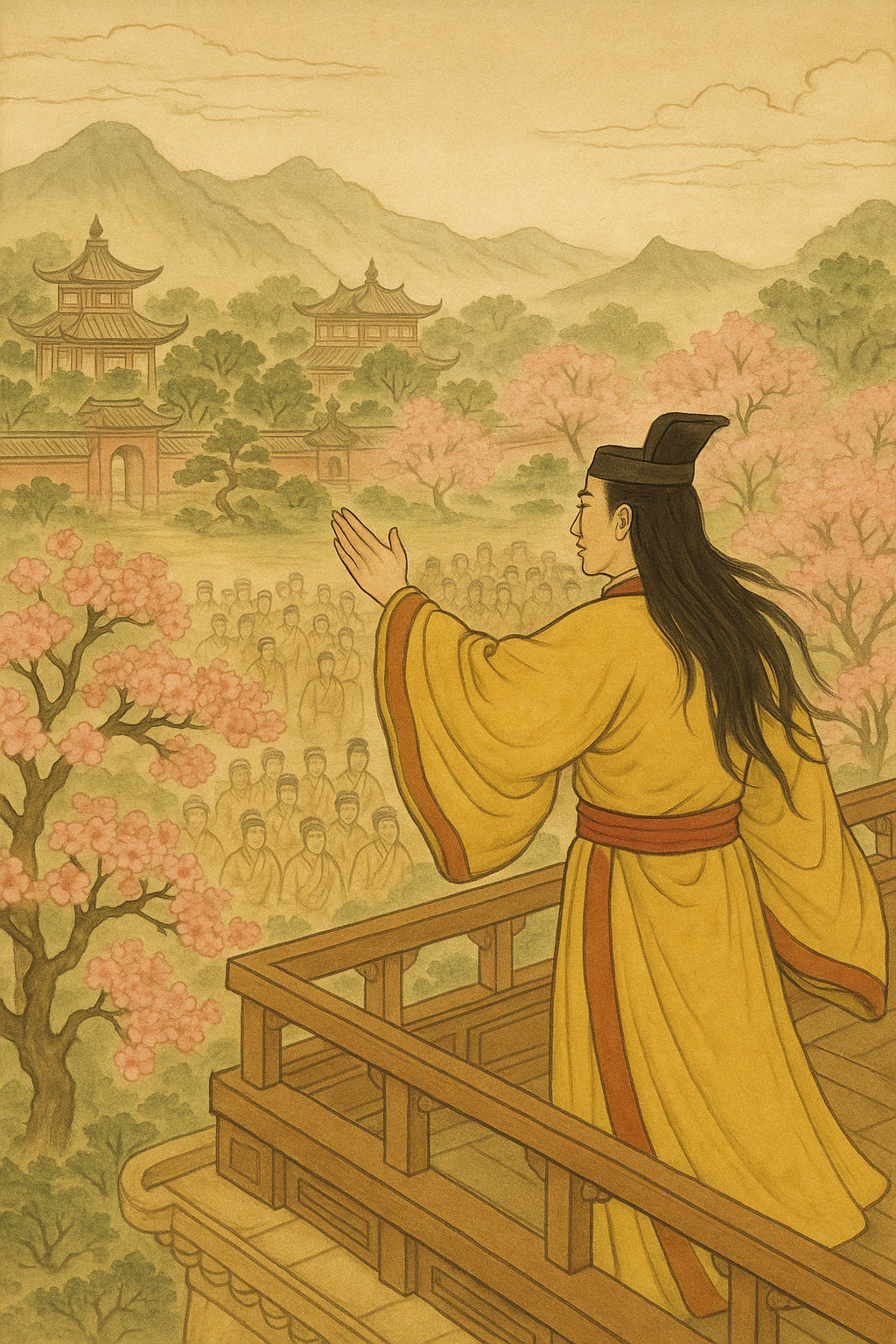

He feels his hold on power growing soft, so he tightens his grip. He grows wary of succession. Questions in council grow sharp, and he rewrites old laws — not to be more just, but to preserve his influence. His greatness has not vanished, but now it counsels agression and control rather that generosity and growth.
Yang's smoldering paranoia begins to burn too hot (Dàshǔ 大暑 ). The more he clings, the more the fire turns inward. Ministers walk in fear. The once-lively court grows hushed. Where once he inspired, he now watches shadows on the walls, convinced they conspire against him.
What he built now feels fragile, something easily taken by a greedy successor, and the weight of preserving what he has made presses heavily on his shoulders. His sons whisper in the corridors. He hears their voices, but never their words, imagining them discussing how to take his throne and cast him out. His meals are tasted three times. His sleep is broken by dreams of the scrolls detailing his mighty deeds burning to ash — the smoke obscuring his vision and leaving him in darkness.
He lashes out, throwing goblets and shouting in anger. He storms through halls in the dead of night. The land dries, fires spark, storms become violent. Crops wither. Even the sky grows weary of his rage.
He begins to consider darker things -- rewrites to the rules of ascension; purges of his heirs and theirs. His legacy looms large, but he can no longer see where it ends and he begins.
In a quiet corridor of the palace, a child coalesces from the darkness and a mild evening breeze. She is barely more than a whisper: Yin reborn. Not the old Empress, but her descendant. She wears no crown. She carries no sword. But her presence cools the air.
When she takes the Emperor's hand, something stirs deep within him—an echo of a memory, soft and piercing. He sees the old Empress Yin, his grandmother, as she once was: her steady gaze, her warm bowls of broth, her hands wrapping his in silk. He remembers the way she ruled—not through command, but through presence.
The child does not speak. She does not need to. Her silence contains the weight of lineage, the rhythm of seasons, the calm inevitability of change.
Yang looks into her eyes and realizes that the changes he has been fighting are not a threat, but are part of an infinite continuity. The shifting focus is not erasure, but remembrance. His fire, long untamed, begins to settle. The roar within him quiets to his own steady heartbeat. The raging heat in his chest gives way to a soft, aching warmth.
He weeps—not in despair, but in relief.
And he begins to fade.


The season turns and Autumn begins (Lìqiū 立秋). The whole empire’s posture changes, becoming softer as its leader shifts. Yang no longer commands attention, but walks with quiet dignity. He has rescinded his violent orders and made space for child Yin's training and encouragement. He watches her growing stronger. Yin asks questions. She studies the stars and the scrolls. Her mind is sharp. Her movements graceful. The court begins to notice her—not as a novelty, but as a presence.
For some people in the court, Yang's decline feels like a loss. They miss his vibrancy, his potency. But Yang reminds them that this is not a time of mourning, but of transition. As Yang fades, Yin blossoms. Her elegance deepens. Her voice is low, steady. She is a student of history and a keeper of lineage. She walks with her grandmother’s memories in her blood.
This is not the end of Yang. It is the maturation of Yin.
Yin ascends to the throne as Winter begins (Lìdōng 立冬). There is no parade of trumpets, no grand decree—only the silent, seamless knowing of the court. She does not seize power. She inhabits it. Her posture carries the gravity of the ancestors. Her crown is delicately woven silver studded with opals and saphires. Her presence is cool and luminous, a lantern in a long corridor.
Under her rule, the palace deepens (Xiǎoxuě 小雪). The music grows slower, more intricate, more complex. Dignitaries speak in lower tones. Rich foods—root vegetable stews, glutinous rice, spiced broths—are served with quiet reverence. She recalls the lineage of rulers past, weaving their memory into her counsel.
Yang, now fully faded, lingers only in warmth—by the hearth, in dreams, in the firelight of her gaze.


In the deepening dark of Winter (Dōngzhì 冬至) the palace glows with lantern light. The air is cold, but the halls are full. Empress Yin presides over a court rich in song and ceremony. Musicians play ancient melodies. The scent of braised meats and warm grains fills the air. Elders share stories beside braziers. Children recite poems beneath embroidered banners. Time slows.
There is no shouting, no striving—only a deep, reflective stillness. A quiet majesty. Her reign is one of nourishment, memory, and depth. She gathers the past into the present like a cloak and wears it lightly, beautifully.
Yet even after Solstice, Yin's power expands. The days remain short, the wind sharper (Dàhán 大寒). Snow thickens on the stone steps of the palace, and frost etches the windows with delicate, unspoken truths. Her court grows even quieter, not with absence but with reminiscence.
Yin moves through the chambers like a dream remembered. Her presence invites silence, reflection, restoration. It is a time of keeping close, of drawing inward, of sitting with what is real. The foods are darker now—black sesame, fermented beans, strong teas. The songs echo farther in the cold, their notes clinging to the walls like stories.
She does not seek stimulation, only stillness. She does not resist the coming end. In this, she is different from Yang. She will not fight the fading of her influence, because she knows it is not an ending. It is a return.
And in the quietest room of the palace, she watches the hearth. And at its center, a single ember stirs again.
The cycle begins anew

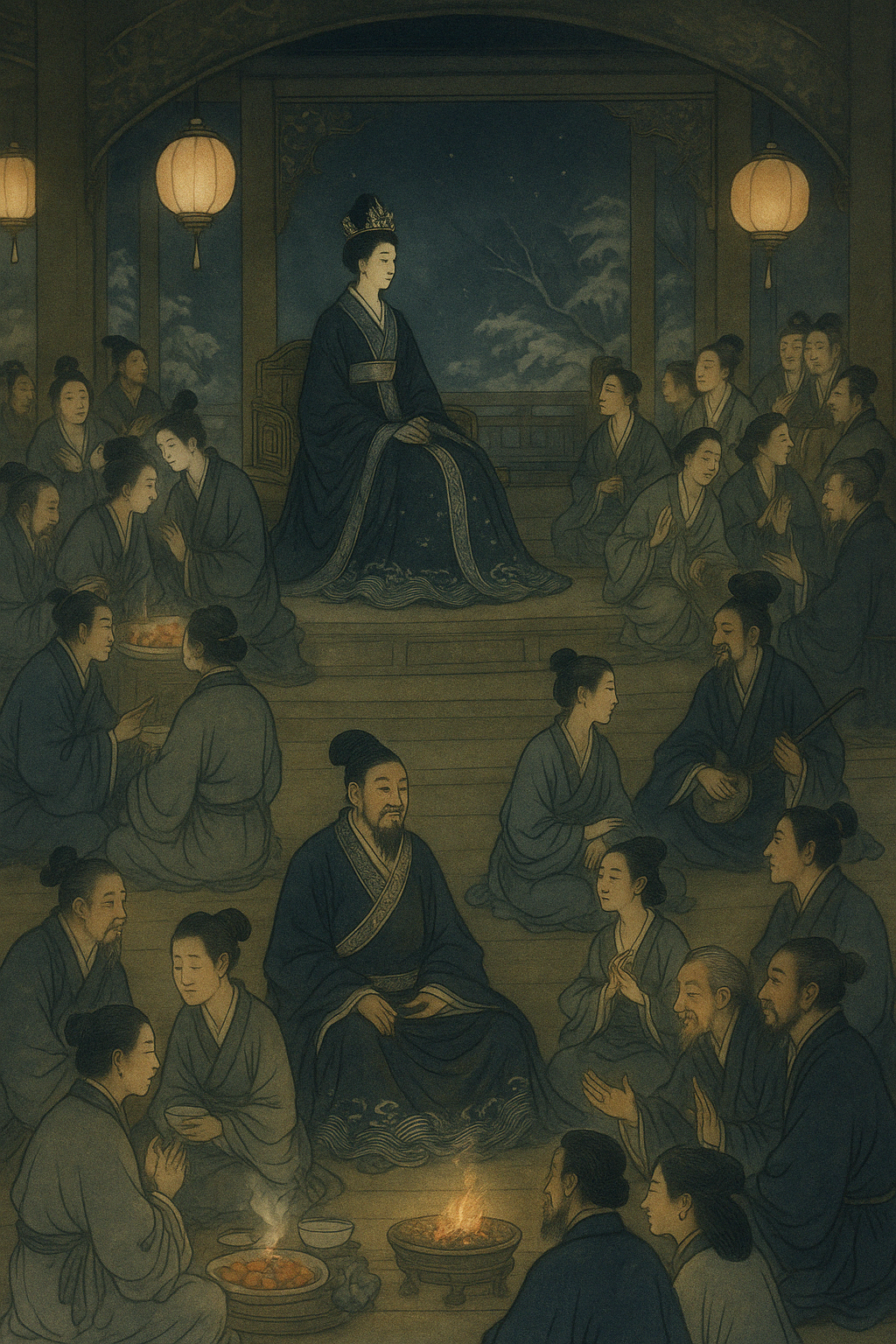
The Whole Story


What Can We Help With?
Many people are surprised to learn how much Chinese medicine can treat. At Root and Branch, we support everything from chronic issues to acute illnesses, stress to digestion. We may not be primary care on paper—but we’re here to be your first call when something’s not right.
There is a moment we see often in clinic. It usually happens between the second and third visit, during a quiet pause between questions, or sometimes after the first few needles are placed. The patient exhales, softens, and says something like, “I didn’t know you could treat this.”
It’s a common misunderstanding. Many people believe that Chinese medicine is only for back pain, stress, or problems that have not responded to anything else. That it is a last resort, or something to try when nothing else has worked.
But Chinese medicine is much broader than that. While we are not considered primary care providers in the legal or conventional sense, we often function in that role for our patients. We are the person someone calls first, the one who tracks the bigger picture, and the one who remembers the story—not just the symptoms. For many people, that feels like primary care. Because it is care that comes first, and it considers the whole person.
We treat pain, of course—back pain, headaches, neck tension, joint aches. But we also treat the quieter things: the digestion that has never felt quite right, the sleep that comes but doesn’t hold, the cycles that are irregular or painful, the hormones that feel off. These are the kinds of issues that may not show up clearly on lab work, but still affect day-to-day life.
We often support people through the in-between times. When you are not acutely ill, but not quite well either. When things are not “urgent,” but they are persistent. We see people with low energy, foggy thinking, fluctuating digestion, lingering fatigue, or recurrent infections. These concerns may not seem serious at first, but they can quietly interfere with your quality of life. We work to help shift those patterns in a lasting and gentle way.
We also treat acute conditions—colds, coughs, stomach bugs, seasonal flus. Some people come in at the first sign of something, hoping to recover quickly or avoid antibiotics. Others come in afterward, when a lingering cough or fatigue will not go away. Chinese medicine can help at both ends of that process: it supports the immune system, clears what the body is having trouble resolving, and helps people return to a place of ease.
We treat cycles—menstrual, emotional, seasonal, and those that arise from major life changes. We work with people during menopause, postpartum recovery, chronic stress, and fatigue that builds from years of doing too much. These are slow processes. We meet them with patience and consistency.
We approach anxiety not as something to be erased, but as something to be understood. We treat it by working with the nervous system, the breath, and the body’s deeper rhythms. We don’t promise to “fix” anxiety. But we can help regulate the systems that underlie it. That work is meaningful, and often transformative over time.
Our medicine is not built around quick fixes, although sometimes relief comes quickly. Most of the time, change is gradual. We listen, we track, and we respond. We pay attention to how the body speaks through patterns, timing, and symptom clusters. We are not just looking for what hurts. We are trying to understand why now, and how it all fits together.
If you have ever wondered whether Chinese medicine could help with what you’re experiencing, the answer is probably yes. Not because it is a cure-all, but because it is a system designed to understand the whole of a person. It meets you where you are and works from there.
Some people come in with one clear concern—headaches, reflux, painful periods. Others come in with a collection of things that seem loosely connected—fatigue, poor sleep, low mood, or trouble focusing. Some come in because they want to feel more like themselves, more balanced, or more steady. All of that is welcome.
You do not need to have a diagnosis to start. You do not need to explain everything perfectly. You just need to have the sense that something could feel better, and the openness to explore that with us.
So what can we help with?
Quite a lot.
And if you are not sure whether your concerns fit, that’s okay too. Reach out. Ask. Share what has been going on, even if it does not fit neatly into a category. We are here to listen.
We may not carry the title of primary care provider, but many of our patients rely on us in that way. We are here for the long-term relationships, not just the acute flares. For the slow improvement, not just the symptom management. For the full complexity of your life, not just the parts that feel medically urgent.
That is the kind of care we offer. And for many people, it is exactly what they have been looking for.

What They Came In For: Pain from an Motor Vehicle Accident
After a car accident left her with lingering neck and shoulder pain, Sara M. tried everything—chiropractic, physical therapy, rest—but nothing seemed to work. Then she came to Root and Branch. This is the story of how things finally started to shift, and what real care can feel like.
When Sara M. first came to our clinic, she didn’t have high hopes. Not because she didn’t believe in Chinese medicine—she just didn’t believe anything was really going to help.
Three months earlier, she had been in a car accident. It wasn’t major, but it was enough to jolt everything. Her neck had snapped forward, her shoulder jammed tight on impact. At first it felt like soreness. A few days later, it turned into a kind of constant stiffness, and within a week it was pain—sharp, stubborn, and spreading into her upper back and arm. She couldn’t sleep well. She couldn't sit through meetings. Driving triggered it. So did picking up groceries. So did reaching behind her to grab her seatbelt.
She did what most people do. She saw her doctor, who referred her to physical therapy and gave her muscle relaxants. She tried chiropractic. She iced it. She stretched. She rested. And still, day after day, she felt like her body was stuck in some kind of aftershock.
“I just felt like I was doing all the right things,” she told us during her first visit, “and nothing was changing.”
By the time she found her way to Root and Branch, she was exhausted. Not just physically, but emotionally. She was tired of retelling the story, tired of appointments, tired of feeling like her pain was being treated like a problem to solve—rather than an experience she was still stuck inside.
We began, as we always do, by listening. We asked her to describe what she’d been feeling—not just the pain, but the ways it had changed her day-to-day life. We had her move her head and arm in a few different directions so we could see what hurt and what didn’t. Simple movements that, in her case, were no longer simple. Turning her head was difficult. Lifting her arm made her wince. Even breathing deeply seemed tight.
We gently pressed around her shoulder and upper back, not just to find the painful spots, but to understand how her body was holding the tension. Muscles that should’ve been moving freely felt locked down, like they were guarding something. Her body had been trying to protect itself for months—but now it didn’t know how to let go.
We asked about her sleep, her digestion, her energy, her stress—not because those things were “the real cause,” but because pain always has context. And part of our job is to understand the full picture.
Then we treated her.
We used acupuncture to settle her nervous system and help the muscles around her neck and shoulder begin to release. We added a few points to improve circulation and reduce inflammation, and supported the places where her body was still bracing.
After the needles came out, we did some gentle bodywork—a few small, slow movements to help her shoulder and upper back remember how to move without pain. We used a technique called counterstrain, which helps tense muscles relax by putting them in a position of comfort. Nothing forced. Nothing intense. Just a quiet invitation to soften.
We sent her home with an herbal formula to support her healing between clinic visits, and a few simple breathing exercises—not to stretch or push anything, but to give her nervous system something steady to follow. A new rhythm.
When she came back a week later, her eyes were wide.
“I can’t believe how much better I felt,” she said. “Even after the first appointment. I felt clearer. My pain wasn’t gone, but it felt like something had shifted. Like my body had finally exhaled.”
Week by week, that shift deepened. The tension unwound. The pain softened. Her sleep improved. The headaches she hadn’t even mentioned at first started happening less often. She started feeling like herself again.
It wasn’t instant. It wasn’t linear. But it was real.
And more than that—it felt like someone was finally treating her, not just her pain.
We love stories like Sara’s not because they’re miraculous, but because they’re so common. Many of our patients come in with pain that hasn’t responded to other forms of care. They’ve seen multiple providers. They’ve done the protocols. And they’re still hurting—not just in their bodies, but in the quiet places where frustration lives.
What makes Chinese medicine different isn’t just the tools we use—it’s the way we use them. With attention. With curiosity. With the understanding that the body wants to heal—and that sometimes, it just needs a new kind of invitation.
If you’ve been stuck in pain, and you’re not sure what’s next, we’re here. We may not be your first stop. But we can be the one where things finally start to shift.

Qi Node 1: 立春 Lìchūn (Spring Begins)
This first qi node of the year is not a season, but a threshold. A moment when the frozen ground stirs, and the world begins to breathe again. In Chinese medicine, it marks the return of Yang, the reawakening of Wood energy, and the slow stretch toward growth. Not all at once. Not with urgency. Just enough to remind us: change is already underway.
When the Ice Cracks and the World Begins Again
It’s quiet, but it’s not still.
Lichun arrives each year not with fanfare or dramatic transformation, but with a subtle shift. A sense that something has changed—barely perceptible, but undeniably present. It’s the first qi node of the new year in the Chinese lunisolar calendar, often translated as the “Beginning of Spring,” though that translation doesn’t quite capture its nuance. It’s not yet Spring in the way we often imagine it, full of blossoms and warmth. It’s something earlier, more tentative. A soft return to movement after the long exhale of winter.
There’s something sacred in that subtlety. Lìchūn marks the beginning of upward motion, of Yang returning after its deep winter slumber. And in a world that often celebrates only the boldest gestures of change, it’s worth pausing to acknowledge the importance of these smaller, quieter beginnings.
While the weather may not yet embody the change, nature is already in motion. Beneath the frozen ground, roots are waking. Tree buds, though still tightly curled, are starting to form. Migratory birds begin their subtle shifts, sensing what we cannot yet see. The days, just barely, stretch a little longer. Lichun isn’t a season—it’s a moment. A threshold. One we often miss if we aren’t paying attention.
This phase corresponds to the Wood element in Chinese medicine—a phase characterized by growth, movement, and vision. But like all beginnings, this movement is not without its discomfort. Think of it as the feeling in your body when you’ve been curled up too long and start to stretch: it’s awkward, maybe even a little painful, but it feels necessary. There’s a restlessness here, a desire to begin moving forward, even if you’re not quite sure where you’re headed.
This is the energetic mood of Lìchūn. An invitation to engage, to begin emerging from stillness—but gently, without rushing.
On Not Forcing Spring
It’s tempting to respond to any New Year—or new beginning—with intensity. Set goals. Make plans. Transform everything all at once. But Lichun teaches something different. It suggests a slower rhythm, one aligned with the barely waking Earth rather than our cultural drive for instant reinvention.
If Winter has been a time of reflection and conservation, Lichun is the first stretch toward renewal. Not with force, but with curiosity. It’s a time to notice what ideas or desires are beginning to stir. What has been incubating during your quieter months that might now want light?
In Daoist thought, and particularly within the framework of Chinese medicine, health is not something we chase with discipline or self-denial. It’s a relationship we tend, slowly and consistently, through alignment with the natural world. And this time of year is not about dramatic action—it’s about orientation. It’s about feeling where the new growth wants to emerge.
Rather than charging ahead, this season invites us to take stock. To ask ourselves, softly, where we’re headed. And more importantly, why. The energy of Wood longs to move forward, to grow, to create. But it moves best when it has direction—not rigid, but intentional.
We often associate Spring with cleaning, with purging, with detoxing. But Lìchūn doesn’t require us to be harsh. The impulse to "clear out" is natural, but the method can be gentler. What we’re really doing is making space—for movement, for vision, for change. And just like in nature, not everything needs to be uprooted at once. Some things need to stay a little longer, to finish breaking down, to become part of the fertile soil of what comes next.
What To Do:
This early part of the year is a beautiful time to align your daily habits with the returning energy of the world around you. Here are some ways to step into the Lichun season with care and intention:
Move with Purpose, Not Pressure
You don’t need to launch into an intense exercise routine right now. Instead, look for movement that feels like a stretch—not just physically, but emotionally and energetically. Gentle yoga, long walks in changing weather, qi gong, or just a few minutes each day of free movement to music can help your body re-engage with flow after winter’s stillness.
If you can, move outside. Even if it’s brisk. Just don’t work up a sweat exposed to the elements. Let your body feel the season, and let your senses begin to wake up with it.
Support Your Digestion with Seasonal Foods
As your internal systems begin to re-activate, your digestion will appreciate foods that are both warming and gently activating. Light broths with scallions and fresh ginger, young greens sautéed with sesame oil and rice vinegar, and lightly fermented vegetables can support your Liver system and help encourage healthy movement of qi.
This is also the time to reintroduce a bit of sour flavor into your meals—lemon, vinegar, pickles—all of which help stimulate the Liver’s transformative function. Think less “cleanse” and more “tend.”
Make Space, Not War
You don’t need to deep-clean your entire home or empty your closet Marie Kondo–style. But consider clearing one small area: a corner of your desk, your nightstand, your kitchen table. Not to punish yourself for winter’s messiness, but to open a little room for something new. Lìchūn is a great time to begin rearranging—not just physically, but mentally. Reassess what commitments, obligations, or assumptions might need a little pruning.
Reconnect with Vision
In Chinese medicine, the Liver is associated with both physical vision and our capacity for long-term planning and dreaming. What would it look like to gently reawaken your sense of direction—not as a set of goals, but as a feeling tone? Maybe it's a color. A landscape. A phrase. Something that points you toward growth without demanding it.
You don’t have to know the full plan. Just begin to imagine the shape of it.

Enter The Yin Wood Snake
The Yin Wood Snake year winds in softly, asking us to move with quiet purpose. In a world obsessed with doing, this is a year for tending, composting, and deliberate growth. Wisdom won’t shout—it will whisper. And if you listen, you just might hear your own transformation beginning.
Each year in the Chinese calendar is shaped by the layered dance between an animal from the zodiac and one of the ten Heavenly Stems. In 2025, we shift into the energy of the Yin Wood Snake (戌木蛇), and it will be nothing like the year we are leaving behind. If 2024, the Yang Wood Dragon (甲木龙), was a thunderclap—big, bold, and burning with expansive ambition—then 2025 arrives as a whisper. A rustle in the undergrowth. A slow coil. The Snake invites us not to soar the skies, but instead to coil and wait. This contracted posture allows us to think and to digest our experience as we plan for what comes next, ultimately shedding what needs to go in order to get where we want to be.
Snake Years
Snake years are subtle. There is wisdom in them, but not the kind that announces itself loudly. This is a year of behind-the-scenes intelligence, of coiling inward to examine what lies beneath the surface. In Chinese cosmology, the Snake is refined, strategic, and deeply internal. It listens before it moves. It calculates, and it waits.
And so in Snake years, things tend to shift quietly. What looks like inaction may turn out to be transformation. What seems like distance might be discernment. The Snake does not waste its energy and neither should we. This is a year for planning more than leaping, for cultivating personal refinement, and for seeking transformation through discipline and grace.
This is also a year that may feel at odds with the dominant cultural current in places like the United States, where action, productivity, and forward momentum are often equated with success. Our culture doesn’t always have patience for the slow turn inward, for the pauses between breath. And so we may see a rising tide of existential discomfort—feelings of stuckness or inadequacy not because something is wrong, but because we are being asked to move in a rhythm that diverges from the one we’ve been conditioned to chase.
Trying to force a Snake year into the mold of linear productivity is like yelling at a seed to sprout faster. It only leads to frustration, burnout, and deeper disconnection. In a society where doing is everything, learning to simply be—strategic, slow, reflective—can feel destabilizing. But that dissonance isn’t a sign of failure. It’s the edge where something deeper might take root. That quiet edge, though, can feel sharp if we’re not ready for it. The discomfort of slowing down, of listening rather than producing, can stir a kind of unease that’s hard to name. It’s in that stillness, in the space between doing and being, that things begin to stir.
Snakes can be secretive. Withdrawn. Prone to second-guessing. They might hold their tongue too long, or hide things even from themselves. And when the emotional pot does boil over, it's often because pressure has been building in silence for too long. A Snake year can bring tension just beneath the surface, especially if we try to force things to move faster than they want to.
But if we move with the rhythm of the year—if we learn to follow its slow, elegant arc—there is so much to gain. Real change. Quiet strength. A sense of clarity that comes from discernment.
Yin Wood
The elemental influence this year is Yin Wood (戌木), sometimes imagined as bamboo, a vine, or a blade of grass. It is not a mighty oak or a towering pine. It is the kind of growth that adapts, that bends, that seeks the light even in difficult places. Yin Wood is quiet, but not weak. It is enduring. Patient. Inwardly alive.
Yin Wood doesn't force. It finds its way. It teaches us that resilience isn't about rigidity; it's about the ability to move with grace even when conditions aren't ideal. It invites us to stretch gently toward what nourishes us and to let go of what no longer fits.
So this year, Wood gives us the urge to grow, but Yin tempers that urge with softness. Instead of pushing forward, we may find ourselves curling inward, composting old ideas, tending to the roots of projects and relationships we started in flashier, louder times.
The snake year, as all of the animals in the zodiac, carries its own elemental signature of Fire and each of the elements have relationships to each other — come controlling and limiting the force of another (controlling relationship), while others augment the potency of an element (the mother relationship), while yet others can siphon the intensity of an element (child relationship). Wood is the mother of Fire, and so there is a tendency for the Heavenly Stem of this year to increase the strength of Snake’s intrinsic qualities. That force multiplier is not as strong as if it were a Yang Wood Stem (dry hardwood certainly adds more to a bonfire than grass) but it encourages the fire nonetheless. Thus, Snake and Yin Wood together create a particular flavor: strategic but flexible, wise but quiet, constantly growing but rarely in ways others can see.
The Shift from the Dragon
Last year, the Yang Wood Dragon ruled the skies. Dragons are always big and bold. They are the only celestial creature in the Chinese zodiac and they are deeply connected to history, knowledge, and the omniscience of Heaven. Dragons have plans written with a cosmic viewpoint and so they have a tendency to not take much of our human needs into consideration. That power is often leveraged in a Dragon year for great changes but it can also feel like people are being steamrolled by unfeeling change. So, last year was largely made of bold moves, rapid expansion, high-stakes plans, and vision boards so large they barely fit on the wall. Some of those visions bore fruit. Others burned out under their own intensity. The Dragon was full of purpose and forward motion, but it left many people scattered, tired, and unsure where to land. The Yang Wood of last year also had a containing effect on Dragon (Earth is the Dragon’s element and Wood Controls Earth), so you can only imagine what it would have looked like if we were in a a Fire Stem and that qi would have fed the Dragon’s most intense impulses…
Now comes the Snake, asking us to come home to ourselves. To narrow the focus. To reflect, refine, and move with care. If the Dragon was about declaring your kingdom, the Snake is about asking who you really want in it. If the Dragon pushed everything into motion, the Snake invites a long, deliberate exhale. Snakes are not social or particularly compassionate zodiac animals. They are reflective but not introspective. They love pondering, exploring, and wondering at the movements of the universe but they are not particularly interested it what that all means for them, just what it might mean in general. In many ways, Snake qi is a fitting successor to the Dragon because Snakes are still not particularly concerned about human affairs or needs, they are just way less intense about it: What might it all mean? But do we need to be so loud about the search?
This year asks: What have you begun that now needs pruning? What relationships or ambitions were sparked in the fire of last year but now require patience and tending? What needs composting before anything else can grow?
This is a shift not just in pace, but in direction—from expansion to integration, from speed to stillness, from action to contemplation.
Health in the Snake Year
The body this year may speak more softly but more insistently. Tension that used to be tolerable now demands address. Fatigue that once passed with a good night’s sleep might linger. Our nervous systems are more tender, our digestion more reactive. The Liver system, in its yin wood expression, reminds us that not all movement is visible. Circulation, emotional clarity, and subtle regulation matter more than big performances of health.
We might find ourselves more sensitive to the effects of stress. There may be more headaches, tight shoulders, vivid dreams, or digestive murmurings that point to emotions needing expression. This isn't the kind of year where powering through works. The body wants partnership, not domination. It wants us to listen early, adjust often.
This is a good year for quiet restoration. Bitter greens, slow walks, acupuncture that opens the channels without stirring up chaos. Qigong over HIIT. Broths and teas that gently move and warm without overstimulating. Health this year is less about conquering symptoms and more about cultivating conditions in which vitality can quietly return.
Emotionally, Snake years can be complex. Feelings that have been lingering below the surface might rise, but not always with clarity. There is a tendency to circle, to revisit, to hold things close before they are named. It can feel introspective, even isolating, if we’re not prepared. There may be a sense that no one fully understands what we’re going through. And sometimes, that’s true—because we ourselves are still trying to understand it. This is not a year for emotional performativity. It’s a year for honesty, and that kind of honesty often takes time.
That said, it's also a year of tremendous psychological insight. Therapy, journaling, dream work—these are not just supportive, they are aligned with the spirit of the time. The mind wants depth this year. It wants to untangle old threads and find meaning.
You might find yourself needing more solitude, or more time with people who can hold complexity without trying to fix it. The best friendships and partnerships in a Snake year are often the ones where presence matters more than words. Snake energy doesn't care much for surface-level socializing. It wants connection, yes, but it wants real connection. The kind built on shared values, long conversations, and quiet trust.
This may be a year when certain relationships fade, because not all connections are meant to be carried forward indefinitely. And other relationships will surprise you by deepening unexpectedly, often in moments of stillness or shared reflection. Love may look less like fireworks and more like steady warmth. Friendships may become fewer, but more essential. If you're building new connections, give them time. The Snake does not reveal itself quickly, and neither should you.
Moving With the Year
The Yin Wood Snake doesn’t want you to hide. It wants you to become intentional. It wants you to choose your direction deliberately, to move through the world with presence, and to trust that slow growth is still growth.
Let this be a year of tending. Of coiling inward when needed, and then expanding with care. Of taking the time to ask yourself not just what you want, but what actually nourishes you.
Let yourself be strategic without becoming hard. Wise without becoming cold. And most importantly, let yourself be soft where it counts. Resilient in the quiet, supple in the unseen. Because just like the Snake, your transformation this year may not look dramatic to the outside world.
But it will be real. And when the time comes to shed your skin, you’ll know you’ve grown exactly as you needed to.
This is a year to write the plan, not announce it. To whisper truths into your own ear before offering them to anyone else. To see your own internal rhythm as sacred—and trust that those who matter will attune to it. You don’t have to be loud to be strong. You don’t have to be fast to be wise. Give yourself permission to pause, to reflect, to grow at your own pace. Make space for daily rituals that return you to center—lighting a candle, brewing herbs, walking under the trees. Stay close to the things that help you listen.
If last year burned too hot, let this year be a balm. If last year asked too much, let this year give you back some of what you lost. We are not predicting the future when we write about the qualities of a year. Human activity and choices can always seem like they are disconnected from the Qi of any given year, as if that year is not holding up its end of the bargain. But the rhythms are always there, and how we relate to them, how we cultivate our conduct in alignment with those rhythms, is the only real metric of success in any given year.
If you’ve been moving too fast to feel anything at all, let the Snake wrap around your shoulders and remind you: wisdom takes time. So does healing. So does trust.
Welcome the Snake. Let it show you how powerful it is to be quiet. How healing it is to move with care. How whole you already are, when you stop trying to be something louder than yourself.
May it guide you with grace.

To Sleep Like A Baby
By
Travis Cunningham LAc. MSOM DICEAM
(The Elusive) Good Night Of Sleep

How long has it been since you’ve had a good night of sleep? Can you remember what it was like?
Do you remember falling asleep? Staying asleep? Or, how you woke up? Do you remember the dreams you had? Or, do you only remember the feeling of restfulness upon waking?
One of the most challenging things to consider when we contemplate sleep, is just how unconscious a good night of sleep can be. We require nothing to sleep well. All humans must sleep. But how much? And, to what quality? What is required and what is optimal? What does sleep do for us? And, how can sleep be corrected if it becomes problematic?
If we take the basic premise that sleeping well is a natural process, we encounter our first problem…
“If a good night of sleep happens unconsciously, how can we consciously change it?”
And thus, (the internet) spawns a million suggestions. Searches, studies, science - all seeking to answer the same basic questions.
One of my teachers used to say that “if we look at the disease, we will find one thousand medicines to treat it. But, if we look at health, we will find only one cure.” Before we can learn to treat a problem, we must first understand what it is like to have no problem. So, what is healthy sleep?

Defining Healthy Sleep
The first thing that one might notice in the analysis of healthy sleep is that sleep - all sleep, is a rhythm. Just like breathing, eating, urination, defecation, movement and rest, sleep is a rhythmic process. When a person generally sleeps well, one night of poorer sleep doesn’t bother them so much. When a person generally sleeps poorly, one night of good sleep doesn’t benefit them so much. Many people who have chronic insomnia will actually report that they feel worse, when they (rarely) get a full night of sleep. We can make sense of this fact with the simple understanding that sleep is rhythmic. And, the effect of a single “beat” of sleep, is not nearly as impactful as the timbre of a repeated rhythm.
When we compare sleep to other rhythms, like eating, we find that sleep is a longer rhythm. Sleep is longer; both in the time that it takes to engage in, and the time that it takes to influence as a habit. When we are younger, we can live with poor sleeping habits for a longer period of time without feeling the negative effects on our vitality. As we age, poor sleeping habits catch up with us more quickly and become much more difficult to correct once they are set. In the traditions of East Asia, this is explained by the concepts of Yin and Yang.
In youth, we are more Yang. We have access to more energy and are able to make changes in our lives more easily. As we age, we become more Yin. We become more stable, (hopefully) more grounded and wise, but with less capacity to quickly change and shift. It is advised that we establish good habits when we are youthful because it is easier to keep these habits as we get older. While I believe that any habit is changeable at any stage life, sleep is a rhythm that is easier to correct in our earlier years.
It is important to discuss the longer rhythmic nature of sleep right away because if we wish to change a longer rhythm, we must expect that it will take a longer period of time to shift than other activities. When I work with adults in the clinic for sleep, I tell them to expect that it will take a minimum of three months to shift the basic pattern and possibly longer if there is a standing history of insomnia. Good sleep takes time. It takes effort to create a positive sleeping habit, before good sleep can become effortless once again.
Sleep & Time
Sleep, just like any rhythmic process is inextricably connected to time. The connection to time has two aspects. First, we have the duration or amount of time a person is sleeping within a day or night. Second, we have the time during the 24 hour day that a person chooses to sleep. While at first, these two aspects of time seem to be separate topics, at a closer glance we will find that they overlap and influence each other.
In East Asian medicine, there is a keen interest in the efficiency and quality of nature. Ancient people observed that all creatures followed the circadian rhythms of day and night. Human beings tended to sleep during the night time and stay awake for most of the day. Humans generally followed the cycles of the Sun, and were more active when the Sun radiated its light from the sky.
As human beings evolved with the Sun’s cycles, our physiology “learned” to become more efficient when we follow them. We have naturally more energy to act during the day and more proficiency to restore ourselves through resting at night. In modern times, we can easily live outside of or contrary to these natural rhythms. But we inevitably pay the price through inefficient restoration and a challenged expression of vitality.
Many modern people may push against the idea that for optimal vitality, we must adhere to the circadian rhythm - resting and waking with the cycles of the Sun. These people may insist that they feel better staying up late at night, and waking in the late morning or early afternoon. I can honestly say that I have not (yet) seen a single person in clinical practice to make this claim who has not obviously damaged their health because of it. Sleep, as we saw before, is a longer rhythm. It is harder for most people to see the damaging effects of an inefficient sleep habit in the short term. But over the course of weeks, months and years, the deficit will show itself.
So what does a sleep deficit look like? For some people, it can simply mean that they require more hours of sleep to function normally than they might. The lack of efficiency in restoration means that the body needs more time to recover than it could otherwise. In traditional medicine, we think of a healthy sleeping habit to (generally) require between 6-8 hours of sleep within a 24 hour cycle. Most people trend closer to the 8 hour mark with what they need, then the 6 hour one. This need can also fluctuate with the seasons - trending a bit longer in the winter and a bit shorter in the summer.
Problem One: Needing More Sleep

If a person finds that they need more sleep than 8 or 8.5 hours to feel rested, it is a sign that their sleep is inefficient or in deficit. I’ve treated patients who claim to need 11 or even 12 hours of sleep per night to feel rested. This is a sign of a profound deficiency of vitality that the body is trying to rectify by sleeping more. In traditional medicine we would say that the body is having a difficulty storing its vitality. The need to sleep for this many hours obviously effects the person’s daily life. I’ve also noticed that a huge percentage of these patients struggle with depression. In these cases, there is good news. If we can help to restore their vitality, the person will generally need fewer hours of sleep and their depression will either lift or at least be less problematic for them.
In East Asian medicine, we see this pattern of sleep coincide with feelings of cold in the body, weak digestion and malaise or fatigue. We call this Yang deficiency with Yin sinking. The warm and active quality of Yang is deficient and unable to transform or utilize the nutritive substance of Yin. This Yin substance “sinks” in the digestive tract, causing looser stools and a general feeling of heaviness in the body. The remedy for this pattern is treatment which targets warming the Yang, making it strong enough to transform the Yin substance and lighten the body.
Problem Two: Being Unable To Sleep
The other possibility for inefficient sleep or sleep deficit, is that a person may be unable to sleep or unable to sleep deeply. These people generally learn to sleep for fewer hours than the 6-8 that is considered normal or healthy. They basically never sleep well or feel rested, but may report feeling worse when they (rarely) do get a decent night of sleep.
While this may appear different than the first type of problem, it is actually the same. Both problems come from inefficient sleep or a lack of restoration. In East Asian medical diagnosis, I find that most of these patients still qualify as Yang deficient. In these cases the Yang is not only deficient, but also floating. These people can tend to have an overactive mind when they lay down to sleep, feel warmer at night or experience night sweating and have very vivid dreams. Underneath the superficial heat, there is cold. Sometimes you can feel this cold when you touch their feet or lower abdomen, especially when compared to the temperature of the neck.
These people would be treated differently than the first type, given that their presentation is not the same. I find that working with these folks can be a bit more challenging, because they will often feel more tired when we start treatment. These feelings of tiredness are often what they have been avoiding during the day, by use of stimulates or stimulating activities. Unfortunately, they must begin to feel their body’s fatigue in order to restore their vitality through sleep.

Can It Change?
In every case of insomnia, inefficient sleep or sleep deficit that I’ve seen thus far, the answer has been yes - it can change. The more important question is how much of a priority is the person willing to make their sleep? Sleeping well is a by-product of living a life where good sleep is possible. If we live contrary to the body’s natural rhythms, we cannot expect our sleep to be efficient or restorative. But if we are willing to change, so can our sleep. So how can we get our sleep back on track?
Step One: Empty The Stomach
A famous Chinese medicine doctor once said, “if a person tells me that they have a problem sleeping (any problem sleeping), I tell them the same thing: No food after dark. If they can adhere to this rule alone for two weeks, about 60% of sleeping problems will resolve.”
This one sounds a bit strange at first but when we take a closer look, it makes quite a lot of sense. When we go to sleep at night, our heart rate decreases and our body’s surface becomes cooler. A complex chain of events begins to happen involving many organs, nerves, blood vessels and the hormonal system. In East Asian medicine, we call this phenomena Yin ascending, Yang descending or the communication of the Heart (Fire) and Kidney (Water).
If we go to bed and our stomach is still full, our body has to ramp up its metabolism to digest the food. Our heart rate increases, and it can even feel uncomfortable to lay down. When our stomach (Earth) is full, the pathway for the heart (Fire) and kidney (Water) to communicate is “blocked.” This can inhibit the quality of a person’s sleep or even prevent sleep from occurring at all. The first and clearest step to getting better sleep is to increase the amount of time between your last meal or snack and your bed time. I recommend people work toward 3 hours between the two, if possible.
Step Two: Create A Slide

If you have any difficulty getting to sleep, its unlikely that you’ll be able to do so for awhile without a routine before bed. So create one. This routine will look different for every person. But the routine should include the general feature of moving from more activity to less. I call this “creating a slide.”
Keep in mind, that by activity, we don’t only mean physical activity. Modern people are less and less physically active as our work becomes more closely engaged with technology. For some of us, our evening routine may need to include physical movement to release the activity in our nervous systems. There are many great practices for this - from gentle Qigong, to Yoga. My favorite is actually just walking. Remember the cheesy phrase: Whatever it is that you do to unwind, make sure to include your body and mind.
Step Three: Swing Out To Swing In
Many people have a difficult time sleeping because they lack basic movement or exercise during their day. But by engaging in a short exercise routine, people can dramatically enhance the quality of their sleep at night.
There are many studies that have been done on this subject alone. Some of these studies have analyzed specific data on the cycles of hormones and the assistance that day-time exercise can provide.
In East Asian medicine, we can summarize this phenomena quite simply: Yang activity benefits Yin restoration. Swing out, in order to swing in.
Step Four: Create A Break In The Static
So many cultures around the world take a siesta or a mid-day nap. Interestingly enough, if we look at the times of the day that most cultures take siesta (1-4PM), these are the clock-opposite times that most Americans struggle to sleep at night.
If you ask people about how they sleep, many people who can fall asleep easily will struggle to stay asleep between 1-4AM. East Asian medicine is a medicine that looks at opposites (Yin & Yang). If there is a problem that regularly occurs for someone at 3AM, we might look at adjusting the person’s conduct at 3PM to change it. For example, If a person is regularly waking up at 2:30AM and unable to fall back asleep, one way to change this dynamic would be for the person to take a short nap at 2:30PM. It sounds strange, but it totally works!
Another way to think about the helpfulness of mid-day rest is what I call, creating a break in the static. First, imagine that during the work day, we accumulate stress or a type of pressure in our nervous system. To me, this stress feels like static electricity, so I call it static. As the static builds without a release point, our nervous system continues to get more and more stimulated. If this continues all day, when we reach the day’s end, we may experience the “tired but wired” phenomena. We feel very tired, but we cannot sleep.
By taking a mid-day nap or short resting period, we can provide a natural release valve for our accumulated stress. Now before you instantly write off this idea by telling me that you don’t have time, hear me out. A break even as small as 5 minutes can significantly shift the state of accumulated stress within the nervous system. I’ve worked with all types of busy people. If you prioritize it, you can create the time.
What can you do with this time? The best thing that I’ve found, short of a quick nap is a mindful breathing practice or a shaking exercise (scroll down the page to see the exercise). If you make the time and participate every day, you will feel the changes.

Step Five: Get Help
If you’ve been struggling with your sleep for a long time, or even a shorter period of time, the quickest way to get better is to receive help. I’ve specialized in helping people with their sleep since beginning my training in East Asian medicine. Not being able to sleep efficiently is a huge burden - one that I know from my own experience.
It is possible for your sleep to improve if you are willing to receive help and participate in the process. If you’d like to take the next step, follow the links below to read more about treatment for insomnia or sign up for your first appointment today.
Treating Seasonal Allergies With Chinese Medicine
How to treat seasonal allergies with traditional Chinese medicine.
A Spring In Your Step

Dear reader,
I am writing to you in early Spring. The weather is still cold here. Frost covers the ground at night and is breached by sun in the early morning. It is still too cold to wear a light(er) jacket. And yet, the first flowers have started making their appearance.
As I notice the crocuses waking up on my morning walks, I find myself contemplating the meaning of Spring. In the historic and cultural medicine of China, human beings witnessed the transitions of nature. The qualities that belong to these transitions were described as Qi.
I think people make too much of the term Qi. If we just look at how things move and change, it follows to use a word that describes the quality of this change. That which moves behind the appearance of things, could be a simple definition of Qi.

The Qi of Spring is said to be like wind. Wind is movement or a quicker form of change. In Spring, we transition from the cold Qi of Winter to the hot Qi of Summer. What force can propel such a change from one opposite to the other? Wind. Wind necessitates change. It propels our bodies to find a new balance of adaptation with the environment around us. The Chinese say, that the fluids of our body have to become thinner in Spring. Traditionally, the density of our body’s fluids have to do with their ability to hold heat. In the cold Qi of Winter, the body must have the thickest fluids. In the hot Qi of summer, the body’s fluids must become thinnest. In the Spring then, the fluids must begin their thinning process.
The pressure to adapt to nature is seen as a necessary part of life in traditional medicine. There is no way to become immune to change. A failure to adapt to the circumstances outside of our bodies creates an adversarial relationship with the Qi of nature. This adversarial relationship is called a “strike” in traditional medicine. An external strike against the body is the body’s failure to adapt to the new circumstances surrounding it.
From the perspective of the body, this dynamic feels like the Qi of nature is striking it. It’s important to understand that there is no malicious intent from the Qi of nature. The body simply interprets the change as a strike because it isn’t prepared for the shift. The body then goes into a defensive and adaptive process. This process, we know as disease. In some cases, the form that this disease takes is called allergies.
Allergic to Adaptation
In biomedicine, we understand an allergy to be a reaction from the body’s immune system toward a particular substance that the body comes into contact with. The immune system recognizes this substance as a hostile presence and mobilizes its resources to attack. The following symptoms we are all familiar with…
Itching
Sneezing
Coughing
Phlegm or congestion
Dry/tearing eyes
Dermatological or digestive problems
And more…
Regardless of the type of symptom, traditional medicine views the cause of this disorder to be a failure of the body to adapt. The remedy then, must not only be about treating the above mentioned symptoms, but helping the adaptation process of the body to complete in live time.
If the nature of a problem is adaption, our next question would then be, “how can we aid the adaptation process?” Luckily, there are many answers to this question. Some, are actions we can take ourselves. Others, require aid by a trained practitioner in the arts of Chinese medicine.
A Simple Exercise: Shaking
Many of the ancient practices of China that have been crafted to assist the body and mind to adapt are not esoteric or outlandish. These practices often fall under the category of hygiene. Though, in this context, we don’t only mean getting cleaner. We mean instigating the vital forces of the body toward a more appropriate kind of circulation.

Stand in an even posture with the feet shoulder-width apart.
Allow for a very slight bend in the knees (making them “active,” and not locked)
Close your eyes and begin gently bouncing - allowing the whole body to pulse and move.
Allow the mind to drift to the various parts of the body - especially places of tension. Shake loose any feeling of stuckness.
When you feel your practice coming to a close, stop shaking and remain still.
Allow the mind to become quiet and feel the residual waves of internal activity.
When you are ready, gently re-open the eyes.
This shaking technique is often performed at the beginning of a Qigong practice. Its purpose is awakening the movement of Qi and blood in the body and to release blockages within the channels. The first time you do this practice, it is recommended to do so for only one or two minutes. After you get comfortable with the practice, you can increase the shaking time to five or ten minutes. In certain styles of Qigong practice, adept practitioners will even shake for as long as forty-five minutes to one hour! For our purposes, this amount of time is unnecessary.
The practice of shaking can be done on its own without any other practices or intentions. It can be practiced any time of day or in any season, but it is most beneficial to practice first thing in the morning and in the Spring season. This is because in both of these times be it daily or seasonally, the Qi of nature is beginning to move once again. If we instigate a similar quality of movement in our body, it helps the body to adapt and line up with the quality inherent in nature at that time.
This gentle practice of alignment prepares the fluids of the body for proper balance for that day. If we continue this practice for many days consecutively, it prepares the fluids of the body for proper balance for that week, month, and season. This is an excellent technique to use to help the body adapt to the seasonal transition and prevent complications like colds, flus, and the present of seasonal allergies.
Traditional Medicine Interventions
Depending on the person’s constitutional tendency as well as the status of the vitality in the body, more intervention may be required than simple hygiene practices. The medical interventions of herbal medicine and acupuncture are uniquely equipped to aid a person in this adaptation process to a deeper level. If done well, such interventions can not only alleviate the symptoms of conditions like allergies, but help the body to adapt and therefore, prevent the symptoms from reoccurring in future seasons.
In order for the intervention to work, each treatment must be individualized to the person and their circumstances. All generalized patented formulations and protocols of medicine are flawed. These formulations are unable to comprehend the needs of the person in the here and now. It’s for this reason that we do not recommend any medicines for general supplementation but suggest that each person be evaluated through consultation with a qualified practitioner.
If you are interested in this personalized type of care, click on the “schedule now” button below to book an appointment at our clinic in Portland, Oregon.
If you’d like to read more about how we treat seasonal allergies clinically, click the link below to access our clinic’s allergy treatment page.