
Notes From Dr. Rudio
Most of what people believe about hormone therapy traces to one study from 2002, and the women in it were mostly in their sixties. Dr. Olivia Rudio sorts out what that study did and didn't show, what the risks actually are, and what Chinese herbal medicine offers alongside it.
Hormone Therapy, Honestly
Few topics in women's health come loaded with as much fear and as much outdated information as menopausal hormone therapy. A lot of what people think they know traces back to a single set of headlines from 2002. Here, Dr. Olivia Rudio, our women's health specialist, works through what the evidence shows, what the risks actually are, and where Chinese medicine fits, whether or not hormones end up being right for you.
Q: Let's start at the beginning. What is hormone therapy for menopause, and what is it supposed to do?
Dr. Rudio: When a woman begins the transition toward menopause, the ovaries gradually change the way they produce reproductive hormones, particularly estrogen and progesterone. During perimenopause, these hormones can fluctuate considerably. After menopause, ovarian production of estrogen and progesterone drops dramatically, leaving the body with much lower levels of these hormones.
Because estrogen and other reproductive hormones act throughout the body, these changes can affect many different systems. Some women may experience few to no symptoms, while others experience significant changes in their sleep, temperature, mood, vaginal and urinary tissues, and bone strength. Hormone therapy for menopause is one option used to replace some of the hormones that are declining and, depending on the formulation and the individual, can help relieve hot flashes, vaginal dryness, and recurrent UTIs. But the fact that hormone levels decline during menopause does not mean that menopause itself is a disease or that every woman needs to replace what has been lost.
Hormone therapy has changed over time. One of the best-known early forms was Premarin, a preparation of conjugated equine estrogens made from estrogens collected from the urine of pregnant mares. Menopausal hormone therapy today covers a range of formulations, with different types of estrogen, different ways of administering it, and different doses. The appropriate approach depends on the person's symptoms, goals, age, whether they have a uterus, and their individual medical history and risk factors.
Q: I grew up hearing that hormone therapy causes cancer. Where did that come from?
Dr. Rudio: In the 1960s, estrogen supplementation was strongly encouraged as a way to help women stay young and feminine "forever." Robert A. Wilson, a gynecologist, published a bestselling book called Feminine Forever in 1966, arguing that menopause amounted to a hormone deficiency and that supplementing with estrogen could help women remain feminine and healthy. In the 1970s, however, the pendulum swung when researchers discovered that unopposed estrogen appeared to increase the risk of endometrial cancer. This is why women who still have a uterus are generally given a progestogen alongside systemic estrogen to protect the uterine lining. By the 1980s, hormone therapy was also being promoted for its potential benefits for bone health.
Despite these broader claims, the FDA-approved indication for estrogen therapy was treatment of menopausal symptoms such as hot flashes and urinary problems. Culturally, however, hormone therapy had taken on a much bigger role as a kind of preservation tool, based on the idea that menopause itself was a hormone deficiency. That idea eventually helped lead researchers to ask whether replacing hormones might also protect women against cardiovascular disease. This led to the infamous Women's Health Initiative (WHI), which began in the 1990s. In 2002, one arm of the study was stopped early after researchers reported that women taking a commonly used form of combined hormone therapy had higher rates of breast cancer, stroke, and blood clots.
The part that got lost in the headlines is who was actually in the study. The women were mostly in their sixties and seventies; the average age was around 63, and many were more than a decade past menopause when they started hormones. Since then, we've learned that when a person starts hormone therapy matters a lot, and understanding that has changed how we think about its risks and benefits.
Q: So was the study just wrong? What changed?
Dr. Rudio: First, I think it is important to point out that the goal of this study was to see whether hormone therapy could reduce the risk of diseases that become more common as women age, particularly cardiovascular disease, osteoporosis, and certain cancers. For its established use in treating menopausal symptoms like hot flashes, HRT has long been an effective option for the right candidate.
What a second look at this study generated was something called the "timing hypothesis."
The study was accurate for the women it actually looked at; the results reflected what happened in a population that was mostly older and further from menopause. The mistake was treating those results as the truth for every woman at every age. When researchers looked more closely at age and timing, a different picture began to emerge.
For women who start hormone therapy before about age sixty, or within ten years of menopause, the picture looks different. Research suggests that starting hormone therapy during this window is associated with a more favorable cardiovascular benefit-risk profile, particularly compared with starting it much later. Some studies have even found lower rates of coronary heart disease in women who begin hormone therapy closer to menopause. But this doesn't mean HRT is a treatment for cardiovascular disease or that it is protective for everyone. The timing matters. Starting hormones as an older woman, particularly one who already has significant cardiovascular risk, is a very different situation from treating a recently menopausal woman for symptoms like hot flashes. We had been asking one study to answer a much bigger question than it was designed to answer.
Q: So where does Chinese medicine fit into all this?
Dr. Rudio: I don't see Chinese medicine as being in competition with hormone therapy. If a woman has decided with her medical provider that hormone therapy is right for her, that doesn't change the way I practice.
Remember earlier when I mentioned that the original estrogen used in hormone therapy was derived from pregnant horse urine? I find that symbolically interesting as an acupuncturist and herbalist because, in Chinese cosmology, the Horse has a natural relationship with the Fire phase. Fire is Yáng 陽: warm, active, stimulating, and associated with the Heart, circulation, and the movement of qì 氣 and Blood through the body. The Heart, in turn, has a key relationship with the Blood.
I should be clear that there is no medicinal application of horse urine in any Chinese herbal formulas that I know of or studied in school. What interests me is the symbolism, because it opens up another way of thinking about what happens when the body has a lot of Fire and activity over a long period of time.
Fire has a limitation: it consumes Yīn 陰. Yīn is the more substantive side of the body, the Blood, fluids, tissues, and nourishing substances that give the body something to draw from and that anchor all that activity. When there is a lot of Yáng activity without enough Yīn underneath it, the body can begin to show signs of having been overdrawn: dryness, heat, hot flashes, and difficulty settling down and resting.
Modern life asks a lot of women. We live in a culture that already tends toward Yáng, with constant stimulation, productivity, activity, stress, and very little encouragement to slow down. By the time a woman reaches perimenopause, she may already be living with years of demands on her body and nervous system. Menopause doesn't simply happen in isolation from that history.
This is one reason the Blood is so important to assess in women's health concerns around peri- and post-menopause. Blood in Chinese medicine covers more ground than the blood we see in a lab test or the blood a woman loses during her period. It is part of how we understand nourishment, circulation, sleep, and Shén 神, the consciousness, mental vitality, and emotional presence of a person. Women who have a menstrual history have an advantageous insight into the quality and movement of their Blood based on what their menstruation looked like.
Q: What if I can't take hormones, or don't want to? Or what if I take them and still feel terrible?
Dr. Rudio: This is exactly where Chinese medicine earns its place, and it covers more women than you might think.
If hormones are off the table for you, whether because of a cancer history, a clotting risk, or your own considered choice, you still have options. Well-chosen herbal formulas can take the edge off hot flashes, improve sleep, steady mood, and ease dryness and fatigue, without touching your hormones. Acupuncture can support the transformation started by the herbs. Dialing in a formula takes longer than rubbing on some topical estrogen, and for many women even the modest changes early in treatment are enough to make the difference between coping and struggling. Given a few weeks, many women report a complete retreat of their symptoms.
The other big group who Chinese medicine can help is women who are on hormone therapy and still do not feel right. Maybe the flashes are better, but the sleep is still broken, or the mood is low, or the digestion is off, or there is a fatigue the hormones never reached. Hormones replace estrogen, and that is where their job ends. Tuning the rest of the system, the sleep and the mood and the digestion and the energy, is the work Chinese medicine is built for, and it sits comfortably alongside a prescription. You do not have to choose one team.
The decision about hormone therapy belongs to you and the clinician who knows your history. What the last twenty years have changed is the quality of the conversation you can have about it. The 2002 headlines are not the last word, the risks are smaller and more specific than most people were told, and both the form and the timing matter. Bring your own history into that conversation, including what your periods looked like, because that is information your clinician cannot get anywhere else.
Want to talk about what you’ve got going on?
Schedule a free conversation with Dr. Rudio - Click Here
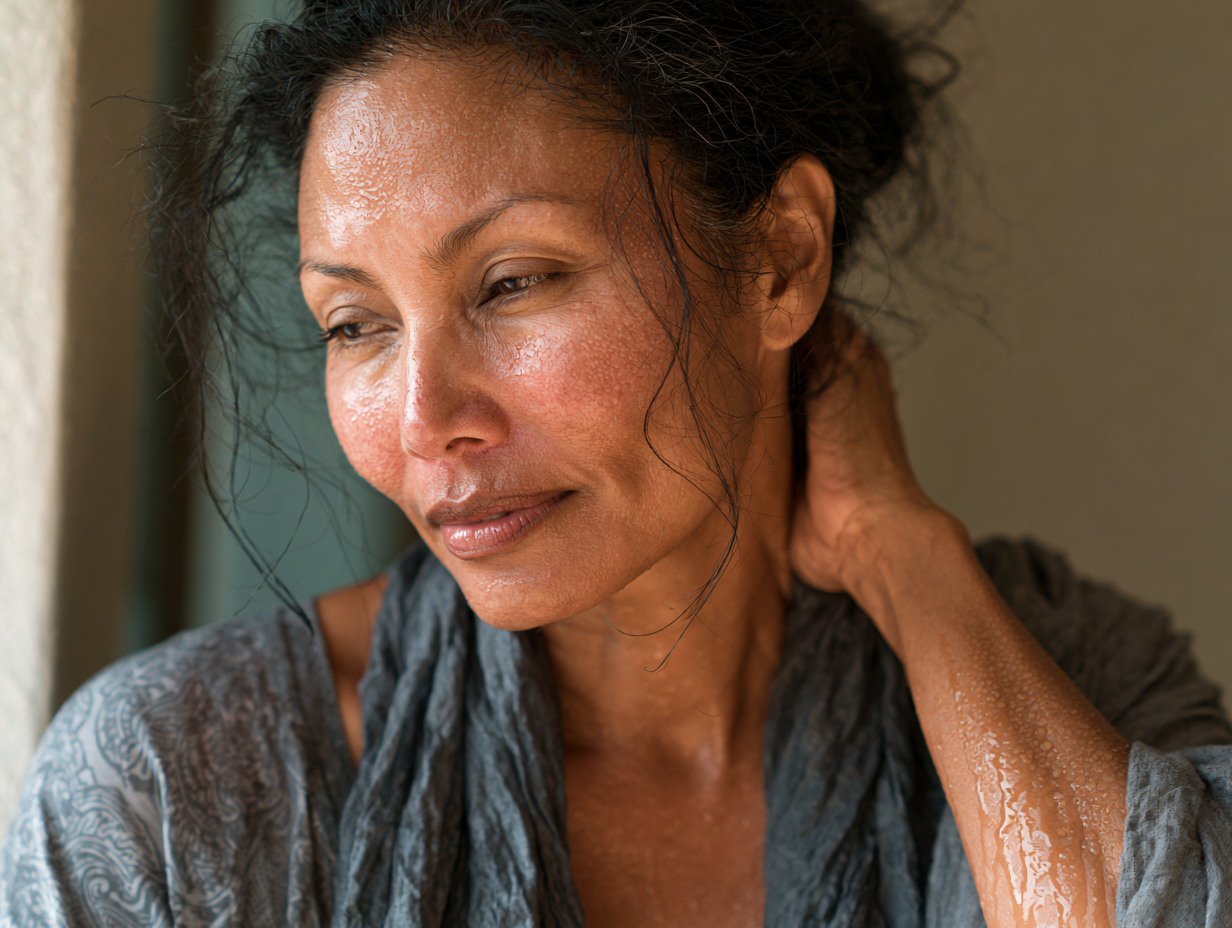
What They Came In For: Hot Flashes
Erin was dealing with hot flashes that were keeping her from sleeping and made her feel irritable and uncomfortable all the time. Chinese medicine stepped in to make things better.
Erin was 48, working full time and running a household, and she had been doing it on four or five hours of broken sleep for close to a year. She came to Root and Branch mainly because she was exhausted.
Her cycles had been irregular for about eighteen months, shorter some months and skipped others. The hot flashes started around the same time. During the day they came on as a wave of heat that rose from her chest to her face, often in the middle of a meeting, and left her flushed and sweating at the hairline. At night they were worse. She would wake around three in the morning soaked through, throw off the covers, sometimes change her shirt, and then lie awake and alert for an hour or more before falling back asleep. The alarm went off at six. She had been sleeping like this most nights since the previous Spring.
"I've started dressing in layers I can peel off without anyone noticing," she said. "That part I can manage. It's the sleep. I haven't slept through the night in months, and I feel it in everything."
She had tried the standard things. Her primary care doctor ran bloodwork and told her it was normal for her age. Hormone therapy came up as an option, and Erin wanted to think about it before deciding. She put a fan by the bed, cut back on wine and afternoon coffee, and tried a black cohosh supplement from the pharmacy. None of it made much difference to the night waking.
What frustrated her was that the diagnosis came with no plan attached. "Everybody keeps telling me this is normal," she said. "I believe them. I still can't function on this much sleep, and normal doesn't make it easier to live with."
She wanted her sleep back, and she had run out of options she liked.
What a Hot Flash Actually Is
Hot flashes and night sweats are the signature symptoms of the menopausal transition, and they are more common and more durable than most people expect. Up to about three-quarters of women experience them during the transition, and a substantial share rate them moderate to severe.
For a long time the working assumption was that they lasted six months to two years. Larger studies have revised that picture considerably. The Study of Women's Health Across the Nation, which followed more than three thousand women through the transition, found that frequent hot flashes and night sweats lasted a median of about seven and a half years, persisted for more than seven years in over half of the women, and continued for roughly four and a half years after the final period. Earlier onset predicted longer duration. For someone like Erin, already a year in, this matters, because it turns "wait it out" into a much larger request than it sounds.
A hot flash is a thermoregulatory event. The hypothalamus maintains a narrow comfort range for core body temperature, and as estrogen declines and fluctuates through the transition, that comfort range narrows further. Small increases in core temperature that would once have gone unnoticed now trip a full heat-dissipation response: blood vessels near the skin dilate, which produces the flush and the sensation of heat, and the body sweats to shed warmth, sometimes followed by a chill. The signaling involves norepinephrine and serotonin and a specific group of hypothalamic neurons that become more active as estrogen withdraws. A night sweat is the same event happening during sleep, and because each one tends to pull the sleeper toward waking, the result is fragmented sleep. For many women, and for Erin in particular, the sleep loss is the more disabling problem.
The most effective treatment biomedicine offers is menopausal hormone therapy, which directly addresses the estrogen withdrawal driving the symptoms. The risk picture around hormone therapy was reassessed in the years after the initial Women's Health Initiative alarm, and for many women in the transition the individualized balance of benefit and risk is more favorable than the early headlines suggested. It remains a personal decision, and some women have medical reasons to avoid it or simply prefer to. Non-hormonal medications are also available, including certain antidepressants, gabapentin, and a newer class of drugs that target the hypothalamic thermoregulatory circuit directly. Behavioral measures round out the standard approach: identifying and avoiding triggers such as alcohol, caffeine, spicy food, and overheating, and using cooling strategies at night. These approaches help a meaningful number of women. They left Erin with symptoms that were slightly reduced while the core problem, especially the broken sleep, continued.
Listening for the Pattern
We began the way we always do, with a long intake and a close look. Erin's tongue was red with very little coating, and her pulse was thin and quick, with a particular emptiness at the position we associate with the Kidney. We asked about the timing of the heat, whether she ran warm or cool in general, how her mouth and skin felt for dryness, and what the three in the morning waking was actually like. Her answers formed a consistent picture.
In Chinese medical terms, Erin's pattern was shèn yīn xū 腎陰虛, Kidney Yīn deficiency, with deficiency heat, xū rè 虛熱, rising as a result. Yīn 陰 is the cooling, moistening, and stabilizing aspect of the body, the counterpart to the warming and active quality of Yáng 陽. The two are meant to hold each other in check. When Yīn becomes depleted, it no longer anchors and cools Yáng, and heat floats upward without restraint. That upward, unanchored heat is a close description of what a hot flash feels like from the inside: warmth that climbs to the chest and face, sweating that empties the body's fluids further, and a background dryness in the mouth and skin.
The tradition treats the menopausal transition as a Kidney event. The Sùwèn 素問, the foundational classic of Chinese medicine, describes a woman's reproductive life in terms of tiān guǐ 天癸, a reproductive essence tied to the Kidney that arrives in adolescence and draws down in the late forties. As it declines, the substantial, cooling base of the body thins. Biomedicine describes the same period as the decline and fluctuation of estradiol and the loss of its steadying effect on thermoregulation. Both are describing a loss of the stabilizing, cooling influence that had kept the system even, one in the language of Kidney Yīn and one in the language of hormones.
The sleep had its own logic within the pattern. In Chinese medicine the Kidney and the Heart depend on each other: Kidney Water rises to cool the Heart, and Heart Fire descends to warm the Kidney, so that neither runs away from the other. When Kidney Yīn is depleted, the Water cannot rise to cool the Heart, and Heart Fire flares at night, disturbing the Shén 神, the aspect of consciousness housed by the Heart that governs clarity and settled presence. This is the pattern called xīn shèn bù jiāo 心腎不交, Heart and Kidney not communicating, and it explains the specific quality of Erin's waking. She woke hot and wired, alert in a way that made getting back to sleep difficult, which matches both the Chinese medical picture and the sympathetic arousal that accompanies a nocturnal hot flash.
What the Treatment Involved
Erin's care centered on herbal medicine, with acupuncture supporting it. The herbal strategy had three parts: rebuild the depleted Kidney Yīn, clear the deficiency heat that was floating upward, and settle the Heart so that sleep could consolidate. The formula was built on a classical base for exactly this pattern, a modification of Zhī Bǎi Dì Huáng Wán 知柏地黃丸, which pairs a set of Yīn-building herbs with two additions that clear deficiency heat and direct it downward, away from the chest and head. We added herbs to quiet the Heart and settle the Shén at night.
A well-constructed Chinese herbal formula works as a system rather than a single active compound. Some herbs carry the main strategy, others support or moderate them, and others steer the overall action toward particular organ systems. Erin's formula was adjusted every few weeks as her symptoms shifted, with more emphasis on the sleep early on and more on rebuilding the Yīn base as the nights settled. Rebuilding Yīn is slower work than clearing heat, and the sequence reflected that.
Acupuncture added a second line of support, aimed at settling the nervous system and reinforcing the same cooling strategy. The research on acupuncture for hot flashes points in two directions. Pragmatic trials, which test acupuncture as it is actually delivered in a clinic, have been encouraging. The Acupuncture in Menopause study, a pragmatic randomized trial published in 2016, found that acupuncture reduced hot flash frequency by roughly a third compared with usual care, with the benefit largely holding over the following months. A Norwegian trial found that acupuncture added to self-care reduced flashes more than self-care alone.
The dietary advice followed the same cooling strategy without tipping into extremes. The aim is to lower the heat load the body is already managing, which means easing off the reliable triggers, alcohol and especially wine, caffeine, and spicy food, each of which dilates blood vessels or raises sympathetic tone. Cooling and moistening foods support the depleted Yīn: pears, apples, cucumber, celery, leafy greens, berries, melon, and steady hydration through the day. We kept the overall diet from becoming all cold and raw, since a diet tilted too far toward cold food over the course of a day tends to weaken digestion, which in Chinese medicine works against the Spleen and in physiological terms shows up as bloating and sluggishness. Cooked vegetables and adequate protein kept the meals grounded.
The sleep environment mattered as much as the food. She kept the bedroom genuinely cool, slept in breathable layers she could shed, and built in a real wind-down in the evening to lower her nervous system before bed. Moderating alcohol in the evening specifically was worth emphasizing, since it fragments sleep and provokes night sweats even when it makes falling asleep easier. We moved her exercise earlier in the day and added ten minutes of slow breathing before bed, which gives the nervous system a clear signal that the day is closing.
What Changed
The sleep improved first. Within the first two weeks, Erin's night sweats eased, and when she did wake, she was getting back to sleep faster. By around six weeks she was sleeping through most nights. The daytime flashes took longer and never disappeared entirely. Over the following two to three months they became less frequent and less intense, enough that they stopped interrupting her workday.
"I still get them," she told us. "I slept eight hours three nights this week though, and I'd honestly forgotten what that felt like."
That sequence is typical for this pattern. Settling the Heart and clearing the night heat tends to come first, because those are the more movable parts of the picture. Rebuilding Kidney Yīn is slower and quieter work, and it is what gradually reduces the daytime flashes. None of this stops the transition, which is a normal stage of life. The work is supporting the body through it so that the symptoms stop organizing a person's life. Erin also kept hormone therapy on the table as a possibility to revisit with her doctor, and the two approaches were never in competition. The point was to give her a functional baseline again, and better sleep did most of that.
If you are somewhere in the menopausal transition and the nights have stopped being restful,your doctor may have said “well this is a normal part of ageing.” But it’s important to remember that even though the symptoms are common and that they are indeed part of ageing, it does not mean they cannot be treated. In Chinese medical terms, the transition is a Kidney event, a drawing down of the body's cooling, stabilizing base, and the heat that rises when that base thins is a describable pattern with places to intervene. In biomedical terms, it is a change in thermoregulation driven by shifting hormones, with its own set of tools. Those two descriptions are compatible, and so are the approaches that follow from them. Whether or not you also choose hormone therapy, there is room to support the body through it, and for many people the first change they notice is the return of a full night's sleep.
The Classical Map of Women’s Health
Human life runs in certain cycles. 7 years for women and 8 years for men. Learn more about the classical aspects of aging and life stage management for women here.
Seven Times Seven:
Understanding the classical stages of life for female bodies
The first chapter of the Sùwèn 素問, the older half of the Huángdì Nèijīng 黃帝內經 and one of the foundational texts of Chinese medicine, compiled circa 100 BCE to 100 CE, contains a short passage that lays out the whole arc of a woman's physical life in seven-year stages. Development moves in steps of seven years, and two of those steps mark the boundaries of reproductive life. At the second, around age fourteen, the capacity for reproduction matures and menstruation begins. At the seventh, around age forty-nine, that capacity is spent and menstruation ends. The number the text arrives at for the close of fertility, forty-nine, sits within about two years of the median age of menopause in modern populations, which is around fifty-one, and that median has changed little over the centuries the measurement spans. For a framework two thousand years old and built entirely from observation, the accuracy at that endpoint is striking.
The map rests on a single concept, Kidney Jīng 精, sometimes translated as essence. The phrase clinicians still use for what happens at menopause, declining Kidney Jīng, describes something specific and observable. The seven-year stages are the tradition's way of tracking that decline across a life, and nearly every marker it uses is something a person can see.
The Seven-Year Stages
The text assigns each seven-year step a physical change, and read in order the sequence is recognizable as ordinary human development. At seven, it says the Kidney qì 氣 becomes abundant, and the visible signs are familiar ones: the baby teeth loosen and are replaced, and the hair grows in thick. At fourteen comes the change that opens reproductive life. Tiān guǐ 天癸 arrives, the Rèn 任脈 vessel begins to flow and the Chōng 衝脈 vessel fills, menstruation begins, and conception becomes possible. Tiān guǐ is the term the passage uses for the matured reproductive capacity itself. It is sometimes translated as heavenly water, and the tradition understands it as the point at which the deep reproductive potential held in the Kidney ripens into function.
The Chōng and Rèn are two of the eight extraordinary vessels, the deep channels the tradition ties most closely to reproduction. The Rèn runs up the front midline of the body and governs the uterus and pregnancy. The Chōng is called the sea of Blood and supplies the Blood that fills and releases in the menstrual cycle. When the passage says these two vessels fill at fourteen and empty at forty-nine, it is describing the opening and closing of the reproductive years in the tradition's own anatomy, with the monthly cycle running in between as the visible sign that the vessels are full and working.
Between those two boundaries the text tracks the body's rise and its slow turn downward. At twenty-one it places the Kidney qì at an even fullness, with the last teeth, the third molars, coming in. At twenty-eight the bones and sinews are at their firmest and the body is at its physical peak. At thirty-five the first decline appears, and the text is specific about where it shows: the Yángmíng 陽明 channel, which passes over the face, begins to weaken, so the face starts to lose its fullness and the hair begins to thin. At forty-two the decline has spread, the face ages further, and the hair begins to whiten. At forty-nine the reproductive vessels empty, tiān guǐ is exhausted, and menstruation ends.
Two features of this scheme stand out. Its markers are observable throughout: teeth erupting and being lost, hair thickening and thinning and graying, the firmness of bone, the onset and end of menstruation, the changes in the face. These are the plain events of a life, and the text arranges them in the order biology actually follows. The number seven, meanwhile, is doing organizing work. The tradition pairs it with eight and runs the parallel account of men's development in eight-year stages, and the tidy arithmetic of seven twos and seven sevens is a classical ordering device laid over an approximate biology. Menarche today arrives earlier than fourteen, closer to twelve, and the fit at each step is loose. What holds is the shape of the curve and, at its far end, a figure for menopause that modern data has barely moved.
What "Declining Kidney Jīng" Describes
Jīng is the deep and finite resource the Kidney is said to store, the material basis of growth, reproduction, and aging. A person receives a fixed endowment of it at birth, inherited from the parents, supplemented over a lifetime by food and rest. The endowment is not entirely fixed, since the tradition distinguishes the Jīng inherited at birth from the Jīng the body makes from food across a life, and the second can support and partly conserve the first. Still, the inherited portion sets the underlying curve, and once it is spent it is not replaced. Growth and maturation are that Jīng accumulating and expressing itself, and aging is that Jīng declining. The seven-year stages map this single curve, rising to the peak the text places near twenty-eight and falling away from there.
The particular markers the passage chose follow the tradition's own logic. The Kidney governs the bones and produces the marrow that fills them, it manifests outwardly in the head hair, and it controls the teeth, which are understood as a surplus of bone. Tracking Jīng through the teeth, the bones, and the hair is consistent with what the Kidney is held to govern. The eruption of teeth at seven and twenty-one, the firmness of bone at twenty-eight, and the thinning and whitening of hair from thirty-five on are, in this scheme, signs of the state of Kidney Jīng, visible in the tissues the tradition assigns to it.
In biomedical terms, this curve is the maturation and decline of the reproductive endocrine system, set inside the broader aging of the body. The ovaries mature at puberty and wind down through the forties. The reproductive hormones, high and cyclic through the fertile years, fluctuate and then fall across the transition, and bone, skin, and hair change as they do. The tradition's picture of a finite endowment spent across a lifetime has a genuine parallel in the biology of the ovarian reserve. A woman is born with her entire supply of egg cells already formed, a store that is never added to and that declines steadily until it runs low around the age the text names.
The parallel should not be pushed too far. The Chōng and Rèn are not blood vessels, tiān guǐ is not a hormone, and the seven-year scheme is not an endocrine theory in disguise. What the two accounts share is the object they describe, the observable arc of a woman's reproductive life from its opening to its close, and the recognition that the arc is governed by a deep, finite resource that matures, sustains fertility for a few decades, and then runs down. Chinese medicine named that resource Jīng and followed it through the body's visible tissues. Biomedicine names its reproductive part in ovarian and hormonal terms and follows it through the blood. The two descriptions meet on the same timeline.
The framework also located what modern medicine calls perimenopause, the years of transition before the final period. The Sùwèn presents forty-nine as the last step of a long, gradual decline. It marks that decline starting much earlier, at thirty-five and again at forty-two, so the end of menstruation is the final stage of a process the text has been following for more than a decade. The window the classical scheme brackets, roughly forty-two to forty-nine, lines up with what a clinician now calls the perimenopausal transition, the years when the reproductive vessels are emptying, tiān guǐ is nearly spent, and the cycle grows irregular before it stops. Read this way, perimenopause is the tradition's long descent from the twenty-eight-year peak, watched and named two thousand years ago.
The table stops at forty-nine because reproductive capacity ends there. Life does not, and neither does Kidney Jīng. The seven-year list maps one function, the reproductive arc, and its close marks the end of that function alone. The chapter these tables sit inside is concerned with something longer. It opens with a question about why people no longer live out their full natural span, the tiān nián 天年, which it reckons at around a hundred years, and it answers that a long life depends on conserving Jīng rather than spending it carelessly. Placed in that frame, forty-nine falls near the middle of a well-lived life.
In the tradition's terms, the post-reproductive stage has its own physiology. Through the fertile years the body spends Blood on the monthly cycle and holds the capacity to carry a pregnancy, both of which draw steadily on its resources. When menstruation ends, that monthly expenditure ends with it. The Chōng and Rèn no longer fill and empty each month, and that change is a turn from outward spending toward conservation, with the resources those vessels once moved now kept in reserve. For this reason the tradition treats the close of menstruation as a consolidation, the point at which a decades-long output stops and the body holds what it has.
For a clinician, this framework shapes how the menopausal transition is approached. If the years around menopause are a known stage in a lifelong curve, the symptoms that gather there, the disrupted sleep, the heat, the changes in mood and body, become the expected features of that stage, signs of declining Jīng that the medicine has seen and treated for centuries. The work is to support the body through the transition, easing the symptoms it produces and helping the body settle into the stage that follows.
The framing matters as much as the treatment. In the common contemporary picture, menopause reads mainly as loss, the start of the body's decline toward its end. The classical map sets a different default. Forty-nine closes the reproductive stage and opens a post-reproductive one that the same text expects to run for decades. At forty-nine a woman is partway through the map, entering a stage the medicine has understood for two thousand years as a part of life in its own right.

Everyday Alchemy: Eating for the body you have now
Choosing the right foods for yourself is a dynamic process that lives at the intersection between appetite, season, constitution, age, and desire. Learn more about making choices that will benefit you as you age.
In the late forties or early fifties, many people notice that the way they have always eaten has stopped working. The strategies that used to reset things, eating a little less for a week, skipping a meal here and there, going lighter after a heavy stretch, stop producing the old results. Often they make matters worse. Cutting back leaves you more tired than lighter, and the change you were hoping for does not come. The same lunch that used to sit fine now leaves you heavy in the afternoon, and a day of eating light to make up for a big weekend leaves you cold and drained without making you any leaner.
The body you have at fifty is not the body you had at thirty, and it does better on different food. For a long stretch of adult life, especially for anyone who learned to eat inside a culture organized around staying lean, the aim of eating was often subtraction, some version of less, lighter, or fewer. In midlife a more useful aim is support. The questions worth asking become whether a meal holds enough complexity to protect your muscles and bones, whether it is something your digestion can handle well, and whether you are eating enough to keep your system running. For most people at this stage, that way of thinking about food works better than the one it replaces.
The Spleen and a Changing Metabolism
In Chinese medicine, digestion centers on the Spleen 脾. The Spleen here covers more than the small organ biomedicine gives that name. It stands for the whole work of transforming food into usable substance and moving it through the body, roughly digestion and the front end of metabolism taken together. When the Spleen is strong, food becomes energy and material the body can use, and a person feels well fed and steady through the day. The Spleen also has clear preferences. It does its best work with food that is warm, cooked, regular, and moderate in amount, and it is taxed by large quantities of cold or raw food, by heavy, greasy, or very sweet meals, and by eating at erratic hours or on the run.
The Spleen's capacity is not fixed across a lifetime. It draws on the deeper reserves of the Kidney 腎, which hold the body's foundational warmth, and as those reserves draw down with age, the Spleen has less to work with. A younger, stronger Spleen can handle a cold lunch eaten standing up, a late heavy dinner, and a run of erratic meals without much complaint. The same treatment lands harder on a Spleen in its fifties. What Chinese medicine describes here is the ordinary midlife experience of a body that has become less forgiving. The digestion that absorbed almost anything at thirty now registers what it is given, and a heavy late meal or a week of skipped breakfasts shows up more plainly than it used to.
The physiology runs alongside this. Two changes matter most. The first is the loss of muscle, which begins in the forties and speeds up through the menopausal transition for women in particular. The body sheds muscle unless it is actively working to keep it, and because muscle is metabolically expensive tissue, losing it lowers the rate at which the body burns energy at rest and removes one of the main places it stores blood sugar. The second is a decline in insulin sensitivity, so the body handles carbohydrate less smoothly and stores fat more readily, particularly around the middle. Together they explain why the same eating and activity that held a person steady at thirty can leave them gaining at the waist and losing strength at fifty.
The two accounts meet at a practical point. Both the Spleen and the muscle do their work when they are fed well, and both suffer under restriction. The reflex to eat less becomes counterproductive here. When intake drops too low, the body breaks down muscle for fuel, which lowers the metabolic rate further and deepens the very problem the restriction was meant to fix. In Chinese medical terms, hard dieting weakens an already declining Spleen, which leaves digestion more sluggish and the person more tired and more prone to the heaviness that comes with poor transformation. The approach that worked at thirty, when a strong Spleen and plenty of muscle could absorb a stretch of undereating, does real harm at fifty. At this stage, eating enough of the right food is what protects the muscle and keeps the digestion working.
How to Eat for the Body You Have Now
The change that matters most is to eat more protein and to spread it across the day. The aging body builds and holds muscle less efficiently than a young one, so it needs more protein to maintain what it has, and many people eat far less than would help, especially at breakfast. The practical version is to build each meal around a real source of protein. Eggs, Greek yogurt, cottage cheese, chicken, fish, beans, and lentils all work, and the aim is to have some at every meal rather than saving it all for dinner. Depending on the season and your constitution though, you’ll need to be mindful of how much cold and/or raw food you are leaning on to get those protein numbers up (looking at you yogurt and cottage cheese). A warm breakfast with protein in it does more for a midlife body than coffee and toast and way more than a processed mixture of powders and additives that folks have decided is healthy (that’s some hard side-eye to you breakfast smoothie), and it holds blood sugar steadier for hours afterward.
The next change is toward warm, cooked, regular meals, which suits the Spleen and the blood sugar at the same time. Cooked food asks less of the digestion than large amounts of raw food, and that matters more as the Spleen's capacity narrows. Meals at reasonable, regular hours keep blood sugar steadier than grazing or a long gap followed by a large late dinner. In practice this can be as ordinary as oatmeal with eggs in the morning and a warm grain-and-vegetable bowl at lunch. Cold and raw food still have a place, especially in Summer. The shift is to make warm, cooked meals the foundation of the day and let cold, raw food be the smaller part, which lines up well with steadier blood sugar too.
A couple of ordinary habits protect all of this. Not skipping meals, especially breakfast, matters more now, because skipping pushes the body toward breaking down muscle and usually leads to overeating later when the day catches up. The conditions you eat in matter as well. A meal eaten slowly and sitting down is easier to digest than the same meal eaten standing at the counter or half-attended between tasks. The Spleen does its transforming work better when the body is settled, and over months that shows up as steadier digestion and more even energy.
On the other side, a few things are worth easing back. Large amounts of sugar and refined carbohydrate spike blood sugar most sharply, and they land harder now that insulin sensitivity has dropped. Alcohol adds calories the body does not need, disturbs sleep, and encourages fat storage at the middle, so less of it helps on several fronts at once. Heavy, greasy, and very sweet meals sit poorly with a midlife Spleen and bring on the heaviness that follows overtaxed digestion. Vegetables, fruit, and whole grains fill the plate out and add the fiber that steadies blood sugar and supports the bowel.
It helps to know what to expect as you make these changes. The strongest pull will be back toward restriction. Decades of learning that the answer to a changing body is to eat less do not vanish because the physiology has changed, and the urge to cut back when the waist thickens is the one to resist. The scale is also the wrong thing to watch. Energy, strength, digestion, and the way clothes fit all shift before the number does, and sometimes the number barely moves while the body underneath it improves. These changes are gradual, because muscle and digestion both rebuild slowly. Eating this way is a long-term practice, and settling into it does more for the body you have now than any quick correction could.
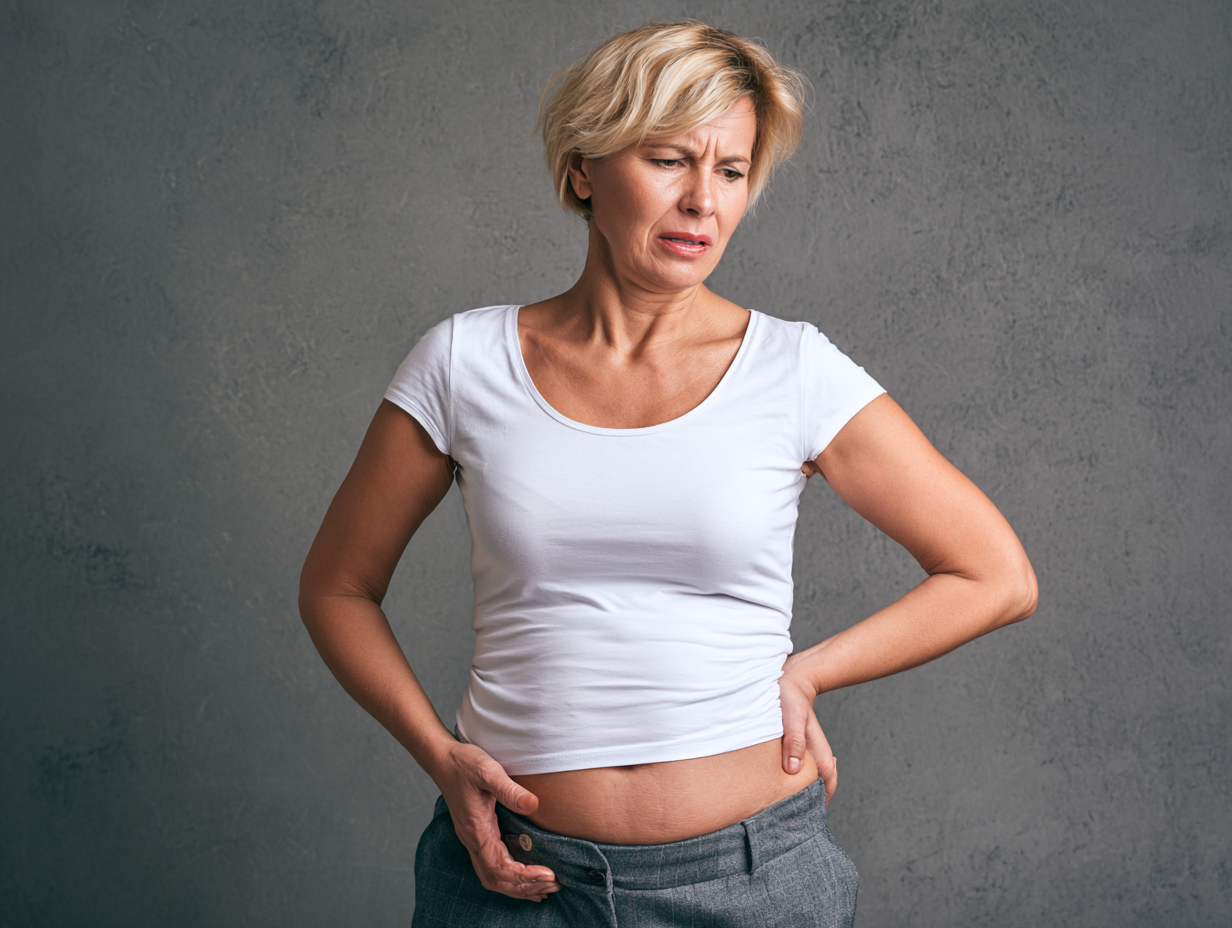
What They Came In For: Mid-life Weight Gain
Wendy was gaining weight, especially in her middle, and all the old tricks weren’t making a difference. Chinese medicine offered some insight into what she could do differently to feel good in her body again.
Wendy was 52 and had come to Root and Branch because her body had changed shape and she could not account for it. Over about two years, her weight had settled at her middle. Her waistbands were tight, her jeans fit differently, and the change was concentrated almost entirely at her waist while her arms and legs looked much the same to her.
Nothing about how she lived had changed. She had walked most mornings for years, cooked most of her own meals, and eaten roughly the way she always had. When the weight started collecting at her waist, she did what had worked in her thirties and forties. She ate a little less and added some cardio. It made no difference to her middle. When she cut back harder, she felt drained through the afternoons and the weight still did not move.
"I'm doing what I've always done," she said. "My body just decided to reorganize itself."
Her primary care doctor had run the usual bloodwork and told her it looked fine, with a note that her fasting blood sugar had crept toward the high end of normal. The advice was to watch her weight, since this was common at her age.
"My doctor said to eat less and move more," Wendy said. "I've been eating less and moving more for thirty years. That's not new information."
What bothered her was partly the shape change and partly the sense that her metabolism had slowed at some level she could not reach with the old methods. She also felt softer and weaker than she used to, and her afternoons had gone flat. She wanted to understand what was actually happening, and she wanted guidance she had not already tried on her own.
What Changes at Midlife
The scale and the shape are two different measurements, and at midlife they do not move together. Careful body-composition studies, including the long-running Study of Women's Health Across the Nation, have found that a woman's total body weight tends to climb gradually through her forties and fifties at a fairly steady rate, without a distinct jump at menopause, and then to level off afterward. What changes sharply around the transition is body composition: the rate of fat gain roughly doubles, muscle mass declines, and fat that once distributed across the hips and thighs begins collecting in the abdomen.
Estrogen is part of why the fat moves. Before menopause, estrogen favors fat storage in the hips, thighs, and buttocks, the subcutaneous pattern that is metabolically fairly benign. As estrogen declines, that preference weakens, and storage shifts toward the abdomen and toward the visceral compartment, the deep fat that surrounds the organs. Visceral fat behaves differently from the fat under the skin. It is metabolically active and inflammatory, and it raises the risk of high blood pressure, unfavorable cholesterol, and cardiovascular disease. Waist measurement at midlife therefore carries health meaning that the number on the scale does not.
Two other changes compound the shift. Insulin sensitivity tends to decline through this period, partly because visceral fat itself interferes with insulin's action and partly because estrogen had been helping the body respond to insulin. As cells respond less readily, the body stores fat more easily and blood sugar becomes harder to manage, which fits Wendy's creeping fasting glucose. At the same time, muscle mass falls. Muscle is metabolically expensive tissue, so losing it lowers the number of calories the body burns at rest, and it removes one of the main places the body disposes of blood sugar. A woman can therefore be eating and moving exactly as she did a decade earlier and still gain fat at the middle, because the machinery underneath has changed.
The same shift explains why the standard advice reaches its limits. Eating less and adding cardio can help with overall weight and are worth doing. They do little for the muscle loss and the insulin resistance that are driving the change in shape. Aggressive calorie restriction can even work against a woman here, because when intake drops too low the body tends to break down muscle for fuel, which lowers the resting metabolic rate further. Menopausal hormone therapy modestly reduces central fat accumulation in studies. It is prescribed for menopausal symptoms and broader health considerations, and that decision belongs with a woman and her doctor.
Listening for the Pattern
We started with a long intake. Wendy's tongue was pale and slightly swollen, with teeth marks along the edges and a thin greasy coating toward the back. Her pulse was soft and a little slippery. She described heaviness after meals, an afternoon slump that food did not fix, and a general sense of being weighed down that had come on with the shape change. She also ran cold more than she used to, especially in her hands and feet. These findings pointed in a consistent direction.
In Chinese medical terms, the core of Wendy's pattern was pí xū 脾虛, Spleen deficiency. The Spleen 脾 in Chinese medicine covers more than the small organ of the same name in biomedicine. It names the whole function of transforming food into usable substance and moving it where it needs to go, roughly the work of digestion and metabolism taken together. When the Spleen is strong, food is transformed and put to use, and a person feels light and energetic. When the Spleen weakens, that transformation slows, and what is not transformed accumulates as what the tradition calls dampness, shī 濕, a heavy, sticky condition that settles in the middle of the body and shows up as fullness, fatigue, and a softness through the waist. Wendy's heaviness after meals and her thick tongue coating were signs of exactly this.
Underneath the Spleen sat a second, deeper part of the pattern. In Chinese medicine the Spleen depends on the warmth of the Kidney 腎 to do its work. The Kidney holds the body's foundational fire, the aspect the tradition calls Kidney Yáng 腎陽, the deep source of warmth and vitality that powers transformation throughout the system. As a person ages, and particularly as the reproductive transition draws down the Kidney's reserves, that foundational warmth dims. A Spleen working with less warmth beneath it transforms food less effectively, which is part of why the digestion that served a woman at forty can leave her heavy and cold at fifty. Wendy's tendency to run cold, and her sense that the slowdown reached deeper than diet, both pointed to this Kidney involvement.
This slowdown is the same one biomedicine describes, seen from the level of the whole system rather than the individual hormone. The decline in the Kidney's foundational fire corresponds to the age-related fall in metabolic rate and the loss of muscle. The weakening of the Spleen's transformation, with dampness collecting at the middle, corresponds to the slowed metabolism and the fat gathering in the abdomen. The tradition and the laboratory are describing one process, a metabolism that has slowed at its foundation, in two vocabularies.
What the Treatment Involved
Wendy's care combined herbal medicine, some acupuncture, and a set of changes to how she ate and moved. The herbal strategy had two aims that matched the two layers of the pattern: strengthen the Spleen so it transforms food more effectively and stops generating dampness, and support the Kidney's foundational warmth beneath it. The formula was built on a classical Spleen-strengthening base, a modification of Shēn Líng Bái Zhú Sǎn 參苓白朮散, which tonifies the Spleen and drains dampness, with warming herbs added to support the Kidney. As with any well-made formula, it worked as a coordinated set, some herbs carrying the main work and others supporting and directing them, and it was adjusted over the following months as Wendy's digestion strengthened and the heaviness lifted.
No herbal formula reverses the hormonal transition or dissolves fat directly. What a formula like this does is support the digestive and metabolic function that the lifestyle changes then build on, so that a body that had been transforming food poorly starts doing it better.
Acupuncture played a supporting role, mostly on the stress side of the picture. Chronic stress keeps cortisol elevated, and cortisol promotes exactly the visceral fat storage and insulin resistance that are already increasing at this stage. Acupuncture sessions tend to shift the nervous system out of that sympathetic, high-alert state, which supports the metabolic work indirectly. The evidence for acupuncture as a weight treatment in its own right is limited, and we were straightforward with Wendy about that: the needles were there to support her digestion and lower her stress load.
The changes to how Wendy ate and moved carried most of the weight of the treatment, because they act directly on the muscle and the blood sugar. The central change was resistance training. Muscle raises the resting metabolic rate and gives the body a larger place to store blood sugar, so building and holding it counters the metabolic shift of midlife more directly than cardio or eating less can. Wendy started with twice-weekly strength sessions working the major muscle groups and increased the load gradually as she got stronger. Walking stayed in the picture for cardiovascular health, and the strength work became the priority.
On the food side, the emphasis was on protein and steadier blood sugar, without cutting intake to the point of losing muscle. Protein at each meal supports muscle and blunts the blood-sugar rise from a meal, so Wendy built meals around eggs, chicken, fish, beans, and lentils. Vegetables, fruit, and whole grains rounded the meals out and added the fiber that helps steady blood sugar. She eased off refined carbohydrates and sugar, which spike blood sugar most sharply, and cut back on alcohol, which adds empty calories, disturbs sleep, and encourages fat storage at the middle.
The Chinese medical picture pointed the same direction. A weakened Spleen is helped by warm, cooked, simply prepared food and burdened by large amounts of cold, raw, greasy, or very sweet food, which are harder to transform and tend to generate more dampness. In practice this meant Wendy made cooked vegetables, soups, and warm breakfasts the bulk of her intake and treated cold cereal and raw salads as smaller parts of the day, which happens to line up well with steadier blood sugar.
Sleep and stress got explicit attention as well, since poor sleep worsens insulin resistance and high stress keeps cortisol and abdominal fat storage elevated. Protecting her sleep and building in real downtime were part of the metabolic plan in their own right.
What Changed
The first changes Wendy noticed were in energy and strength. Within a few weeks the afternoon slump eased, and within a couple of months she was noticeably stronger in her sessions and through her day. The heaviness after meals lifted as her digestion improved. The change in body shape came more slowly, over several months, as she gained muscle and gradually lost some of the fat at her middle. Her waistbands loosened before the scale moved much, which is what tends to happen when muscle is replacing fat.
"My clothes fit better, I've got my afternoons back, and I feel strong in a way I haven't in years," she said. "I stopped weighing myself, honestly."
That progression is typical when the approach works on the muscle and the metabolism directly. Strength and energy return first, because the muscle and the nervous system respond relatively quickly. The shift in body composition follows over months, as muscle rebuilds and the metabolism steadies. None of this reverses the hormonal transition. The goal was a metabolism that worked better for the body Wendy has now, with the strength and the steadier blood sugar that protect her health going forward. She also kept the option of discussing hormone therapy with her doctor open, as part of the same larger picture.
If your weight has begun settling at your middle in your forties or fifties while your habits have stayed the same, you are describing one of the most consistent physical changes of the menopausal transition, and you are not imagining that the old approaches have stopped working. In biomedical terms, the shift is driven by declining estrogen, a move toward visceral fat storage, falling insulin sensitivity, and the loss of muscle. In Chinese medical terms, it is a Spleen that has weakened and a Kidney foundation that has dimmed, a metabolism slowed at its source. Both accounts point toward the same practical work: building muscle, steadying blood sugar, supporting digestion, and treating the change as a matter of metabolic health and strength. The number on the scale is the least useful part of that picture, and for most people it is also the last thing to move.