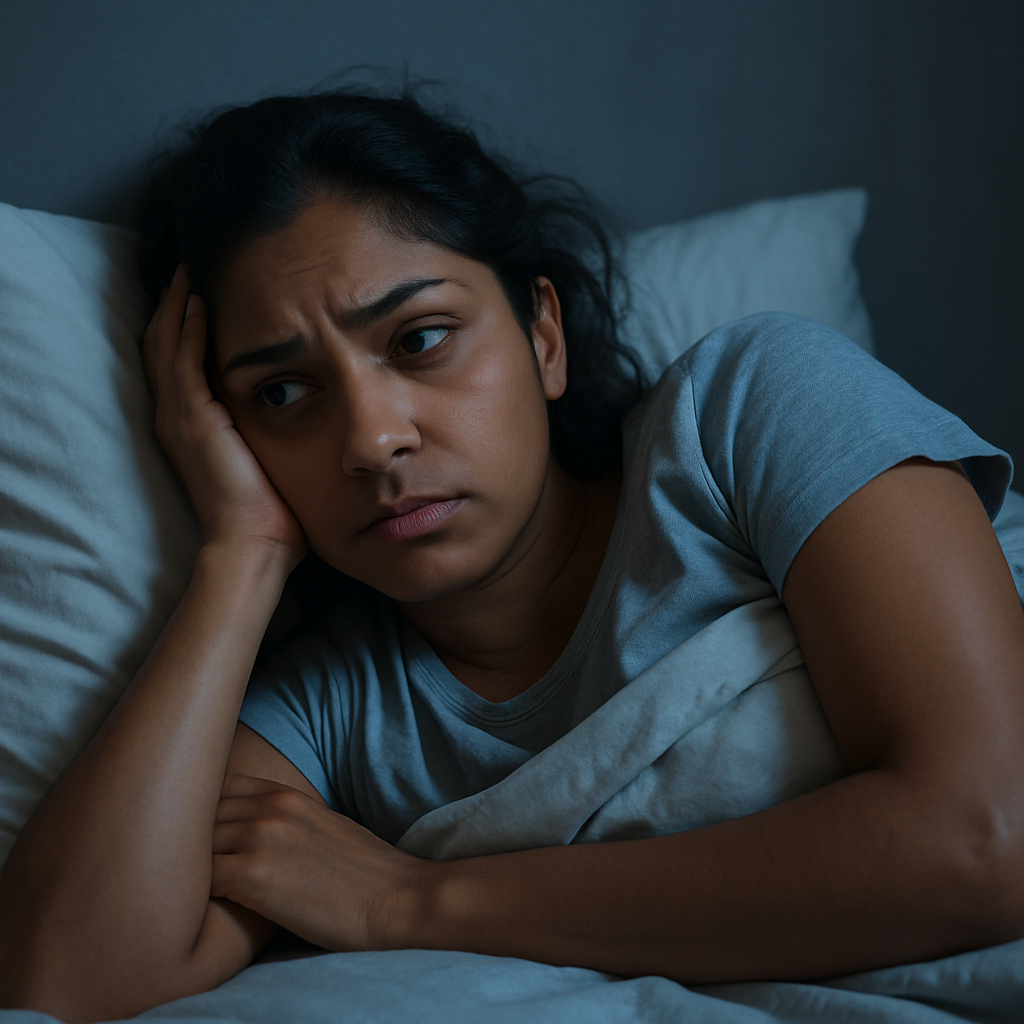
What They Came In For: Insomnia
Erin came to the clinic after months of insomnia. She’d cleaned up her sleep hygiene, but still woke night after night. With acupuncture and herbs, we helped her body remember how to stay asleep — not by forcing it, but by restoring the rhythms that allow real rest to return.
Erin came in because she couldn’t sleep.
Not just a rough night here and there — not the kind of sleep trouble that passes with a couple of early bedtimes — but deep, unrelenting insomnia that had taken over her nights for months.
She told us it started quietly. At first, she just had trouble winding down. She’d lie awake for a while scrolling her phone, or thinking through unfinished tasks, or replaying conversations from the day. But after a few weeks, it turned into something more stubborn. She couldn’t fall asleep until 1 or 2 in the morning, even when she was exhausted. And once she did fall asleep, she’d wake again — sometimes every hour. By morning, she felt like she hadn’t slept at all.
Erin described it as a kind of buzzing — like her body was on high alert all night. Her eyes would close, but her chest still felt wound tight, like something inside her was pacing the floor.
Her doctor called it primary insomnia. Nothing else seemed to be wrong. Her bloodwork was normal. Her vitals were fine. She wasn’t on any medications. They offered her a prescription for sleep aids and suggested she try to reduce stress.
But Erin didn’t want to sedate herself into sleep. She wanted her body to remember how to do it naturally — to feel safe enough to let go, quiet enough to rest.
By the time she came to us, Erin had already lost a lot to her insomnia. She used to love her morning routine — a long walk, hot tea, time to write in her journal — but now she could barely get out of bed. Her work had become harder. She felt foggy all the time, quick to tears, and emotionally raw. Her relationships were strained. Everything took more energy than it used to, and there was no rest to replenish it.
She told us, “I just don’t feel like myself anymore.”
Step One: Rebuilding the Conditions for Sleep
To Erin’s credit, she had done some research online about the negative impacts of tech on sleep and had started cleaning up her sleep habits.
She stopped bringing screens into the bedroom. No more scrolling before bed. No TV to fall asleep to. She started going to sleep at the same time every night — even on weekends — to re-train her internal clock.
She added in a few analog rituals: a warm cup of herbal tea, some gentle stretching, sometimes a few minutes with a paper journal or a novel. And most importantly, she stopped trying to make herself fall asleep. She gave herself permission to just lie there and rest, to read or breathe or be still, without watching the clock or pressuring herself to drift off.
These shifts helped. She started falling asleep a bit more easily. That heavy, wired feeling at bedtime began to soften. But the core problem — the one that made her feel truly unwell — was still there.
She was still waking up. Night after night, like clockwork, around 2 or 3am. Sometimes she could get back to sleep, but often she’d be awake for hours, mind alert and body humming. By morning, the little sleep she’d managed to get didn’t feel like enough.
That’s where Chinese medicine came in.
Step Two: Helping the Body Remember
From a Chinese medicine perspective, insomnia isn’t just about behavior or routine. Those things really matter, especially when it comes to maintaining quality sleep, but they’re not always enough to overcome the damage from persistent poor sleep. For Erin, we could see that her body wasn’t just overstimulated — it was out of rhythm. The systems that should have been quiet and replenishing at night were still active, still moving.
Her pulses confirmed what she described: her system was unsettled at night, not anchored. The internal transitions that allow sleep to come — quieting the mind, drawing awareness down into the body, releasing the day's tension — weren’t happening smoothly. She could fall asleep now thanks to better sleep hygiene, but something was still waking her up from the inside.
In Chinese medicine, we often speak of the Heart 心 (xīn) as the seat of consciousness — the part of us that governs wakefulness, clarity, and emotional tone. At night, that part is meant to be nourished and settled, so the mind can rest. But in Erin’s case, that internal quiet hadn’t been possible for some time. The Liver 肝 (gān), which is responsible for regulating movement, dreams, and transitions, seemed to be activating too early — stirring her awake before her body was ready.
With acupuncture and herbal medicine, we began to help her body recalibrate. We used points that calm and regulate the nervous system, supporting the internal downshift that should come naturally at night. We gave her a custom herbal formula designed to nourish the blood and support the quieting functions of the Heart system — not in a sedating way, but in a stabilizing one.
Over the next few weeks, the 3am wake-ups became less frequent. When she did wake, she could fall back asleep more easily. Her sleep deepened. Her mornings started to feel different — less heavy, less frantic.
Sleep returned in layers. A few good nights, then a stretch of consistency. Then — finally — a full week where she didn’t think about sleep at all.
A Return to Herself
After a couple months, Erin said something that stuck with us:
“I’m not even thinking about sleep anymore — I just go to bed, and then I wake up.”
It’s such a simple sentence, but it marked a big shift. Because by then, she wasn’t living around her insomnia anymore. She had energy again. Her moods were steadier. She had started journaling in the mornings again, taking walks before work. She had space in her life again that wasn’t filled with exhaustion.
We often say that Chinese medicine doesn’t force the body to do anything. It listens, it supports, and it reminds the body of what it already knows how to do — including how to rest.
Erin still keeps her nighttime rituals. She still avoids screens in the bedroom. But now, her body responds to those signals. Now, when she gets into bed, she knows what will happen next: she’ll rest. She’ll sleep. She’ll wake up feeling like herself again.

What They Came In For: Painful Menstruation
For years, Meena R. lived around her period—severe cramps, heavy bleeding, and exhaustion that took over every month. At Root and Branch, custom herbal formulas and targeted acupuncture helped her cycle shift, gently and powerfully. This is the story of how she stopped bracing for pain—and started feeling in control.
By the time Meena R. walked into our clinic, her period ruled her calendar.
She had been dealing with severe cramps and heavy bleeding for as long as she could remember. Every month, for five to seven days, her world narrowed: heating pad, dark room, extra clothes packed “just in case,” and a silent prayer that her cycle wouldn’t land on an important meeting, a social event, or a flight. Sometimes she bled through her clothes. Sometimes the pain made her nauseated. Always, she endured.
She had tried birth control pills, which helped at first but came with their own side effects. She tried prescription painkillers, which dulled the edge but left her groggy and bloated. She tried supplements, yoga, pelvic steaming, magnesium, cutting out dairy. Some things helped a little, nothing helped enough.
And every time she brought it up—at her annual exam, during doctor’s visits, in rushed urgent care check-ins—she got a version of the same message: “That’s just your period.”
Which felt a lot like being told to get used to it.
When Meena came to Root and Branch, she was skeptical—but also exhausted. She didn’t want a miracle. She just wanted one cycle that didn’t leave her drained, curled up, or rearranging her life around bleeding.
We began, as always, by listening and asking questions. When did the pain start? Was it sharp, dull, dragging, throbbing? What did she notice about clots, color, flow, fatigue? We asked about her cycle from beginning to end—not just the “bad” days, but what led up to them, what came after. We looked at her digestion, sleep, mood. Her tongue, her pulse. Her full picture.
She described herself as “a person who pushes through,” but her body told us otherwise. Her pulse was wiry and tight, her lower abdomen cold to the touch. Her period arrived like a flood—sudden, heavy, painful—followed by days of exhaustion and emotional crash.
We explained that in Chinese medicine, pain and heavy bleeding aren’t random—they’re signs of stagnation and weakness happening at the same time. The blood is stuck, but also not being held. There’s tension, but also depletion. And both need to be treated, in the right order, with care.
We started with a customized herbal formula. That was the cornerstone of her treatment. One blend before her period to move what needed to move and ease the buildup of tension. Another to take during her period to reduce pain and regulate flow. These weren’t off-the-shelf teas. They were carefully selected combinations meant to restore rhythm and clarity to her cycle. She brewed them twice a day, sometimes more during her worst days.
Alongside the herbs, we used acupuncture to move blood, release tension in the lower abdomen, and support her hormonal system. We placed needles with a focus on the Liver and Spleen channels—key players in blood regulation—and paired that with calming points to settle her nervous system, which had been bracing for pain every month for years.
The first cycle after treatment was still painful—but it was different: less intense and shorter. She didn’t bleed through anything. She went to work the second day, which felt like a small miracle.
By the third cycle, she wasn’t dreading it anymore.
“I’ve never had a period sneak up on me before,” she said, half laughing, half stunned. “It just… came. And it wasn’t awful.”
The bleeding slowed. The clots lessened. The pain, once all-consuming, became background noise. The fatigue lifted. Slowly, her cycle started to feel like something she could live with, rather than hide from.
What she came in for was fewer bad days.
What she got was a more balanced cycle—and a renewed sense of agency in her own body.
At Root and Branch, we see period pain often—whether from endometriosis, fibroids, hormone imbalance, or no clear reason at all. We treat what’s there, but we also treat what’s underneath. Because pain may be common, but it’s not “normal.” And heavy bleeding doesn’t have to be your monthly reality.
If your cycle has been running your life, we want you to know: there’s another way.

What They Came In For: Long Covid
Months after a mild case of COVID, Thomas K. still wasn’t himself—fatigue, brain fog, and unrest that wouldn’t let go. At Root and Branch, a custom herbal formula and targeted acupuncture helped his system reset. This is the story of what it’s like to finally begin coming back to life.
“I just want to feel like myself again.”
That’s what Thomas K. said when we asked him what brought him in. Then he paused.
“And the truth is, I’m not even sure I remember what that feels like.”
He’d had COVID ten months earlier. It was his second time getting it—the first had been over a year prior, and he’d recovered easily. A few days of fatigue, some sniffles, and then life went back to normal. He was vaccinated. He’d done everything “right.” So when he got it again, and it started as a mild case, he wasn’t too worried.
But this time, the recovery never came.
The fever passed. The test turned negative. But the fatigue stayed. Not the kind you push through with coffee or a good night’s sleep—the kind that settles into your bones. He started needing to lie down in the afternoon. Sometimes his chest felt tight—not dangerous, just off. His brain felt foggy, like he was trying to think through static. He forgot words. Simple tasks took longer. His mood got flatter. His sleep got worse.
He kept waiting to bounce back. But the weeks turned into months, and nothing changed.
He’d had all the tests. Labs normal. Lungs clear. “You're just stressed,” one provider said. Another called it post-viral syndrome and offered antidepressants. He wasn’t against medication. He just didn’t feel like anyone was really listening to what was happening in his body.
That’s when he found his way to Root and Branch.
What he wanted was simple: clarity, energy, and the ability to trust his body again.
We started with the big picture. When did the fatigue hit hardest? How did he feel after meals? How had his digestion been since the illness? What about temperature regulation? Sweating? Focus? Anxiety? We looked at his tongue, felt his pulse. Beneath the surface, his system told a familiar story: a body still caught between recovery and defense. Weakness at the core. Stagnation in the chest. A nervous system on edge.
We explained how long COVID presents, through the lens of Chinese medicine, as a pattern of post-viral depletion and dysregulation. Energy isn’t just “low”—it’s blocked. The body isn’t just tired—it’s stuck in a pattern it can’t exit.
So we built a treatment plan to help guide it out.
At the center of that plan was a custom herbal formula—one tailored to nourish the body’s energy without overstimulating it, to open the chest, support lung and spleen function, and gently recalibrate the nervous system. Not a stimulant. Not a sedative. Just medicine that knew how to listen to what the body actually needed.
He took it twice a day, every day. And we adjusted it often—because as his body changed, the formula needed to change too.
We paired it with acupuncture designed to support his recovery on multiple levels: points to regulate his sleep, clear the lingering heaviness in the chest, restore cognitive clarity, and rebuild his sense of groundedness. After each session, he’d say the same thing: “I didn’t know I could feel this calm anymore.”
After three weeks, his fatigue began to shift. Not all at once—but there were longer stretches of clarity. Mornings that started easier. Fewer naps. More consistency. His brain fog started to lift. He could read again, focus on a conversation without drifting.
After six weeks, he said, “I feel like I’m finally climbing out of something.”
We continued to treat the fluctuations—days where his energy dipped again, or sleep became fragile—but overall, the direction was steady. Upward. Back toward himself.
What Thomas came in for was his energy.
What he found was recovery—and something more: a renewed relationship with his body, one built not on pushing through, but on paying attention.
At Root and Branch, we’ve worked with many long COVID patients, each with a slightly different picture. Some come in with chest tightness. Others with digestive distress, insomnia, hair loss, anxiety, or relentless fatigue. No two cases are identical—but the approach is always the same: track the pattern. Treat the root. Support the whole person.
If you’re living with long COVID symptoms that just won’t let go, know this: there is still healing available. It might not be fast. But it can be real.
And we’re here for the long arc of it.