
What They Came In For: Mid-life Weight Gain
Wendy was gaining weight, especially in her middle, and all the old tricks weren’t making a difference. Chinese medicine offered some insight into what she could do differently to feel good in her body again.
Wendy was 52 and had come to Root and Branch because her body had changed shape and she could not account for it. Over about two years, her weight had settled at her middle. Her waistbands were tight, her jeans fit differently, and the change was concentrated almost entirely at her waist while her arms and legs looked much the same to her.
Nothing about how she lived had changed. She had walked most mornings for years, cooked most of her own meals, and eaten roughly the way she always had. When the weight started collecting at her waist, she did what had worked in her thirties and forties. She ate a little less and added some cardio. It made no difference to her middle. When she cut back harder, she felt drained through the afternoons and the weight still did not move.
"I'm doing what I've always done," she said. "My body just decided to reorganize itself."
Her primary care doctor had run the usual bloodwork and told her it looked fine, with a note that her fasting blood sugar had crept toward the high end of normal. The advice was to watch her weight, since this was common at her age.
"My doctor said to eat less and move more," Wendy said. "I've been eating less and moving more for thirty years. That's not new information."
What bothered her was partly the shape change and partly the sense that her metabolism had slowed at some level she could not reach with the old methods. She also felt softer and weaker than she used to, and her afternoons had gone flat. She wanted to understand what was actually happening, and she wanted guidance she had not already tried on her own.
What Changes at Midlife
The scale and the shape are two different measurements, and at midlife they do not move together. Careful body-composition studies, including the long-running Study of Women's Health Across the Nation, have found that a woman's total body weight tends to climb gradually through her forties and fifties at a fairly steady rate, without a distinct jump at menopause, and then to level off afterward. What changes sharply around the transition is body composition: the rate of fat gain roughly doubles, muscle mass declines, and fat that once distributed across the hips and thighs begins collecting in the abdomen.
Estrogen is part of why the fat moves. Before menopause, estrogen favors fat storage in the hips, thighs, and buttocks, the subcutaneous pattern that is metabolically fairly benign. As estrogen declines, that preference weakens, and storage shifts toward the abdomen and toward the visceral compartment, the deep fat that surrounds the organs. Visceral fat behaves differently from the fat under the skin. It is metabolically active and inflammatory, and it raises the risk of high blood pressure, unfavorable cholesterol, and cardiovascular disease. Waist measurement at midlife therefore carries health meaning that the number on the scale does not.
Two other changes compound the shift. Insulin sensitivity tends to decline through this period, partly because visceral fat itself interferes with insulin's action and partly because estrogen had been helping the body respond to insulin. As cells respond less readily, the body stores fat more easily and blood sugar becomes harder to manage, which fits Wendy's creeping fasting glucose. At the same time, muscle mass falls. Muscle is metabolically expensive tissue, so losing it lowers the number of calories the body burns at rest, and it removes one of the main places the body disposes of blood sugar. A woman can therefore be eating and moving exactly as she did a decade earlier and still gain fat at the middle, because the machinery underneath has changed.
The same shift explains why the standard advice reaches its limits. Eating less and adding cardio can help with overall weight and are worth doing. They do little for the muscle loss and the insulin resistance that are driving the change in shape. Aggressive calorie restriction can even work against a woman here, because when intake drops too low the body tends to break down muscle for fuel, which lowers the resting metabolic rate further. Menopausal hormone therapy modestly reduces central fat accumulation in studies. It is prescribed for menopausal symptoms and broader health considerations, and that decision belongs with a woman and her doctor.
Listening for the Pattern
We started with a long intake. Wendy's tongue was pale and slightly swollen, with teeth marks along the edges and a thin greasy coating toward the back. Her pulse was soft and a little slippery. She described heaviness after meals, an afternoon slump that food did not fix, and a general sense of being weighed down that had come on with the shape change. She also ran cold more than she used to, especially in her hands and feet. These findings pointed in a consistent direction.
In Chinese medical terms, the core of Wendy's pattern was pí xū 脾虛, Spleen deficiency. The Spleen 脾 in Chinese medicine covers more than the small organ of the same name in biomedicine. It names the whole function of transforming food into usable substance and moving it where it needs to go, roughly the work of digestion and metabolism taken together. When the Spleen is strong, food is transformed and put to use, and a person feels light and energetic. When the Spleen weakens, that transformation slows, and what is not transformed accumulates as what the tradition calls dampness, shī 濕, a heavy, sticky condition that settles in the middle of the body and shows up as fullness, fatigue, and a softness through the waist. Wendy's heaviness after meals and her thick tongue coating were signs of exactly this.
Underneath the Spleen sat a second, deeper part of the pattern. In Chinese medicine the Spleen depends on the warmth of the Kidney 腎 to do its work. The Kidney holds the body's foundational fire, the aspect the tradition calls Kidney Yáng 腎陽, the deep source of warmth and vitality that powers transformation throughout the system. As a person ages, and particularly as the reproductive transition draws down the Kidney's reserves, that foundational warmth dims. A Spleen working with less warmth beneath it transforms food less effectively, which is part of why the digestion that served a woman at forty can leave her heavy and cold at fifty. Wendy's tendency to run cold, and her sense that the slowdown reached deeper than diet, both pointed to this Kidney involvement.
This slowdown is the same one biomedicine describes, seen from the level of the whole system rather than the individual hormone. The decline in the Kidney's foundational fire corresponds to the age-related fall in metabolic rate and the loss of muscle. The weakening of the Spleen's transformation, with dampness collecting at the middle, corresponds to the slowed metabolism and the fat gathering in the abdomen. The tradition and the laboratory are describing one process, a metabolism that has slowed at its foundation, in two vocabularies.
What the Treatment Involved
Wendy's care combined herbal medicine, some acupuncture, and a set of changes to how she ate and moved. The herbal strategy had two aims that matched the two layers of the pattern: strengthen the Spleen so it transforms food more effectively and stops generating dampness, and support the Kidney's foundational warmth beneath it. The formula was built on a classical Spleen-strengthening base, a modification of Shēn Líng Bái Zhú Sǎn 參苓白朮散, which tonifies the Spleen and drains dampness, with warming herbs added to support the Kidney. As with any well-made formula, it worked as a coordinated set, some herbs carrying the main work and others supporting and directing them, and it was adjusted over the following months as Wendy's digestion strengthened and the heaviness lifted.
No herbal formula reverses the hormonal transition or dissolves fat directly. What a formula like this does is support the digestive and metabolic function that the lifestyle changes then build on, so that a body that had been transforming food poorly starts doing it better.
Acupuncture played a supporting role, mostly on the stress side of the picture. Chronic stress keeps cortisol elevated, and cortisol promotes exactly the visceral fat storage and insulin resistance that are already increasing at this stage. Acupuncture sessions tend to shift the nervous system out of that sympathetic, high-alert state, which supports the metabolic work indirectly. The evidence for acupuncture as a weight treatment in its own right is limited, and we were straightforward with Wendy about that: the needles were there to support her digestion and lower her stress load.
The changes to how Wendy ate and moved carried most of the weight of the treatment, because they act directly on the muscle and the blood sugar. The central change was resistance training. Muscle raises the resting metabolic rate and gives the body a larger place to store blood sugar, so building and holding it counters the metabolic shift of midlife more directly than cardio or eating less can. Wendy started with twice-weekly strength sessions working the major muscle groups and increased the load gradually as she got stronger. Walking stayed in the picture for cardiovascular health, and the strength work became the priority.
On the food side, the emphasis was on protein and steadier blood sugar, without cutting intake to the point of losing muscle. Protein at each meal supports muscle and blunts the blood-sugar rise from a meal, so Wendy built meals around eggs, chicken, fish, beans, and lentils. Vegetables, fruit, and whole grains rounded the meals out and added the fiber that helps steady blood sugar. She eased off refined carbohydrates and sugar, which spike blood sugar most sharply, and cut back on alcohol, which adds empty calories, disturbs sleep, and encourages fat storage at the middle.
The Chinese medical picture pointed the same direction. A weakened Spleen is helped by warm, cooked, simply prepared food and burdened by large amounts of cold, raw, greasy, or very sweet food, which are harder to transform and tend to generate more dampness. In practice this meant Wendy made cooked vegetables, soups, and warm breakfasts the bulk of her intake and treated cold cereal and raw salads as smaller parts of the day, which happens to line up well with steadier blood sugar.
Sleep and stress got explicit attention as well, since poor sleep worsens insulin resistance and high stress keeps cortisol and abdominal fat storage elevated. Protecting her sleep and building in real downtime were part of the metabolic plan in their own right.
What Changed
The first changes Wendy noticed were in energy and strength. Within a few weeks the afternoon slump eased, and within a couple of months she was noticeably stronger in her sessions and through her day. The heaviness after meals lifted as her digestion improved. The change in body shape came more slowly, over several months, as she gained muscle and gradually lost some of the fat at her middle. Her waistbands loosened before the scale moved much, which is what tends to happen when muscle is replacing fat.
"My clothes fit better, I've got my afternoons back, and I feel strong in a way I haven't in years," she said. "I stopped weighing myself, honestly."
That progression is typical when the approach works on the muscle and the metabolism directly. Strength and energy return first, because the muscle and the nervous system respond relatively quickly. The shift in body composition follows over months, as muscle rebuilds and the metabolism steadies. None of this reverses the hormonal transition. The goal was a metabolism that worked better for the body Wendy has now, with the strength and the steadier blood sugar that protect her health going forward. She also kept the option of discussing hormone therapy with her doctor open, as part of the same larger picture.
If your weight has begun settling at your middle in your forties or fifties while your habits have stayed the same, you are describing one of the most consistent physical changes of the menopausal transition, and you are not imagining that the old approaches have stopped working. In biomedical terms, the shift is driven by declining estrogen, a move toward visceral fat storage, falling insulin sensitivity, and the loss of muscle. In Chinese medical terms, it is a Spleen that has weakened and a Kidney foundation that has dimmed, a metabolism slowed at its source. Both accounts point toward the same practical work: building muscle, steadying blood sugar, supporting digestion, and treating the change as a matter of metabolic health and strength. The number on the scale is the least useful part of that picture, and for most people it is also the last thing to move.

What They Came In For: Constipation
Bill came in with chronic constipation, sometimes going three or four days without a bowel movement. Nothing he’d tried worked. With acupuncture and herbs, we helped his body regain rhythm and ease. Within a few weeks, his digestion was regular again and with it, his comfort, clarity, and mood.
When Things Stop Moving
Bill came in because he was tired of feeling stuck. His digestion had gotten slower over the past few years, in the gradual way that these things often do. At first it meant less regularity, a missed day here and there, nothing he thought about much. By the time he scheduled with us, it was not uncommon for him to go three or four days without a bowel movement. When things did move, the movement was slow, dry, and incomplete.
"It's like my body just forgot how to do it," he said.
He was 68, semi-retired, and active by most measures. He walked his dog daily, made coffee for his wife every morning, and kept up with a small handful of long-standing friendships. The constipation was the one thing that had begun to organize his daily experience. He felt heavy after meals, bloated in the evenings, and often turned down food he would have enjoyed because the aftermath was not worth it. He was not in pain exactly. He was never quite at ease either.
His primary care doctor had told him it was normal at his age. Slow motility, probably. Drink more water, eat more fiber, take stool softeners as needed. Bill had done all of it. He drank plenty of water, ate oatmeal most mornings, took a daily magnesium supplement, and had tried psyllium husk, probiotics, and prune juice across various combinations and durations.
"It's not like I'm eating cheeseburgers every day," he told us. "I'm doing the right things. My gut's just not cooperating."
By the time he arrived at Root and Branch, his baseline had not really moved in years. He still had a proper bowel movement only once every three days, sometimes longer. The longer he went, the worse he felt. Foggy. Sluggish. He described a sense of things backing up in more ways than one.
What Slow Transit Looks Like Biomedically
Chronic constipation is one of the most common gastrointestinal complaints in older adults. Prevalence estimates run somewhere between 15 and 30 percent in people over 60, and the numbers climb further with each decade. The standard biomedical framework distinguishes between several functional categories: slow transit constipation, where stool moves through the colon more slowly than it should; outlet dysfunction, where the muscles that coordinate evacuation are not firing in the right sequence; and constipation-predominant IBS, where transit is variable but trends slow. Bill's presentation matched the slow transit pattern.
The typical workup rules out structural causes (obstruction, stricture, tumor) and then defaults to a layered set of recommendations. Increase fluid intake. Increase fiber, usually starting with soluble fiber like psyllium. Add osmotic agents like magnesium or polyethylene glycol. Consider stimulant laxatives if the osmotic agents are not enough. For patients who do not respond, the next step is often a referral for anorectal manometry or a colonic transit study, followed by prescription prokinetics like prucalopride or, in selected cases, biofeedback for the pelvic floor.
This algorithm works for a significant fraction of patients. It also leaves a meaningful fraction stuck. The patients who do not respond tend to be people who have already addressed the obvious modifiable factors and whose physiology is doing something more subtle than the algorithm is designed to catch. Bill was in this group. He had checked every box on the standard list and his bowel still would not move on its own.
Reading the Pattern
When we did Bill's intake, the picture that emerged was less about a single broken mechanism and more about a system that had lost its momentum across several layers at once. His pulse was thin and slightly wiry, which in Chinese medicine suggests both depletion and a layer of tension running underneath. His tongue was pale, dry, and showed a slight scallop along the edges. His abdomen was soft overall but felt mildly firm in the lower left quadrant. He reported feeling cold easily, especially in his hands and feet in the evening, and his sleep had become lighter over the past two years.
The pattern that fit was a combination of fluid depletion and underlying Yáng deficiency, with some Liver qì stagnation layered on top. In classical terms, the Large Intestine had lost both its moisture and its motivating warmth, and the Spleen and Kidney systems that should have been replenishing both were no longer doing so reliably. The wiry quality in the pulse and the firmness in the lower left suggested that what little Yáng was available was getting bound up in tension rather than flowing through to drive peristalsis.
This is a common picture in the patients we see for chronic constipation in this age range. The conventional framing of "slow motility" describes what is happening at the level of muscle contraction. The Chinese medical reading describes the broader physiological context in which the slow motility is occurring. The bowel is not moving because the systems that should be warming it, moistening it, and rhythmically driving it have all become quieter together. Treating any one of them alone tends to produce limited results, which is part of why Bill's previous interventions had each helped a little and none of them had changed the underlying picture.
There is a useful biomedical bridge here. The enteric nervous system, the network of roughly 500 million neurons embedded in the wall of the gut, depends on adequate hydration of the mucosal surface, adequate parasympathetic tone, and adequate rhythmic input to keep the migrating motor complex (the wave of contractions that moves contents through the bowel between meals) firing on schedule. In older adults, all three of these inputs tend to decline together. The mucosa runs drier, autonomic tone shifts toward sympathetic dominance under chronic stress, and the rhythmic cuing of the gut becomes less reliable. The Chinese medical description of dryness, depletion, and lost rhythm is describing the same phenomenon from a different vocabulary.
The Treatment Approach
We started Bill on weekly acupuncture and a custom herbal formula, with the explicit goal of restoring rhythm rather than producing a single bowel movement.
The acupuncture sessions used points on the abdomen and lower back that have specific effects on the Dà Cháng 大腸 (Large Intestine) pathway, supported by points that nourish the Spleen and tonify Kidney Yáng. The biomedical correlate is that these points reliably shift autonomic tone toward parasympathetic dominance and increase blood flow to the splanchnic circulation. For a patient whose gut had been running on low parasympathetic input for years, time spent in a parasympathetic state was therapeutic in itself.
The herbal formula was built around moistening the intestines, gently warming the lower burner, and supporting the Spleen and Kidney systems that had become depleted. We deliberately stayed away from the strong purgative herbs that produce a single dramatic bowel movement and leave the underlying picture unchanged. Bill had tried the over-the-counter equivalent of that approach and it had not gotten him anywhere. The formula was designed to do a slower kind of work, and the herbs were adjusted every few weeks as his presentation shifted.
Diet recommendations were minor. Bill was already eating reasonably well. We suggested warming his breakfast oatmeal with a little ginger and walnuts, easing off raw salads in favor of cooked vegetables in the evening, and being more deliberate about a small amount of healthy fat with each meal. The goal was not to overhaul his diet. The goal was to stop subtly cooling and drying a system that was already too cool and too dry.
What Changed
After the first two weeks, Bill was going every two days without thinking about it. The evening bloating had eased noticeably. His appetite was better and he had started enjoying meals again rather than budgeting around them.
After a month, he was having regular, comfortable bowel movements almost daily. No urgency. No straining. No mental real estate spent on whether today was going to be a day.
"I never thought I'd feel this much joy over taking a normal crap," he said.
The change ran deeper than the headline symptom. Chronic constipation affects energy, mood, sleep, and the general sense of being at home in one's own body. Bill described feeling less irritable in the evenings, sleeping more solidly, and noticing that the low-grade fog he had assumed was just aging had lifted. None of these were surprises. The gut and the rest of the body are in continuous conversation, and when the gut is sluggish for years, the rest of the body adapts around the sluggishness in ways that are easy to attribute to other causes.
If You Have Been Told It's Just Age
What Bill came in for was a bowel that would move on its own. What he got was a system that had its rhythm back, which is a different and more durable thing.
If you have been told your slow transit is just a feature of getting older, that framing is not wrong exactly. Motility does change with age. What the framing tends to miss is that age-related changes are not a single switch that flips. They are a slow accumulation of small shifts in hydration, warmth, autonomic tone, and rhythmic cuing, each of which is more responsive to careful intervention than the "just age" framing suggests. The patients who do best with Chinese medicine for chronic constipation are usually the ones who have already done the basics and want to understand what else might be going on underneath. There is usually quite a bit going on underneath, and most of it is workable.

What They Came In For: IBS
After years of unpredictable digestion and no real answers, Josh L. came to Root and Branch looking for something different. What changed everything? A custom herbal formula tailored to his body—and a treatment plan that listened. This is the story of how his gut finally started to settle.
When Your Gut Stops Making Sense: Finding Rhythm Again After IBS
When Josh L. first came in, he was a little embarrassed to talk about what was going on. He had already been to his primary care doctor, a GI specialist, and a nutritionist. He had Googled more than he wanted to admit. He had tried cutting out gluten, dairy, coffee, and sugar. He had tried probiotics, peppermint capsules, and digestive enzymes. Nothing really helped.
Still, the idea of describing his digestion out loud to another stranger felt like a lot. "I just don't want to be that guy," he said. "You know, the one who won't shut up about his stomach. But I’m here for help, so here we go."
His symptoms had been going on for over two years by then, long enough to start shaping how he lived. Some days were fine. Other days, he would eat something perfectly normal, grilled chicken, a salad, a bowl of rice, and suddenly find himself doubled over with cramping and urgency an hour later. Sometimes he was constipated for days. Other times, everything ran straight through. He could not predict it. Could not track it. He just always had to be near a bathroom, just in case.
The GI doctor told him it was IBS and ruled out anything more serious. Which was reassuring, but also, in its own way, deflating.
"It kind of felt like getting diagnosed with a shrug," Josh told us. "Like, well, it's not cancer, so we can try some stuff and maybe it’ll help."
By the time he came to Root and Branch, he was tired. Tired of second-guessing every meal, of pretending that everything was fine when it wasn't. He didn't necessarily expect Chinese medicine to fix it. He figured it couldn't hurt to try something different.
What IBS Actually Looks Like From the Inside
Irritable Bowel Syndrome is one of the most common digestive diagnoses in the United States. Current estimates suggest it affects somewhere between 10 and 15 percent of adults, though many people who have it never end up with a formal diagnosis. It is what clinicians call a functional disorder, meaning the plumbing looks fine on imaging and biopsy, but the function is off. The gut is doing the wrong thing at the wrong time, and no one can quite point to why.
For patients, that framing can feel maddening. You know something is wrong. Your life is arranged around bathroom proximity. You have stopped eating at restaurants, stopped taking road trips, stopped trusting your own body to behave in public. And then a specialist tells you the tissue looks healthy, the bloodwork is unremarkable, and there is no structural problem to repair.
The standard recommendations that follow usually include fiber adjustments, a low-FODMAP elimination diet, stress management, and sometimes medications like antispasmodics or low-dose antidepressants to modulate gut-brain signaling. These approaches help a meaningful number of people. They also leave a meaningful number of people stuck. Josh was in the stuck group.
Listening for the Pattern
We started, as we always do, by listening. We asked about his symptoms, yes, and also about his story. About how long things had felt off. About how stress landed in his body. About the nights his gut kept him awake, and the strange way everything tightened during even minor decisions. In Chinese medicine, IBS is not a single condition with a single fix. It is a pattern, and patterns are about relationships between systems rather than isolated symptoms.
We looked at his tongue, felt his pulse, examined his abdomen, and asked questions that might have seemed unrelated. About his energy levels across the day. About how well he slept. About whether he could actually relax after meals or whether he ate standing up, half-distracted, between obligations. His answers formed a recognizable shape. The digestive system was stuck in a state of overreaction. Underneath that reactivity was a quieter picture of weakness and cold. His gut had lost its rhythm and was swinging too far in both directions, clenching when it should have been releasing, and releasing when it should have been holding steady.
In classical terms, this is a version of a disharmony between the Liver system and the Spleen system. The shorthand is useful mainly because it names what a lot of IBS patients experience but rarely have framed for them. One part of the body is generating pressure and tension. Another part, the part responsible for steady digestion and transit, is too depleted to hold its ground. The two systems start working against each other, and the bowel is caught in the middle.
Why Stress Changes Your Stool
Most IBS patients already know, intuitively, that stress affects their digestion. What they often have not been told is why, in mechanistic terms, that relationship is so strong.
The gut has its own nervous system, the enteric nervous system, which contains roughly 500 million neurons. It runs largely independently, but it is in constant two-way conversation with the brain through the vagus nerve. When the body perceives threat, even low-grade chronic threat like deadline pressure or financial worry, the autonomic nervous system shifts into sympathetic dominance. Blood flow redirects away from the digestive organs, bowel motility changes, and visceral sensitivity increases, meaning the same amount of gas or stool that would have been unremarkable now registers as pain.
In people with IBS, this stress-response wiring tends to be set on a hair trigger. The gut overreacts to normal stimuli. A medium-sized meal feels like an overwhelming load. A mild emotional stressor produces a cascade of cramping. Over time, the pattern reinforces itself. The gut becomes more reactive. The person becomes more vigilant about the gut. Vigilance increases sympathetic tone. Sympathetic tone worsens the gut.
This is the loop Josh was caught in when he arrived. His digestion was not failing because he was eating the wrong foods or because he was unlucky to be wildly allergic to things he liked to eat. It was failing because his whole system had been living in a state of alarm for so long that the gut had forgotten how to do its job calmly.
What the Herbs Were Actually Doing
That is where the herbal medicine came in.
We formulated a custom blend for him, something to gently warm the center of his digestion, regulate the bowel, and calm the overactivity without suppressing it. The formula included herbs that support digestive function, herbs that soften tension in the smooth muscle of the gut, and herbs that address the underlying cold and depletion we had identified during the intake. The goal was to meet his body where it was and help guide it back toward its own regulation.
Well-formulated Chinese herbal medicine works differently from the single-compound pharmaceutical model most patients are used to. A formula is built as a system. One or two herbs address the main pattern. Others support the primary herbs, moderate their effects, or direct the action toward specific systems. The overall formula has properties that no individual herb in it would have alone. For a condition like IBS, where multiple systems are out of sync with each other, this kind of layered approach matches the problem.
There is also a growing body of research looking at how Chinese herbal formulas affect the gut specifically. Some formulas have been shown to modulate the gut microbiome, reduce inflammatory markers in the intestinal wall, and influence serotonin signaling in the enteric nervous system. The mechanisms are still being mapped, but the clinical results have been consistent enough that several formulas are now recognized in integrative gastroenterology as viable options for functional bowel disorders. In many ways, modern clinicians are catching up to what classical doctors have known for hundreds or sometimes thousands of years.
Josh's formula became the foundation of his care. It changed as he changed, adjusted every few weeks to respond to how his symptoms shifted. It was the steady thread that helped his gut relearn consistency.
The Role of Acupuncture
We paired the herbs with acupuncture, though in Josh's case the herbs were doing most of the heavy lifting. Acupuncture has a well-documented effect on autonomic nervous system balance. Treatment sessions tend to shift patients out of sympathetic dominance and into parasympathetic tone, which is the state in which digestion actually happens. For someone whose gut has been operating on high alert for years, time spent in that shifted state is therapeutic in itself.
Several clinical trials have examined acupuncture for IBS specifically, with generally positive results on symptom scores, quality of life measures, and reductions in abdominal pain. The effect sizes are modest in most studies, but the safety profile is excellent and the benefits accumulate over a series of treatments.
For Josh, acupuncture was the component that helped him unwind the emotional undercurrent driving his symptoms. He would often come in wound tight and leave loose-limbed and quiet. Over time, that quieter state started to become more available to him outside the treatment room.
What Changed, and How Fast
Within the first week, his urgency calmed. Within two weeks, his bowel movements had begun to normalize. Meals felt less like a risk. The background panic around food started to dissolve.
"I didn't realize how loud my gut had become until it got quiet," he told us one day. "I feel like my whole system is less reactive now. Like I finally have a little space between what I eat and what happens next."
Clinical improvement in IBS looks like a less reactive gut. The person develops a more neutral relationship with their own digestion, and food stops being a threat assessment and starts being food again. The specific symptoms matter for the overall timeline of improvement and where we decide to measure outcomes (things like bowel frequency, urgency, and pain), but the underlying shift is about the nervous system and the digestive system learning how to trust each other again.
Patients will even describe this shift in the clinic when they talk about feeling more in relationship with their bodies, and less adversarial with eating and digesting. We hear less about how “my stomach hates me” and more about how they have agency and choice again.
Josh's symptoms did not disappear overnight. Over the course of a few months, they stopped dominating his life. Over the next 3 months, he started trusting his digestion again. And by the end of a year thinking about his health and his digestion through a Chinese medicine lens, he was living day to day without even considering whether this thing he was about to eat was a trigger food. IBS had become a thing he once dealt with and not a defining fact of his experience.
If You Are Still Looking
What Josh came in for was relief. What he got was something more useful in the long run: clarity about what his body was actually doing, digestive resilience that held up across different kinds of days, and a sense of being understood by the clinical approach he had chosen.
If you are struggling with digestive issues that have an unknown cause, you are not alone, and you are not imagining it. The statistics on IBS are substantial. The gap between what the standard workup reveals and what patients actually experience is one of the most common frustrations in outpatient medicine. That gap is where Chinese medicine often does its best work, because it is set up to describe what is happening in functional and relational terms rather than structural ones.
If you have been told there is nothing else to try, we would gently offer that there might be. We don't just treat IBS as a diagnostic label. We treat the pattern underneath, and we treat the person carrying it. Your body is always telling a story. We are here to help it tell a different one.
Citations
Pei et al. 2020 — Mayo Clinic Proceedings multicenter RCT Pei L, Geng H, Guo J, et al. "Effect of Acupuncture in Patients With Irritable Bowel Syndrome: A Randomized Controlled Trial." Mayo Clinic Proceedings. 2020;95(8):1671-1683. https://www.mayoclinicproceedings.org/article/S0025-6196(20)30151-8/fulltext
Manheimer et al. 2012 — Cochrane systematic review Manheimer E, Cheng K, Wieland LS, et al. "Acupuncture for treatment of irritable bowel syndrome." Cochrane Database of Systematic Reviews. 2012;(5):CD005111. https://www.cochranelibrary.com/cdsr/doi/10.1002/14651858.CD005111.pub3/full
MacPherson et al. 2012 — UK pragmatic RCT MacPherson H, Tilbrook H, Bland JM, et al. "Acupuncture for irritable bowel syndrome: primary care based pragmatic randomised controlled trial." BMC Gastroenterology. 2012;12:150.

What They Came In For: Frequent Colds
Catching every cold that comes around? Chinese medicine looks beyond immunity to the deeper question of constitutional strength and how to rebuild it.
Sarah M. came in because she caught colds constantly. Every six weeks or so, sometimes more often, she'd come down with something. She'd tried vitamin C, zinc, elderberry, and more sleep, but the pattern continued. She wanted to know why her immune system seemed so much weaker than everyone else's.
This is one of the most common concerns people bring to our clinic. It's also one of the most misunderstood, because the problem usually isn't the immune system itself.
Modern immunology frames immunity in terms of defense: how well does your body identify and destroy pathogens? From this perspective, frequent illness suggests a failure of surveillance or response, and the solutions follow logically. Stimulate the immune system, give it more resources, train it to fight harder.
Chinese medicine asks a different question: does your body have the resources to maintain its boundaries in the first place?
In classical terms, we talk about wèi qì 卫气, often translated as "defensive qi." Wèi qì isn't a standing army waiting to fight invaders. It functions more like the integrity of a container. When wèi qì is robust, the boundary between inside and outside holds, and wind and cold and damp don't penetrate easily. When wèi qì is weak, the boundary becomes porous.
Wèi qì is produced by the body's deeper metabolic processes, rooted in what we call the spleen and lung systems. These aren't the anatomical organs but functional networks responsible for extracting energy from food and distributing it through the body. When those systems are depleted, wèi qì suffers and colds come easily.
This was the pattern we saw with Sarah. She ran cold, especially in her hands and feet. Her digestion was sluggish, with bloating after meals and low appetite in the morning. She carried a tiredness that sleep didn't fix. Her pulse was thin and soft, and her tongue was pale and slightly puffy with a thin white coat. All of this pointed to qì deficiency, particularly in the spleen and lung networks.
Treatment focused on building her up. We used acupuncture to support the spleen and lung systems, choosing points that strengthen qì production and consolidate the body's surface. We prescribed an herbal formula based on Yù Píng Fēng Sǎn 玉屏风散, Jade Windscreen Powder, from the Dānxī Xīnfǎ 丹溪心法 (c. 1347), which addresses this pattern of weak protective qì and susceptibility to wind invasion.
We also talked about how she was living. She skipped breakfast and ran on coffee until noon. She exercised hard several times a week despite being exhausted, because she felt she should. In classical terms, she was spending more than she was earning.
Chinese medicine takes the arithmetic of energy seriously. You have a certain amount of qì available each day, and you spend it on movement, digestion, thought, emotional processing, immune function, and repair. If you consistently spend more than you take in, your reserves erode. Sarah didn't need to overhaul her life, but she did need to stop draining herself unnecessarily. Eating breakfast, scaling back intense exercise, and resting when tired would make a real difference.
Over the following months, the colds became less frequent. When she did catch something, it resolved faster. Her energy improved and her digestion settled.
This is what constitutional treatment looks like. We weren't boosting her immune system in the way that phrase usually implies. We were helping her body rebuild the underlying vitality that makes healthy immune function possible. Sarah still comes in occasionally for a tune-up when life gets demanding, but she's out of that cycle of constant illness. Her body holds its ground now.

What They Came In For: Sinus Congestion
Jamal came in with years of sinus congestion and facial pressure. Mornings were foggy, breathing was difficult, and nothing seemed to help long term. With acupuncture and herbs, we helped him clear the deeper root — restoring flow, easing pressure, and helping him finally breathe (and think) clearly again.
When Jamal came to the clinic, he described it like this: “It’s like trying to breathe through a wet sponge.”
His nose had been stuffy for years. Not in the short-term, post-cold kind of way — but in the chronic, barely-remember-what-clear-breathing-feels-like way. Every morning he woke up feeling heavy and swollen in his face. Pressure behind his eyes, a dull ache across his forehead, and a sense of fog that didn’t lift until late in the day — if at all.
Over-the-counter decongestants helped temporarily, but they dried him out and made him feel jittery. Nasal sprays worked for a while but lost effectiveness. Allergy testing showed some mild reactions, but antihistamines didn’t make much difference either. Doctors told him it was “non-specific rhinitis,” maybe with a component of chronic sinusitis. They offered more sprays, allergy meds, and, eventually, a referral to an ENT.
But Jamal wasn’t looking for a surgery consult. He wanted to understand why this kept happening. Why he always felt puffy, heavy, and clogged — even when he wasn’t sick, even when the seasons changed, even when he ate carefully and stayed hydrated.
“I just want to breathe,” he told us. “Like, really breathe.”
A System Stuck in Dampness
From the outside, Jamal looked healthy. He worked out regularly. He ate well. He didn’t smoke. But his system told a different story. His tongue was swollen with tooth marks along the edges. His pulse was soft and sluggish. He frequently cleared his throat, especially after meals, and he told us he often felt a mild post-nasal drip — not enough to notice constantly, but enough to feel like he was always managing something.
In Chinese medicine, we look at long-term congestion not just as a nasal issue, but as a sign that something deeper isn’t moving properly in the body. For Jamal, the issue was what we call dampness — a kind of internal accumulation that forms when the body can’t properly transform and transport fluids. This "dampness" isn’t just water retention; it’s about the quality of internal flow. When it lingers, it becomes heavy, obstructive, and sticky — especially in the sinuses, chest, and digestive system.
This kind of stagnation often arises from a combination of factors: a constitution that leans toward fluid retention, a gut that isn’t processing efficiently, and a Lung system that’s overburdened and underpowered. Over time, it settles in, and the body forgets what it feels like to be clear.
Treatment to Unstick the Flow
Our first goal was to help things move. We used acupuncture points that open the sinuses, drain phlegm, and stimulate the body's ability to regulate fluid metabolism — not just in the nose, but throughout the system. We supported the Lung 肺 (fèi) and Spleen 脾 (pí) systems, which work together in Chinese medicine to circulate clean fluids, maintain healthy mucosa, and keep the surface of the body (like the nasal passages) clear and defended.
Jamal also began a custom herbal formula. It included herbs to transform dampness, clear the sinuses, and gently strengthen his middle — that is, his digestion — so that he wouldn’t keep creating excess phlegm in the first place.
Within two weeks, he noticed that he was waking up without as much pressure in his face. The mornings were still a little stuffy, but he could breathe through his nose by mid-morning, which was already a big shift. After a month, his breathing felt clearer more of the day than not. He even remarked one afternoon, “I didn’t realize until now that I was mouth breathing all the time. I’m not doing that anymore.”
Regaining Clarity
After a couple of months of treatment, Jamal’s baseline had changed. He still had occasional flare-ups — after a long flight, or if he ate a lot of dairy — but he finally understood what his system responded to. He knew what clear breathing felt like, and more importantly, how to support it.
“I feel like I have more mental energy,” he told us. “Like my brain’s not underwater anymore.”
That’s the thing about chronic sinus issues — they don’t just block the nose. They affect sleep, cognition, mood, and energy. When your breathing is obstructed day in and day out, your whole system runs on lower power.
Chinese medicine doesn’t just aim to reduce inflammation or dry out secretions — it seeks to restore the deeper flow that keeps the body clear, light, and well-regulated. In Jamal’s case, it helped him remember what full, open breathing feels like — and how good life can feel when your head isn’t full of fog.

What They Came In For: Long Covid
Months after a mild case of COVID, Thomas K. still wasn’t himself—fatigue, brain fog, and unrest that wouldn’t let go. At Root and Branch, a custom herbal formula and targeted acupuncture helped his system reset. This is the story of what it’s like to finally begin coming back to life.
“I just want to feel like myself again.”
That’s what Thomas K. said when we asked him what brought him in. Then he paused.
“And the truth is, I’m not even sure I remember what that feels like.”
He’d had COVID ten months earlier. It was his second time getting it—the first had been over a year prior, and he’d recovered easily. A few days of fatigue, some sniffles, and then life went back to normal. He was vaccinated. He’d done everything “right.” So when he got it again, and it started as a mild case, he wasn’t too worried.
But this time, the recovery never came.
The fever passed. The test turned negative. But the fatigue stayed. Not the kind you push through with coffee or a good night’s sleep—the kind that settles into your bones. He started needing to lie down in the afternoon. Sometimes his chest felt tight—not dangerous, just off. His brain felt foggy, like he was trying to think through static. He forgot words. Simple tasks took longer. His mood got flatter. His sleep got worse.
He kept waiting to bounce back. But the weeks turned into months, and nothing changed.
He’d had all the tests. Labs normal. Lungs clear. “You're just stressed,” one provider said. Another called it post-viral syndrome and offered antidepressants. He wasn’t against medication. He just didn’t feel like anyone was really listening to what was happening in his body.
That’s when he found his way to Root and Branch.
What he wanted was simple: clarity, energy, and the ability to trust his body again.
We started with the big picture. When did the fatigue hit hardest? How did he feel after meals? How had his digestion been since the illness? What about temperature regulation? Sweating? Focus? Anxiety? We looked at his tongue, felt his pulse. Beneath the surface, his system told a familiar story: a body still caught between recovery and defense. Weakness at the core. Stagnation in the chest. A nervous system on edge.
We explained how long COVID presents, through the lens of Chinese medicine, as a pattern of post-viral depletion and dysregulation. Energy isn’t just “low”—it’s blocked. The body isn’t just tired—it’s stuck in a pattern it can’t exit.
So we built a treatment plan to help guide it out.
At the center of that plan was a custom herbal formula—one tailored to nourish the body’s energy without overstimulating it, to open the chest, support lung and spleen function, and gently recalibrate the nervous system. Not a stimulant. Not a sedative. Just medicine that knew how to listen to what the body actually needed.
He took it twice a day, every day. And we adjusted it often—because as his body changed, the formula needed to change too.
We paired it with acupuncture designed to support his recovery on multiple levels: points to regulate his sleep, clear the lingering heaviness in the chest, restore cognitive clarity, and rebuild his sense of groundedness. After each session, he’d say the same thing: “I didn’t know I could feel this calm anymore.”
After three weeks, his fatigue began to shift. Not all at once—but there were longer stretches of clarity. Mornings that started easier. Fewer naps. More consistency. His brain fog started to lift. He could read again, focus on a conversation without drifting.
After six weeks, he said, “I feel like I’m finally climbing out of something.”
We continued to treat the fluctuations—days where his energy dipped again, or sleep became fragile—but overall, the direction was steady. Upward. Back toward himself.
What Thomas came in for was his energy.
What he found was recovery—and something more: a renewed relationship with his body, one built not on pushing through, but on paying attention.
At Root and Branch, we’ve worked with many long COVID patients, each with a slightly different picture. Some come in with chest tightness. Others with digestive distress, insomnia, hair loss, anxiety, or relentless fatigue. No two cases are identical—but the approach is always the same: track the pattern. Treat the root. Support the whole person.
If you’re living with long COVID symptoms that just won’t let go, know this: there is still healing available. It might not be fast. But it can be real.
And we’re here for the long arc of it.

How Bugs Can Heal Chronic Pain & Disease
“I hate to sound like a broken record,” said one of my teachers, “but a lot of her problem is due to blood stagnation.”
I smiled at Greg’s remark. It was a familiar piece of advice, but one that bared repeating. Greg was one of the few westerners to go to China, learn chinese, finish a P.H.D. in Chinese medicine, and then study with various doctors who had decades of clinical experience.
“But why use the bugs Greg?” I asked after glancing at the patient’s herbal formula. “What would lead you to the conclusion that we need to break the blood?” His answer began an ongoing explanation of how to use bugs effectively in herbal prescription.
By
Travis Cunningham MAcOM LAc

Ninety Percent of Chronic Pain Gone in One Week
“I hate to sound like a broken record,” said one of my teachers, “but a lot of her problem is due to blood stagnation.”
Dr. Greg Livingston and I were chatting before one of our herbal shifts at the school clinic. We were discussing the details of a diagnosis that one of our patients had been given on the shift the week before. Blood stagnation is the name of a pattern that we learn to identify and treat in Chinese medicine. According to the medicine, stagnant blood is the root of many illnesses. If blood doesn’t flow correctly, pain will result and various organ systems will become undernourished. Malnourishment and lack of flow will then cause other problems and lead to a whole host of diseases and bizarre symptoms.
I smiled at Greg’s remark. It was a familiar piece of advice, but one that bared repeating. Greg was one of the few westerners to go to China, learn chinese, finish a P.H.D. in Chinese medicine, and then study with various doctors who had decades of clinical experience. Greg got excellent results in the clinic. He consistently understood and could explain why he would give treatment the way that he did. He was one of the teachers that I had become closest to while in school. He is someone that I still consider a friend and mentor to this day.
“But why use the bugs Greg?” I asked after glancing at the patient’s herbal formula. “What would lead you to the conclusion that we need to break the blood?”
My question was linked to the way we learn to classify herbs as singular medicinals at school. The category in Chinese medicine that most of the insect medicinals are placed in, is called move the blood. The move the blood category has several gradients of intensity, the strongest of which is called break the blood. That is where the bug medicinals reside.
“Well,” he replied, “the bugs don’t necessarily move the blood any more intensely than Dang Gui 当归 (Angelica Sinensis) or Chuan Xiong 川芎 (Sichuan Lovage), what makes them unique is that they go to the luo mai.”

In Chinese medicine, when a person gets sick the disease is thought to go first into the main channels and collaterals of the body. These pathways are called the jing luo in Chinese. When the disease stays in the body for longer periods of time, it is thought to get into the tiny pathways and offshoots of the larger channels. These tiny pathways are referred to as the luo mai.
“Bugs get into tiny spaces, right?” he said, mimicking the movement of an insect with his hands. “So if you want to get into those tiny spaces of the body to get rid of that stubborn blood stagnation, you need the bugs.”
“Interesting” I replied.
Several weeks later, I was on a different clinical shift with one of my regular patients. This patient had had over ten surgeries on his abdomen leading to chronic abdominal pain. He had also been diagnosed with crohn’s disease, arthritis, and crohn’s-related arthritis. On a good day, his chronic pain was at a 5/10 intensity. On a bad day, it was 7 or 8/10. And it had been like this for years.
With weekly acupuncture, we had managed to get the scarring on his abdomen down “from the size of a dinner plate to the size of a salad plate,” he would say. Each week he would come in, we would needle around his abdominal scar in a technique known as “surround the dragon.” While progress was gradual, it was definite. Both the size of the scar and the local pain had decreased.
While our treatment had been somewhat effective, I wondered if there was more we could do to help him. That is when I remembered my conversation with Greg.
After convincing this patient to try a simple herbal formula that contained insect medicinals, we booked another appointed for the same time the following week.
As I went to greet the patient the next week, I could see he was smiling. When he got into the room, my patient said “Well, I think we’re on to something.”
“Oh yeah?” I replied, “How so?”
“Ninety percent of my arthritic pain has been gone since I’ve been taking the herbal formula you prescribed.”
“Ninety percent in one week?” I repeated, not fully believing my ears.
“Ninety percent in one week,” my patient confirmed.
The Use of Non-herbs in Traditional Herbal Medicine
In the Chinese herbal materia medica, there are a vast number of medicinals listed that we would not normally consider “herbs” in the english language. Some of these are mineral-based substances such as amber, hematite, pearl, and oyster shell. While others may come from (or be) insects or larger animals. In modern times, it can be difficult to conceive of why anyone would want to use animal-based materials for traditional herbal medicine. Isn’t there a plant-based alternative, we ask? In our time of cultural change and technological advancement, it seems like almost anything can be replaced by something else.
But if we look from the perspective of traditional people, we have to admit that animal products are different from plant or mineral-based ones. Animals are slightly different forms of life. They carry unique features of nature and bear a closer resemblance to humans than plants or minerals do. This uniqueness was noticed by ancient people, and those ancient people sought assistance from these animals in their medicine.

A Doctrine of Signatures
The doctrine of signatures is a common method of investigation inside many forms of traditional medicine. This principle suggests that what something looks like in nature, suggests what it has an affinity for in the body. Fro example, Walnuts appear somewhat like the human brain and so tend to promote brain function. Beats are red like blood and contain vitamins and minerals that create healthy blood. Examples of this principle are numerous and found constantly in different cultures all over the world.
It’s important to remember that the doctrine of signatures is not the end of an investigation, but the beginning. After a similarity is witnessed with a substance and the body, experimentation begins. And after experimentation has been exhaustively conducted, there is debate about the usage and function of each particular substance in a given context.
Far too often, we ascribe a kind of archaic simplicity to the reasoning of our ancestors. But the more we examine ancient people, the less foolish they appear to be. The symbols earlier humans used to describe life often have a multidimensional meaning and function. The non-specific nature of each symbol allows it to outline a broad type of experience without being constrained by particular details. This makes a symbol the perfect articulation for a kind of experience instead of an individual one. The doctrine of signatures is just one way that the natural intelligence of bodies and their environments manifests.
Worms for Wind
Worms move in a way that appears very similar to humans when we are convulsing (like in a seizure or stroke). Convulsions may come on without much warning and be chaotic in nature. This quality of movement and appearance is like wind.
Once the convulsions end, certain parts of the body may be closed down or opened inappropriately. Paralysis may ensue. The channels that the body uses to communicate information have become obstructed. This obstruction requires the influence of an agent that knows how to get into tiny places and unblock them. This is where the worms come in.
It’s Important to remember that the doctrine of signatures is a method of explaining the gesture of a medicinal and not necessarily a description of its physical action. The application of an insect medicinal takes place after the insect has died and been processed. In the case of Chinese medicine, our bug medicinals are most commonly put together with other herbs and then simmered in water to be taken in the form of a decoction or tea. In certain applications, they are charred and powdered for topical remedies but never used in live form.
The heading information for each medicinal was taken from Benskey’s Materia Medica (3rd Edition) unless otherwise stated. Please refer to this text for more detailed information.

Dì Lóng 地龙
Latin: Pheretima
English: Earthworm
Properties: Salty, Cold
Channels Entered: Bladder, Liver, Lung, Spleen
Functions: Drains Heat, Extinguishes Wind, Stops Spasms & Convulsions, Calms Wheezing, Unblocks the Channels, Facilitates Urination
One of my teachers in Chinese medicine school would emphasize that earthworms look a little bit like the bronchioles of the Lungs. This, he thought, gave them an affinity to deal with long-standing lung problems.
During the Spring, di long crawls through the soil and begins the aeration process for the season ahead. It’s important to note that including air, the soil is opened up for the water cycle of Spring rain. Unclogging the tight soil for air and water to flow is precisely what di long helps the human body to do; unblocking the body’s breathing and urination.
Internally, di long is most often used in post-stroke and seizure remedies to unblock the channels and help a person recover the functioning of paralyzed tissues. But di long can also be used in a variety of chronic lung problems. It makes a great combination with sang bai pi (mulberry root bark) and si gua luo (luffa) for folks who have a cough with lung weakness due to a history of suppressed lung problems (such as pneumonia during childhood).
Dosing di long does not even need to be that high! As few as three to nine grams per day is enough to make a substantial difference in a person’s case. The most common way for internal administration of this medicinal is through ingestion via decoction, powder, or pill.
Externally, di long can be ground with sugar and applied topically to treat burns and ulcerations.

Jiāng Cán 僵蚕
Latin: Bombyx Batryticatus
English: Mumified Silkworm
Properties: Acrid, Salty, Neutral
Channels Entered: Liver, Lung
Functions: Eliminates Wind, Drains Heat, Transforms Phlegm, Disperses Clumping
Jiang can is a white silkworm in its cocooned stage. Not only does the silkworm move in a similar fashion to the earthworm (like convulsions or wind), but the processing involved in preparing this medicinal for use includes stopping its growth or life by wind. Because this medicinal has been mummified by wind itself, it has an extra affinity for treating disorders that appear wind-like in the human body.
Internally, jiang can is often combined with di long to treat post-stoke and seizure disorders. It can be combined with other herbs to treat acute febrile illnesses, especially ones that include phlegm and congestion.
Jiang can separates itself from di long in two ways. The first has to do with it’s white color and acrid flavor. These two characteristics allow for the ability to treat phlegm and thick fluids in the body. One of my teachers used to say that if you crush jiang can up, it actually looks like phlegm. While one might argue that this could be the case for many herbs, it is certainly true of jiang can.
The acrid flavor of jiang can also helps to vent superficial pathogenic influence. Sensation of itching or bugs crawling underneath the skin, can be treated by this medicinal (with or without the manifestation of a rash).
The second and perhaps more notable difference in the focus of these two medicinals is that jiang can goes to the throat and treats nodules of phlegm and stagnation there. It performs this action quite well when combined with xia ku cao (prunellas spica), zhe bei mu (fritillariae thunbergii bulbus), and mu li (oyster shell).
Similarly to di long, dosing jiang can does not need to be very high! Three to nine grams per day is a more than effective dose to begin in most cases.
Yin Crawlers for Yin Problems
Some bugs happen to live and grow in the murky places of our planet. What may we deduce from this? Well, a creature who thrives in the cold, dark, and damp may have an affinity for Yin.
In ancient Chinese cosmology, Yin and Yang represent the two apparent opposing aspects of our living experience. All things may be divided into Yin and Yang. Yang can be classified by the qualities of brightness, expansion, warmth, and expression. Yin can be classified by the qualities of darkness, contraction, cold, and introspection. Both are needed for the other to exist. Both may create or destroy the other. Either may be used to antagonize the other. Studying the way Yin and Yang interact is a basic study for any of the classical Chinese arts - including medicine.
Bugs that live and grow in water have a special ability to treat problems that are water-like. These are Yin problems of the body - lack of movement, stagnation and decay of fluids, the formation of tumors and masses, and poorly circulating blood. These symptoms, while variant, often result in the creating same experience - horrible amounts of pain. For when Yin gets stuck without enough Yang, disharmony is conclusive.

Shuĭ Zhì 水蛭
Latin: Hirudo
English: Leech
Properties: Salty, Bitter, Neutral, Slightly Toxic
Channels Entered: Liver, Bladder
Functions: Breaks up Static Blood, Disperses Stagnation
As the primary example of a water bug, shui zhi crowns itself queen of the medicinals that conquer Yin pathogenic influence in the human body. As shui zhi’s nature implies, pathologies that have landed in the lower body are its specialty to work on. Shui zhi’s salty flavor enters the blood aspect of the liver, targeting patterns of static blood which have yielded masses in the abdomen.
Shui zhi is perhaps the most focused bug medicinal. In addition to its action of guiding other herbs deeply within the body, shui zhi is said to have the ability to “break up old blood stasis without damaging new blood.” (WAtR, 135) According to the revered physician Zhang Xi-Chun, the hirudo leech has an affinity for carefully finding old blood because it seeks out and consumes blood during the course of its life. Whatever the reason may be, shui zhi’s medicine seems to be the most precise and effective bug medicinal to use in the case of chronic blood stasis, especially in the presence of substantiated accumulations.
Because of the growing popularity of shui zhi as a medicinal, prices on the herbal market have begun to increase making shui zhi quite an expensive ingredient. In the interest of keeping the price of herbal medicine affordable, the practitioners at Root & Branch have discovered that adding even as little as one to two grams of shui zhi to an herbal formula per day is enough to make a huge difference in most cases. It should be noted however, that for best results, three to five grams per day is recommended.
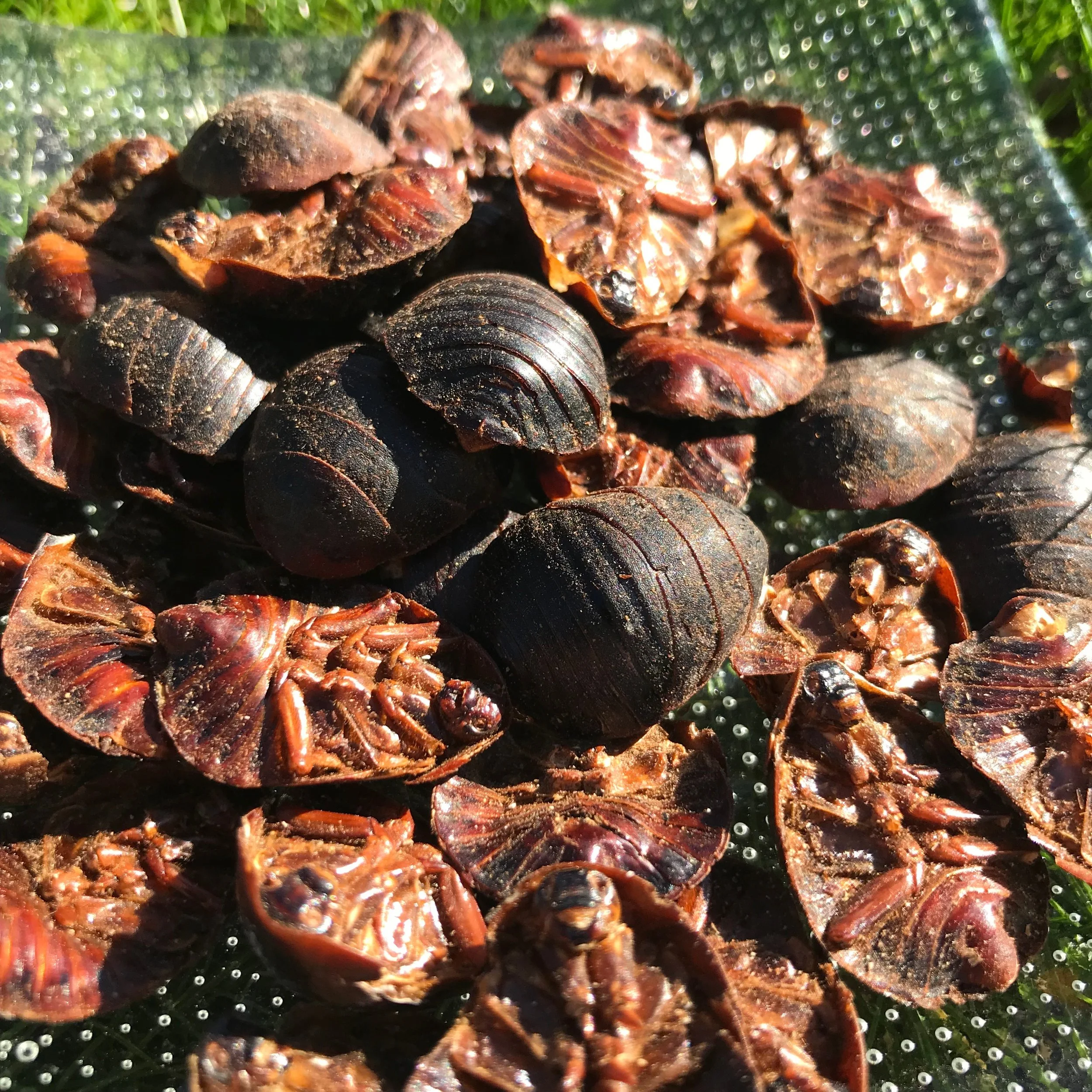
Tŭ Biē Chóng 土鳖虫
Latin: Eupolyphaga/Steleophaga
English: Wingless Cockroach
Properties: Salty, Cold, Slightly Toxic
Channels Entered: Liver, Heart, Spleen
Functions: Breaks up Blood Stasis, Renews Sinews, Joints and Bones
Salty and cold, tu bie chong lives in the ground or in the walls and floors of urban buildings. Its affinity for darkness makes it an ideal medicinal in the conquering of Yin based accumulations: static blood, masses & tumors in the abdomen.
In addition to Yin pathogenic influence, tu bie chong works exceptionally well at healing injuries, bone breaks, and sinew or tissue damage. This is because the cockroach heals itself well in life. If tu bie chong is cut in half and then re-attached, it will heal and continue to live! The doctrine of signatures suggests that this potential is activatable in medicine. This is especially the case when tu bie chong is combined with the resins of trees: Olibanum (rŭ xiāng) and Myrrha (mò yào).
The recommended dosage of tu bie chong is between three and twelve grams per day. One of the best things about this medicinal is that its cheap! For the time being, tu bie chong makes a great add-in to any herbal formula needing guidance into the deeper blood level of the body. It also makes for a good substitute for shui zhi or meng chong on a tight budget.
Yang Fliers for Fast Action
Some insects can fly and are attracted to light. They move and exhibit a buzzing sound, rapidly flapping their wings. This activity makes these creatures more like Yang. Yang is fast, agile, bright and big in its movement. It transforms turbidity and stuckness through an excited kind of Qi. While Yang transformation is successful, it normally requires a more stable partner for its transformations to be lasting.

Méng Chóng 虻虫
Latin: Tabanus
English: Horse Fly
Properties: Bitter, Slightly Cold, Toxic
Channels Entered: Liver
Functions: Quickly Breaks up Blood Stasis
Widely regarded as the most Yang bug medicinal, meng chong specializes in its fast-acting approach to transforming static blood accumulations and masses.
Meng chong flies in the air, buzzing around with a high frequency in life. When taken as a medicinal, meng chong’s bitter flavor combines with its Yang nature to quickly transform and purge accumulations. Though fast-acting, meng chong’s activity is relatively short lived. For this reason, it is normally combined with a more Yin-natured medicinal such as shui zhi to lengthen its medicinal effect.
Because of the rarity of meng chong as a medicinal, prices on the herbal market have begun to increase making meng chong quite an expensive ingredient. In the interest of keeping the price of herbal medicine affordable, the practitioners at Root & Branch have discovered that adding even as little as one to two grams of meng chong to an herbal formula per day is enough to make a huge difference in most cases. It should be noted however, that for best results, three to five grams per day is recommended.
Case Study: Chronic Cough
62 yr. Sys Male

History
Patient reported a history of chronic dry cough for ten plus years (no memory of initial onset). The cough was mild and unremarkable unless the patient would catch a cold. Once caught, the cold would move quickly into the chest and linger for as long as two or three months. The cold would typically manifest with a dry cough, extreme fatigue, and difficult to expectorate phlegm.
The patient also reported catching pneumonia when he was eight years old that was treated with antibiotics.
First Appointment
Patient caught a cold six weeks prior to the initial visit. Though the acute symptoms had mostly resolved, a dry cough and fatigue remained. The cough was bothersome throughout the day and only through the night if the patient awoke for a time. No phlegm was expectorated while coughing, but there was a sensation of fullness in the chest and the epigastrium. Patient reported a neutral body temperature, but a preference for warmth, and no sweating. “I never sweat,” he said. Patient was able to fall asleep easily, but would sometimes wake around 3 AM with racing thoughts and heart palpitations. Occasionally he would be unable to fall back asleep for several hours. The patient had to get up 2-3 times per night, on average to urinate. Appetite, digestion, and bowel movement were all unremarkable.
Tongue
Slightly pale, thicker white coat, red tip, engorged sublingual veins.
Pulse
Overall: tight, muffled, robust
Cun positions felt very muffled but robust and superficial.
Right Cun was slightly scattered, with a Yang Wei pulse indication.
Guan Positions were wiry and tight.
Chi positions were deep and weak.
Diagnosis
Wind-Cold Painful Obstruction of the chest (Bi Syndrome)
Obstruction of the upper burner resulting in clumping of the Qi
Lung Qi unable to descend
Formula
Zhi Shi Xie Bai Gui Zhi Tang (Granule)
Gua Luo Xie Bai Ban Xia Tang 60 g
Zhi Shi 8 g
Gui Zhi 10 g
Hou Po 8 g
Dosage: 6 grams 2 times per day for 7 days.
Second Appointment (one week later)
Patient reported improvement with both cough and energy level. He had expectorated some very thick yellowish phlegm throughout the week and was feeling much better. His middle of the night waking had also decreased, as did the palpitations and feeling of fullness.
Because the patient had to leave town for several weeks, I gave him two more weeks worth of the same formula and told him to get in touch with me once he was back in town.
Third Appointment (one month later)
Patient reported gradual improvement for the first week after the second appointment and then no more improvement. His cough had “gone back to normal” and was now mild, dry and intermittent throughout the day. His sleep had improved, but he would still wake up 2-3 times to urinate per night. He was slightly fatigued throughout the day. All other reviewed systems were unremarkable.
Tongue
Pale-red, dusky, thin white coat, red tip, engorged sublingual veins.
Pulse
less tight than before…
Cun positions were now deeper (about mid depth) and very scattered, but still robust.
Right Cun position still had a Yang Wei pulse indication
Middle positions had become more superficial but were mostly unremarkable
Chi positions were slightly stronger, but still deep and weak overall.
Diagnosis
Blood Stasis in the Upper Jiao
Kidney Qi Deficiency
Kidney failing to grasp Qi
Formula
Jin Fei Cao San with modifications (bulk decoction)
Xuan Fu Hua 9g
Bai Shao (Chao) 9g
Gan Cao 6g
Tao Ren 9g
Dang Gui (Chao) 9g
Di Long 3g
Sang Bai Pi 9g
Zi Wan 9g
Si Gua Luo 6g
Dosage: per day.
Result
After one week, the patient’s cough had completely subsided. I prescribed a similar version of the above formula over the next few months, slowly removing the stop cough and heat clearing medicinals and replacing them with herbs to supplement the Kidney and Lung Qi.
Six months later, the patient’s cough had not returned.
Analysis
The patient’s medical history indicated a long-standing lung weakness. This was likely due to, or aggravated by the occurrence of pneumonia during childhood. In my clinical experience, the Yang Wei pulse indication is a confirmation of this weakness.
The patient’s presenting symptoms of cough, feelings of fullness and pulse led me to believe that the pathogenic influence was stuck in the chest. Preference for warmth and lack of sweating made me lean toward a cinnamon based remedy. This case is clearly one of mixed excess and deficiency. I chose Zhi Shi Xie Bai Gui Zhi Tang to restore the functional movement of Yang Qi, dissipate clumping and expel phlegm.
Once the acute pattern of obstruction was addressed, the residual, more deeply rooted pattern of blood stasis began to show itself. The cun pulses got deeper and more scattered. The engorged sublingual veins and the continuation of the Yang Wei pulse all pointed to the need for herbs that could enter the luo mai.
Formula Breakdown
Xuan Fu Hua, Bai Shao Yao and Gan Cao were chosen as chief ingredients in the formula. These herbs were selected to liberate the Qi dynamic from obstruction and allow the descent of the Lung Qi. Xuan Fu Hua has a salty flavor and some sources say that it assists the Kidney in grasping the Qi. It is also commonly thought of as the only flower that directs downward. Bai Shao and Gan Cao make up the formula Shao Yao Gan Cao Tang, which is used moderate the spasmatic deficiency-related tendency for cough.
Tao Ren and Dang Gui were used to open the blood vessels and move the blood. These two ingredients also have a slightly moistening affect on the Large Intestine. The Large Intestine is the yang pair of the Lungs. Keeping the Large Intestine clear is a useful strategy when promoting the descent of Lung Qi.
Di long and Si Gua Luo are an herb pair used by Dr. Greg Livingston to drive the formula into the luo mai. Di long was selected because of its affinity for the lung and bladder channels - opening up the bronchioles of the lungs and promoting the smooth movement of the water passageways. Si Gua Luo is the luffa vegetable sponge. It looks like the lung’s bronchioles and is one of the only non-bug medicinals that is able to access the luo mai.
Sang Bai Pi and Zi Wan are dynamic cough medicinals used in cases of both excess and deficiency. Sang Bai Pi is sweet and cold, while Zi Wan is acrid, bitter, and warm. Together they are able to able to treat a variety of cough-related consumption patterns.
Why No Qi Tonics?
Because of the robust nature of the pulse in the cun pulse positions, I decided not to include medicinals that directly tonify the Lung’s Qi in the first formula. I felt that the salty flavor of Xuan Fu Hua and Di long were enough to encourage the movement of the Kidney’s grasping ability. In future renditions of the formula, I included various aspects of the formulas Sheng Mai San and Shen Qi Wan in order to tonify deficiency.
The Cultivation & Understanding of Traditional Medicine
Practicing a traditional medicine in modern times has many challenges. One of the biggest challenges comes when we try to communicate the difference of perspectives between the ancient and modern worlds. Perspective shapes the reasoning for action. It creates a context for why a particular medicinal would be prescribed or not. Understanding perspective is necessary before judging the method. And far too often today, we learn to judge before attaining this understanding.
Using insect-based medicinals has been one of the most valuable clinical insights for me. In the short span of my career as a Chinese medicine practitioner, I have been able to help numerous people with the knowledge that I have shared above. I am certainly no where near mastery of the art and science of Chinese medicine. Even so, I hope that the information presented in this article may be of use to practitioners who have the intelligence and skill to employ it.