What Your Stool Is Telling You: A Chinese Medical Field Guide
Bowel movements are one of the most reliable diagnostic signals the body produces, and most adults have never been told what to look for. Chinese medicine has been paying close attention to stool for two thousand years. Here is the physiology of a good one, and what it means when things are off.
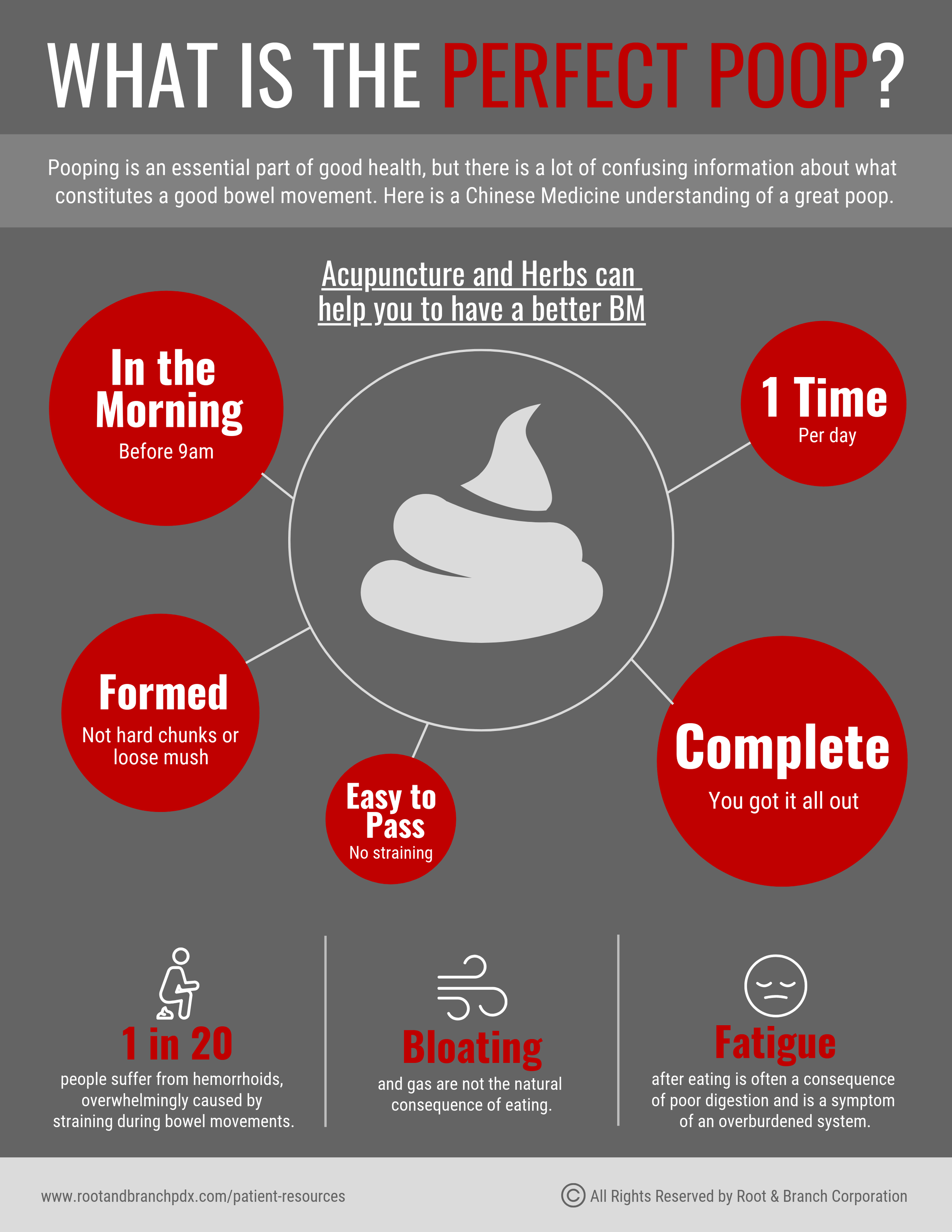
At Root & Branch we hand out an infographic in the clinic called The Perfect Poop, which is included alongside this post. It is exactly what it sounds like. Patients sometimes laugh when they first see it, which is fair, and then they take it home and read it carefully, which is the point. Bowel movements are one of the most reliable diagnostic signals the body produces, and most adults have never been told what to look for.
The Chinese medical tradition has been paying close attention to stool for roughly two thousand years. Color, form, frequency, timing, ease of passage, odor, and the relationship between what goes in and what comes out are all standard items in a careful intake.
What good looks like
A healthy bowel movement has five qualities worth naming explicitly. It is formed, complete, easy to pass, occurs in the morning, and happens about once a day. Each one is a real diagnostic signal, and each one is informative when it goes wrong.
Formed means the stool holds together as a recognizable shape without being hard or fragmented on one end and loose or mushy on the other. The Bristol Stool Scale, which any GI clinic in the country uses, calls this Type 3 or Type 4: a sausage shape, either with surface cracks or smooth. Anything harder than that suggests dryness, slow transit, or insufficient fluid in the bowel. Anything looser than that suggests either too much fluid, too fast transit, or both. In Chinese medical terms, the dry end of the spectrum tends to indicate Yīn or Blood deficiency, Heat, or stagnation; the loose end tends to indicate Spleen qì deficiency, Dampness, or cold in the digestive center. The pattern often shifts across the week or across the day, and that variability is itself diagnostic.
Complete means the bowel actually finishes its work in a single sitting. The sense that something is still up there, the urge that returns twenty minutes later, the multiple trips before the body is satisfied — all of these suggest that the descending function of the lower intestine is not operating cleanly. In biomedical terms, incomplete evacuation is associated with pelvic floor dysfunction, slow colonic transit, and sometimes structural issues that warrant imaging. In Chinese medical terms, it usually points to Spleen qì deficiency (the lifting and holding function is weak, so the conducting function downstream is uneven), Liver qì stagnation (the smooth flow is disrupted, so the bowel cannot release in one coordinated act), or Damp accumulation that makes the stool sticky and reluctant to move.
Morning is the timing claim that surprises people most. A healthy adult bowel tends to move within an hour or two of waking, well before mid-morning. There is good physiological reasoning behind this. The colon's strongest contractile activity, called the gastrocolic reflex, occurs in the hour after waking and after the first meal of the day. Cortisol peaks in the early morning, which contributes to the wake-up signal the gut receives. The Chinese organ clock, which assigns each two-hour window of the day to a particular organ system, places the Large Intestine at 5 to 7am. The two frameworks are describing the same biological reality. The body is designed to release its waste in the morning, and a system that is functioning well will tend to do so spontaneously, without coffee, without straining, and without prompting.
People whose bowels do not move until midday or evening, or whose timing is unpredictable from day to day, are usually showing some combination of irregular sleep, irregular meals, sympathetic nervous system overactivity, and a Spleen-and-Stomach system that has lost its rhythm. The fix is not a stimulant; it is a regular schedule of sleep, breakfast, and unhurried morning time, sustained long enough that the body can reset its own clock.
Once per day is the median frequency for adults. Some healthy people go twice. Some go every other day. The window of normal is wider than the median suggests, but one daily movement is a useful anchor, and significant deviation from that is worth paying attention to. Three or more times a day usually indicates Spleen qì deficiency with Dampness or, in biomedical terms, some form of malabsorption or accelerated transit. Less often than every other day usually indicates Yīn or Blood deficiency, Heat in the intestines, or Liver qì stagnation, and in biomedical terms reflects slow transit, low fiber intake, inadequate hydration, or sedentary habits.
Easy to pass is the quality most worth dwelling on. A well-functioning bowel does not require effort. The stool descends because the descending function of the digestive system carries it down, the smooth muscle of the colon coordinates its contractions, and the pelvic floor releases on cue. The person sitting on the toilet is doing very little active work. Straining is a sign that one or more of these mechanisms is off.
Roughly 1 in 20 adults in the United States have symptomatic hemorrhoids, and the overwhelming cause is straining. This is worth sitting with for a moment. Hemorrhoids are a structural injury caused by the repeated application of intra-abdominal pressure during defecation. They are not random and they are not inevitable with age. They are the predictable downstream consequence of a digestive system that is not doing its job and a person who is compensating with force. The same is true of many cases of pelvic floor dysfunction, anal fissures, and the more advanced forms of pelvic organ prolapse. The body is not meant to push that hard. When it has to, something upstream is asking for attention.
The Chinese medical physiology underneath
The center of digestion in Chinese medicine is the pairing of the Spleen and the Stomach, which together perform what the tradition calls yùn huà 運化, transportation and transformation. The Stomach receives food and begins to break it down. The Spleen extracts the usable portion, sends the clear part upward to be made into qì and Blood, and sends the turbid part downward to continue through the intestines.
This downward direction of the turbid is critical. The Stomach qì descends, the Spleen qì ascends, and the two movements together create the engine that pulls food downward through the digestive tract. When Stomach qì fails to descend, the result is reflux, nausea, burping, and bloating that rises rather than passing. When Spleen qì fails to ascend, the result is fatigue after meals, prolapse symptoms, and loose stools. The two failures often appear together because they are two sides of the same loss of directional integrity in the digestive center.
The Large Intestine sits below this center and does the final work. In Chinese medical terms it receives the turbid downward and conducts it out. Its function depends on the upstream Spleen and Stomach doing their work, on sufficient fluid in the bowel to keep the stool moving without becoming dry, and on the smooth flow of Liver qì across the abdomen to keep the smooth muscle coordinated rather than spasming or stalling.
The Lung, somewhat counterintuitively, is also part of the picture. The Lung and the Large Intestine are paired as the Yīn and Yáng organs of the Metal phase, and they share a functional relationship that classical texts describe explicitly. The Lung governs the descending of qì generally, and the Large Intestine carries out the most concrete version of that descent. Patients with chronic constipation often have shallow breathing, a tight diaphragm, and a history of holding their breath under stress. The connection is not metaphorical. The diaphragm is the major intra-abdominal pressure regulator, and breathing patterns shape the mechanical environment the bowel operates in.
The Liver regulates the smooth flow of qì across the whole system, and its influence on the bowel is constant. When Liver qì stagnates, the gut moves erratically. Cramping, alternating constipation and loose stools, urgency that does not produce much, and the strong relationship between emotional stress and bowel symptoms all reflect Liver involvement. This is the pattern underneath most cases of IBS, and we have written about it at length elsewhere.
The Kidney, finally, provides the deeper Yáng warmth that the digestive engine runs on. Older patients with chronic loose stools in the early morning, patients with cold limbs and low metabolic fire, and patients whose digestion never recovered from a long illness or a stressful period often need to be treated at the Kidney level rather than just at the Spleen and Stomach level. Without the foundational Yáng, the Spleen cannot do its work no matter how well it is supported directly.
When the signals stop matching
Two related signals are worth lingering on alongside the stool itself. Bloating and gas are not the natural consequence of eating, and fatigue after eating is often a sign of an overburdened system.
Both are signals that the descending and transforming work of the digestive center is not keeping up with what is being asked of it. Mild gas is normal. Bloating that distends the abdomen visibly, gas that produces real discomfort, and the sensation that food is sitting in the upper abdomen for hours after a meal are not normal. They are signs that the Spleen qì is depleted, the Stomach qì is not descending cleanly, or that Damp is accumulating in the middle because the system cannot transform the volume or quality of food it is receiving.
Post-meal fatigue follows the same logic. If digestion is functioning well, a meal should leave the eater settled and stable. A modest dip in alertness after a large meal is normal; the desire to lie down after a regular lunch is not. It signals that the Spleen is being asked to do more than it can manage and is borrowing energy from elsewhere to do it, which is the same physiological move that underlies the afternoon crash and the chronic low-grade fatigue many patients arrive with.
These symptoms, like the qualities of the stool itself, are diagnostic. They are not nothing, they are not inevitable, and they respond to treatment. The Chinese medical approach to digestion is not to suppress symptoms but to restore the upstream functions that produce them when they are working correctly.
Learning to read what you have
The standard cultural conversation about bowel movements is almost entirely missing. Most adults have no model of what they are looking for, no sense of what counts as a problem worth raising, and no way to track their own digestive health over time except as a vague sense that something is or is not off. The five qualities above are enough to start a conversation that most people have never had with themselves.
The body is informative if you let it be. Stool is one of the cleanest signals it produces, and learning to read it is one of the more useful pieces of self-knowledge available to anyone willing to look. When digestion is working, the signals match. When something is off, the signals will tell you, in considerable detail, what to investigate next.

The Case for Breakfast, and for Being Hungry
Modern wellness advice often treats appetite as a problem to manage. In Chinese medicine, regular morning hunger is a sign that digestion is working, and breakfast is the meal that sets the metabolic tone for the day. Skipping it asks the body to run on stores that should have been replenished.
Appetite is actually your friend
There is a version of modern wellness advice that treats appetite as a problem to be managed. Hunger is recast as a temptation, a sign of poor discipline, or evidence that the previous meal was somehow wrong. The fix is usually to eat less, eat later, or eat in ways that suppress the hunger signal entirely. A meaningful number of people now skip breakfast as a matter of principle, and a meaningful number of those people also report that their relationship with food has become more anxious rather than less.
Appetite is a good thing. Regular morning hunger is one of the better signs that digestion is doing its work. It arrives on a schedule, does not come with urgency, and goes away when you eat and stays away until the next meal. This is different from the kinds of hunger our patients more often describe: the jittery hunger that follows coffee on an empty stomach, the late-afternoon hunger that comes from a skipped breakfast catching up, or the anxious hunger that is really stress wearing the costume of appetite. Those are signs that something is off. Morning hunger, by itself, is a sign that something is working.
In Chinese medical terms, breakfast sets the metabolic tone for the day. The Spleen 脾 (pí) and Stomach 胃 (wèi), which together form the center of digestion in Chinese medicine, are at their most active in the morning hours. The classical organ clock places the Stomach's peak between 7 and 9 a.m. and the Spleen's between 9 and 11 a.m. Eating warm, substantial food during this window gives the digestive system the work it is built for at the moment it is best equipped to do it. Skipping breakfast asks the Spleen to start its day without fuel, and asks the rest of the body to run on stores that should have been replenished.
The biomedical picture lines up surprisingly well. Cortisol peaks in the early morning as part of the normal awakening response, and one of cortisol's jobs is to mobilize glucose for the day's activity. Insulin sensitivity is generally highest in the morning and declines through the day, which means the body handles the same meal more efficiently at 8 a.m. than at 8 p.m. The hormones that govern appetite, ghrelin and leptin, follow a circadian pattern that has them rising and falling in a rhythm shaped by when and how regularly we eat. When that rhythm is disrupted, by skipped meals, by erratic timing, or by eating heavily at night, the system gets noisier and the signals become harder to read. People who say they "don't feel hungry in the morning" are often describing a hunger signal that has been quieted by months or years of not being answered.
The intermittent fasting literature is not wrong about everything. There are populations and contexts in which time-restricted eating produces real benefits, and some people do well with a later first meal. The complication is that the people who do well with that approach tend to be metabolically robust to begin with, and the people who arrive at our clinic are usually not in that category. They are tired, their digestion is sluggish, their sleep is uneven, and they have often been treating their already-depleted system as if it were robust. For these patients, the prescription is usually the opposite of what the fasting protocols suggest. Eat earlier. Eat warm. Eat enough that the body has something to work with.
The "I'll just have coffee" approach is the most common breakfast in our patient population. Coffee on an empty stomach is a stimulant acting on a system with no fuel. It produces alertness by pushing the adrenal system harder, not by feeding the body, and the energy it provides is borrowed against later. Over weeks and months, the pattern produces the picture we see often in the clinic: morning tension, weak breakfast appetite, mid-afternoon crashes, evening hunger that becomes evening overeating, and sleep that does not quite restore. The fix is not to give up coffee. The fix is to put something underneath it.
What this looks like in practice
A good Chinese medical breakfast is warm, cooked, and substantial enough to register as a meal. The traditional staple is congee, a slow-cooked rice porridge that can carry whatever vegetables, herbs, meat, or eggs you want to add to it. Oatmeal cooked with a little ginger and walnuts is a great Western analog and is what many of our patients end up eating. Eggs, sautéed greens, and a piece of warm sourdough work just as well. The principle is that the food is warm and easy to digest, that it contains some real protein and fat, and that it actually fills you for several hours.
What we generally steer people away from at breakfast: cold cereals with cold milk, raw fruit smoothies (especially with ice), pastries on their own, and any breakfast built around cold and sweet without warmth or substance underneath. These foods do not damage the Spleen in any one instance, but they cool and weaken digestion over time when they are the default morning meal, and the people who eat them most consistently are usually the people whose digestion is already running cool.
Timing matters less than the meal itself, but earlier is generally better than later. Eating within an hour or two of waking aligns with the Stomach and Spleen meridian times and with the morning cortisol and insulin pattern. If your schedule does not allow for that, a breakfast at 9 or 10 a.m. is still vastly better than no breakfast at all. The goal is not to optimize the timing to the nearest fifteen minutes. The goal is to actually eat.
If you are someone who has not been hungry in the morning for a long time, the appetite usually comes back within a week or two of eating breakfast regularly. The hunger signal is responsive to feeding; the body learns to expect food at a certain time and starts producing the signal that asks for it. The first few days can feel a little forced, and that is fine. Eat something small if you do not feel hungry. Within ten days, most people are waking up actually wanting breakfast, which is the body's way of telling you the rhythm has come back online.
The wider point about appetite
Appetite, in the larger sense, is the same kind of signal. A person who is hungry for their work, hungry for time with people they love, hungry for the next book or the next conversation or the next walk, is a person whose system is functioning. Appetite for life and appetite for food are directly related and have the same physiologic basis. They both depend on the same underlying capacity for the body to want what it needs and to know when it has had enough.
The patients who eat without pleasure or intention and sleep without rest and move through their days on caffeine and willpower, are usually the same patients who skip breakfast. The two patterns reinforce each other. A system that is not fed in the morning learns to suppress its demands. A system that suppresses hunger long enough learns to suppress other appetites too. The flatness and fogginess people describe is sometimes depression, sometimes burnout, sometimes a thyroid issue, and all of those things are what happens to a body that has been told for too long that wanting things is the problem.
Breakfast is a small daily way back into that capacity. You eat in the morning because you are an animal that needs food, and because the Spleen and Stomach are ready to work, and because the day ahead will go better if it has something behind it. The hunger that returns when you start doing this is not a problem to manage but is instead the system coming back to itself.
Foundations of Chinese Medicine: The Spleen
Digestion is the root of virtually all other human physiologic processes. Learn about how Chinese medicine thinks about and works with the natural strength of your digestion to maximize outcomes and power a healthy life.
What the Spleen Actually Does
Patients often come into the clinic for one thing and get asked about another. Someone arrives exhausted, and we spend ten minutes on their bowel movements. Someone comes in for heavy periods, and we want to know what they eat for breakfast. Someone is worried about a bruise that took three weeks to fade, and we ask whether they feel worse when they skip meals. The questions can seem oblique, and most patients are gracious about answering them without quite knowing why we are asking.
The reason is that Chinese medicine treats the digestive system as the upstream source of almost everything else the body does. The tradition has a specific organ system, the Spleen, whose job is to take food and fluid and turn them into the substances the body uses to power, build, and repair itself. When that conversion is going well, the downstream systems have what they need and tend to work. When it is going poorly, the downstream problems show up first, which means people often arrive at the clinic for fatigue or menstrual irregularity or anxiety or poor healing, not recognizing that their digestion is the variable that ties them together.
This is one of the genuinely distinctive moves in Chinese medical thinking, and it reorganizes how a lot of common complaints get approached. It is also one of the harder ideas to translate, because the Spleen in this sense is a different organ than the biomedical spleen. Understanding what the tradition actually means by it is most of the work.
The Spleen as Functional System
A short note on the word first. The English "spleen" is a translation of the Chinese character 脾 (pí), and the translation is old enough to be fixed even though it is misleading. The biomedical spleen is a small organ in the left upper abdomen involved in blood filtration and immune function. The Chinese Spleen is a functional system that encompasses digestion, nutrient absorption, fluid metabolism, and the production of qì and Blood from food. The two share a name and very little else. When Chinese medicine writing capitalizes Spleen, it is signaling that the functional system is meant rather than the anatomical organ.
This kind of naming is common in Chinese medical thinking. The organs are defined by what they do rather than by what they are structurally, which means the Heart in Chinese medicine includes functions biomedicine locates in the brain, the Kidney includes functions biomedicine locates in the adrenal glands and reproductive system, and the Spleen includes functions biomedicine distributes across the stomach, small intestine, pancreas, and parts of the liver. The tradition is not confused about anatomy. It is organized around a different question, which is what the body is doing rather than where the doing is happening.
For the Spleen, what it is doing is the transformation of food and fluid into the substances the body actually uses. Classical texts name these substances qì and Blood, and most of this post is about what those terms mean in practice and why the Spleen's role in producing them matters so much clinically.
Qì and Blood as Bodily Resources
Qì 氣 is the most translated and most mistranslated term in Chinese medicine. "Energy" is the usual English rendering and it flattens the term into something vaguer than the tradition intends. In the context of digestion and the Spleen, qì is better understood as the body's capacity to do work. It is what powers muscular movement, keeps organs in their proper position, holds blood inside vessels, drives immune responses, and sustains the countless small cellular operations that add up to being alive. Biomedicine would describe most of this as a combination of ATP, hormonal signaling, neural activity, and tissue integrity. The Chinese framework groups these functions under a single term because the tradition is interested in whether the body has enough of what it needs to do its work, and qì is the name for that sufficiency.
Blood in Chinese medicine overlaps with biomedical blood but extends further. It includes the physical substance that biomedicine measures in a CBC, and it also includes the nourishing and moistening function that blood performs for every tissue it reaches. Blood nourishes muscle, moistens the eyes, supports the mind and memory, carries warmth through the body, and provides the substrate for menstrual flow. When Chinese medicine says someone is Blood deficient, the claim is not necessarily that their hemoglobin is low, though it sometimes is. The claim is that the nourishing and moistening work that Blood is supposed to do is not getting done adequately, and the signs of that deficit show up in the tissues that depend on it.
Both of these substances are produced, in Chinese medical theory, by the Spleen acting on food and fluid. The Stomach receives and begins to break down what you eat, and the Spleen extracts from that partially processed food the refined substance that becomes qì and Blood. The unrefined remainder continues down through the digestive tract for elimination. This is the tradition's account of what digestion is for: not simply to move food through the body, but to convert it into the resources the body uses to run everything else.
The implication is direct. If the Spleen is doing its job well, the body has what it needs. If the Spleen is weak, the supply is thin, and the downstream systems that depend on qì and Blood show the shortage first.
What Spleen Weakness Looks Like Downstream
The clinical pictures that follow are among the most common in outpatient Chinese medicine, and they share a structural feature. None of them is primarily a digestive complaint, and in each of them, improving digestion is often how the complaint resolves.
Fatigue is the most direct. When the Spleen is producing less qì than the body needs, the body has less capacity to do work, and the experience of that shortage is tiredness. The specific quality of Spleen-related fatigue is worth knowing, because it is different from other kinds of tiredness. Patients describe it as heavier after meals rather than relieved by them, worse in the afternoon, accompanied by a sense of mental dullness or brain fog, and often paired with a desire to lie down rather than sleep. It is the fatigue of not having enough to work with, not the fatigue of having worked hard. Standard workups typically come back unremarkable, and patients are often told their labs are fine and their fatigue is stress. The Chinese medical account is that the fuel supply is thin, and the fix is to improve what the digestion is producing.
Menstrual patterns are another territory where Spleen weakness shows up clearly, in two opposite-looking presentations. Light, pale, shortening periods often reflect Blood deficiency, which the Spleen has a direct role in producing. Heavy, prolonged, or breakthrough bleeding often reflects what the tradition calls the Spleen failing to hold Blood in its vessels. Both of these patterns are Spleen patterns, even though they look nothing alike symptomatically, and both of them respond to strengthening Spleen function. Patients who have been told their heavy periods are just how their body is, or that their scanty periods are just stress, often find that several months of digestive support changes the picture meaningfully.
Easy bruising and slow wound healing belong to a similar family. The Spleen's role in holding Blood includes holding it inside small vessels under normal mechanical stress, and when that function is weakened, minor bumps produce bruises that the same bumps would not have produced a year earlier. Healing is also a construction project, and construction projects require materials. When qì and Blood supply is thin, wounds take longer to close, scars take longer to mature, and recovery from illness takes longer in general.
Anxiety that tracks with hunger is the clinical picture most patients find unexpected. When people notice that their anxiety is worse when they have not eaten, better after a meal, and prone to flare in the late morning or late afternoon, the pattern often involves Spleen weakness affecting the production of qì and Blood that support the Heart and the mind. The biomedical parallel is blood sugar regulation and the downstream effects on cortisol and mood, and the two frameworks are describing related aspects of the same underlying reality. Patients in this pattern often do better on regular meals with adequate protein and complex carbohydrate than on any amount of anxiety-directed intervention, because the anxiety is a symptom of a supply problem rather than a primary psychological condition.
Cognitive fog, poor concentration, and the specific complaint of "not feeling sharp" round out the common presentations. The Chinese medical account is that the mind depends on adequate qì and Blood reaching the Heart and the head, and that supply depends on the Spleen. When the digestion is not producing enough, the cognitive work that depends on that production suffers, and patients describe feeling dull, slow to find words, or foggy in ways that do not track with sleep or stress.
Why This Reframes the Clinical Approach
The common thread across these pictures is that the presenting complaint is not the problem. Fatigue, irregular periods, easy bruising, hunger-related anxiety, and cognitive fog can all be driven by digestive insufficiency that the patient has not connected to their symptoms. Chinese medicine looks for this connection routinely, which is why the intake asks about things that seem unrelated to what brought someone in. The practitioner is checking whether the downstream symptom might have an upstream driver.
When the driver is identified, the treatment often targets the digestion rather than the symptom. Herbs that support Spleen function, dietary adjustments that match the Spleen's preferences for warm, cooked, regular meals, acupuncture points that strengthen digestion, and lifestyle changes that reduce the load on the digestive system are the common tools. Patients sometimes find it disorienting that the treatment for their heavy periods is a change to how they eat breakfast, or that the treatment for their fatigue is an herbal formula aimed at their digestion. The logic becomes clearer when the framework is visible. If the Spleen's output is what the downstream systems are running on, improving that output is how the downstream systems get fixed.
This is also why Chinese medicine tends to improve a set of apparently unrelated symptoms at once. A patient who comes in for fatigue and also has heavy periods, slow healing, and afternoon anxiety often finds that all of them shift together over a few months of treatment, because the shared upstream cause is getting addressed. Patients sometimes remark on this with some surprise. They came in for one thing and got five things, and the five things were all the same thing.
The broader point is that the digestive system in Chinese medical thinking is not peripheral to the rest of the body's function. It is the source from which the rest of the body's function is built. Understanding this reframes why the tradition pays so much attention to what and how people eat, why so many Chinese herbal formulas include digestive support as a base, and why patients with complaints that have nothing apparently to do with digestion often benefit most from having their digestion treated first. The Spleen is doing more work than its quiet name suggests, and recognizing that is most of what makes the rest of the tradition make sense.

Everyday Alchemy: Cold and Raw Cautions
Learn about ways to maximize your digestive strength by being mindful of how much cold and raw food you are eating.
On Cold Food, Raw Food, and the Digestive Fire
There is a recommendation that comes up often in Chinese medicine clinics and almost never in the rest of the food conversation in this country: go easy on cold and raw foods, and when you do eat them, eat them in the season they grow, during the part of the day when your digestion is strongest, and in a smaller quantity than the salad-bar version of health would suggest. This runs against a lot of contemporary nutritional advice, which tends to frame raw vegetables and iced drinks as categorically good and to treat any caution about them as fussy or unscientific. The Chinese medical position is more specific than that, and once you see what it is actually claiming, it tends to stay with you.
Cold and raw foods have a place. The question the tradition asks is where that place is: which foods? in which season? at which time of day? and in what quantity?
Why the Digestive Fire Matters
In Chinese medical terms, the reasoning starts with the Spleen and Stomach, the paired organ systems responsible for what the tradition calls the transformation and transportation of food. The Spleen in this sense is the functional system that takes what you eat and drink and converts it into the substances the body actually uses, which is a larger role than the small immunological organ biomedicine names by the same word. That process runs on warmth. Classical texts describe the Stomach as a cooking pot and the Spleen Yáng as the fire underneath it, and the metaphor holds up well enough that it is worth taking seriously. Food that arrives cold has to be warmed to body temperature before the digestive system can work on it, and that warming costs the Spleen something each time. A cold meal occasionally is a small cost. Cold meals as a daily habit, especially in people whose digestive fire is already low, become a pattern called Spleen Yáng deficiency. The clinical presentation includes bloating that worsens after cold foods, loose stools, fatigue after eating, cold hands and feet, and a general sluggishness that people often attribute to stress or sleep when the more proximate cause is sitting on their plate.
Raw food sits in a similar category, slightly differently. Raw plant material is harder to break down than cooked plant material, because cooking does some of the work of digestion in advance by breaking down cell walls and making nutrients more available. A healthy digestive system handles raw food well. A depleted one struggles, and the difference shows up as the same bloating and sluggishness that cold food produces, often with more gas. Raw vegetables in moderation, in the warmer seasons when the body has less thermoregulatory work to do, eaten when digestion is strongest (daylight hours), are a different proposition from a kale salad at six in the evening in February.
The physiological picture in biomedical terms lines up with the traditional framing more than you might expect. Gastric emptying slows when the stomach has to warm incoming food. Digestive enzyme activity is temperature-dependent, with most enzymes working optimally at body temperature and dropping off sharply below it. Cold liquids in particular trigger transient vasoconstriction in the gastric mucosa, which reduces blood flow to the tissue that does the actual work of digestion. None of these effects is dramatic in a single meal. They accumulate across a dietary pattern, and they accumulate faster in people whose digestion is already compromised by stress, illness, medication, or age. The Chinese medical account of why cold and raw foods burden digestion describes a thermoregulatory and enzymatic reality that centuries of clinical observation identified well before laboratory measurement could confirm it.
Season, Time of Day, and Amount
Seasonality enters the picture because what grows locally at a given time of year tends to be what the body can actually use at that time of year. Summer produces the cooling, hydrating foods a warm body wants: watermelon, cucumber, tomato, leafy greens, soft fruits. Winter produces the denser, warming foods that support metabolic function in cold weather: root vegetables, cabbages, winter squash, alliums. The contemporary grocery store has flattened this calendar by making strawberries available in January and butternut squash available in July, but the body has not updated accordingly. Eating watermelon in January asks the digestive system to cool a body that is already working to stay warm. Eating strawberries in January gives you a fruit that was picked unripe, shipped thousands of miles, and contains a fraction of the nutrients it would have in June. The seasonal guidance is practical: work with the thermoregulatory situation the body is actually in.
The time-of-day question is the one patients find most counterintuitive, because the American food calendar tends to concentrate raw vegetables at dinner. In Chinese medicine, digestive capacity follows a daily rhythm. The Stomach and Spleen are at their strongest in late morning and midday, between roughly seven and eleven for the Stomach and eleven to one for the Spleen in the classical organ clock. By evening, digestive fire is lower, which is part of why heavy or cold meals late in the day produce more trouble than the same meals at lunch. If you are going to eat a big raw salad, lunch is a better placement than dinner. If you are going to drink a smoothie made of cold fruit and ice, morning is a better placement than after work (though to be honest, smoothies are one of the biggest culprits of weakened digestion). Shifting the raw and cold portion of the day earlier is one of the simplest adjustments a person can make, and it often produces a noticeable improvement in digestion within a week or two.
Quantity is the last piece, and it is where the practice tends to resolve for most people. The traditional guidance is that cold and raw foods should make up a minor portion of the plate, alongside a cooked main. A palm-sized serving of salad next to a warm dish is different from a dinner-plate-sized salad as the whole meal. A small glass of cold water with a meal is different from a large iced drink. Cold and raw foods place a real demand on the digestive system, and that demand should be sized to what the system can comfortably meet.
Putting all of this into practice tends to look less dramatic than it sounds. A reasonable pattern for most people is something like this. Start the day with something warm, whether that is congee, oatmeal, eggs, or just hot water with lemon before breakfast. Eat raw vegetables at lunch rather than dinner, in moderate quantity, alongside cooked food. Favor room-temperature or warm water over iced water with meals, and keep ice for hot days when you are genuinely overheated. Let the season guide the plate, which in practice means eating more raw and cooling food from late Spring through early Autumn and more cooked and warming food from late Autumn through early Spring. Dinner, in particular, benefits from being cooked and warm, with soups and stews doing real work in the colder months.
The signs that the shift is helping are usually subtle, but they build over time. Digestion that had been sluggish becomes more reliable. The bloating that used to follow certain meals stops happening. Energy after eating improves instead of crashing. Cold hands and feet warm up over weeks. These are the ordinary markers of a digestive system that has been given conditions it can work with, and they compound quietly over months.
I do want to name a tension that exists in this advice though. If you are someone who has been told, possibly repeatedly, that raw vegetables and cold-pressed juices are the foundation of a healthy diet, shifting toward cooked and warm foods can feel like you’re doing something wrong. That feeling should be acknowledged and then consciously set aside. We are not interested in the moral or “correct” way of eating, from any point of view. The Chinese medical view is that raw food is a particular kind of food with particular requirements, and that eating it without regard to season, time of day, or quantity places a load on digestion that a lot of people cannot comfortably carry. The work is mostly a matter of meeting the body where it actually is, not about a universal system of the “right” way to live.
The practice, in the end, is a form of attention. You are paying attention to what the season is offering, to when your digestion is at its strongest, and to how much of any given food your body can actually use. None of this is complicated, and none of it requires giving anything up. It requires only that the question of what to eat include the question of when to eat it, and in what company, and in what amount. Those questions have answers, and the answers tend to make the body feel better. That is the whole of it.