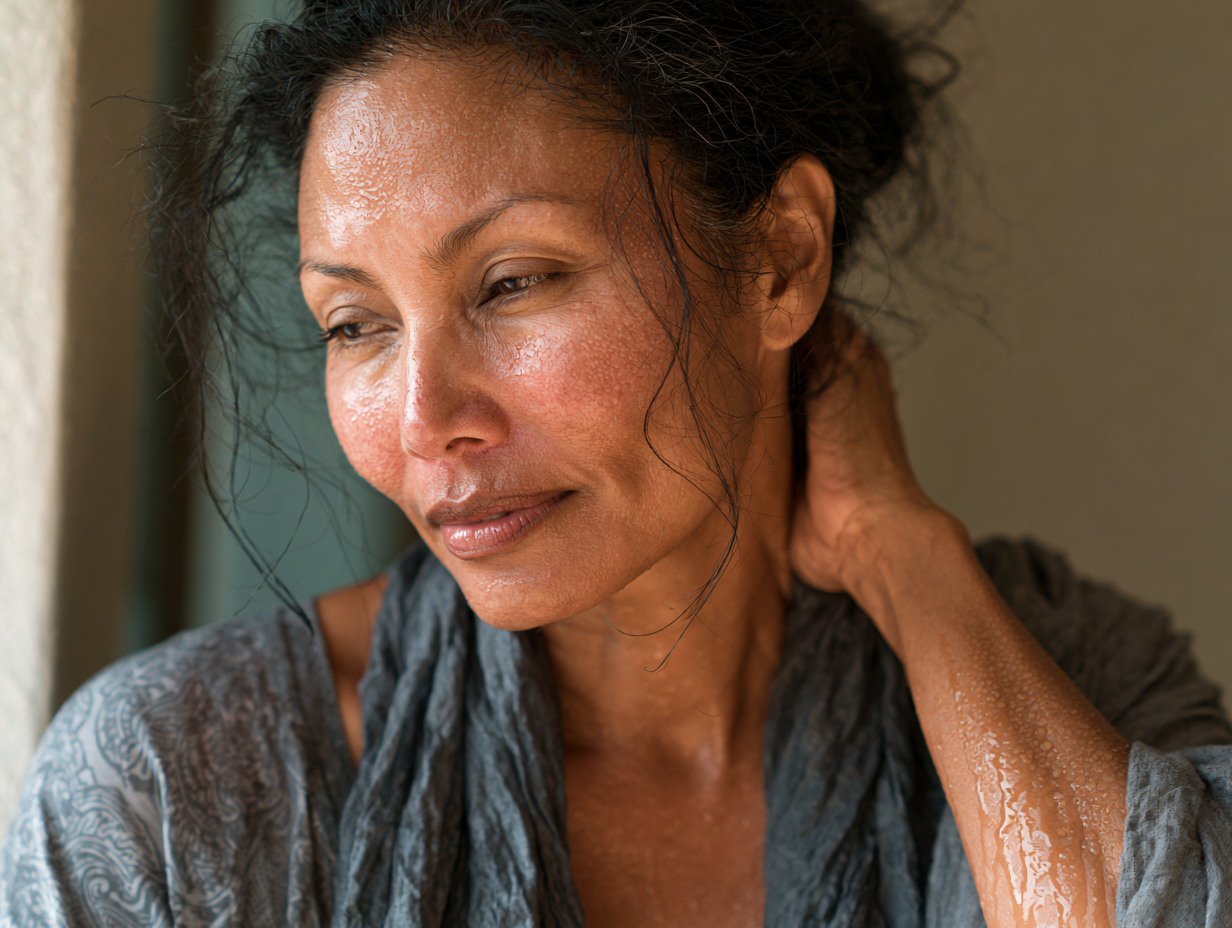
Feeling like a stranger in your own body?
Which element are you?
Wood, Fire, Earth, Metal or Water.
Two minutes, twenty-some questions, and a clearer picture of how your body handles change.
Your type shapes how perimenopause tends to show up for you, and what helps most.
Waking at 3am, too hot to sleep?
Periods that arrive early, late or not at all?
Feeling short-fused or flat in a way that isn’t like you?
The transition
is not something you just have to endure
Chinese medicine can help: perimenopause and midlife hormonal change
Perimenopause usually starts in the early-to-mid forties and can last anywhere from four to ten years. Many of the women who come to Root & Branch have already asked about it somewhere else. Their labs came back “normal.” They were told it’s just age, or offered a birth control pill, an antidepressant, or a referral to wait and see. Some of that helps. A lot of it doesn’t touch the night sweats, the broken sleep or the sense of running on a different engine than the one you had at thirty-five.
Chinese medicine has described this stage of life for two thousand years. It treats it as a transition the body is moving through, and the work is helping that move go smoothly.
What’s actually happening
Across perimenopause, ovarian hormone production becomes uneven before it declines. Estrogen can swing higher than usual one month and drop sharply the next, while progesterone falls earlier and more steadily. That unevenness, more than low hormones alone, drives many of the classic symptoms: hot flashes and night sweats, sleep disruption, heavier or irregular bleeding, breast tenderness, mood changes, brain fog and joint aches.
A blood test on any one day only catches one point in that swing, which is why labs so often look unremarkable while you feel anything but.
How Chinese medicine reads the pattern
In the classical texts, a woman’s reproductive life is described in seven-year cycles, with the shift around age 49 tied to the gradual decline of the Kidney system, the body’s deep reserve of cooling, moistening Yin and warming Yang.
When Yin runs low, there isn’t enough cooling to anchor the body’s heat. That heat rises: flushing, sweating at night, a dry mouth, a racing mind at 3am. When the Liver system is also strained by stress and overwork, you see irritability, breast tenderness, headaches and the feeling of being wound tight. And when the Heart isn’t settled, sleep and mood are the first things to go.
Most women show a blend of these patterns, and your constitution, the element you lean toward, shapes which ones lead. Part of the first visit is sorting out which patterns are present and how they’re interacting.
What treatment looks like
Treatment works on the underlying pattern rather than suppressing one symptom at a time.
Custom herbal formulas. A formula for perimenopause usually nourishes Yin and clears the rising heat, while moving whatever has become stuck. It is built for your pattern and adjusted as the transition moves along.
Acupuncture. Acupuncture shifts the nervous system toward the rest-and-repair state where sleep and temperature regulation recover. In a 2019 randomized trial in BMJ Open, women receiving five weeks of acupuncture reported significantly fewer hot flashes and better sleep than those who waited.
Food, sleep and rhythm. We focus on practical changes: cooling and nourishing foods, when to eat, how to protect sleep, and how to pace a life that hasn’t slowed down just because your body is changing.
Working with your doctor. Chinese medicine works well alongside hormone therapy, and we’re glad to coordinate with your gynecologist or primary care provider.
Handouts and resources
Free to download. Take them home, share them with a friend, bring them to your next appointment.
What to expect from a first visit
The first appointment runs about 90 minutes. We take a detailed history of your cycle across the years, your sleep, energy, temperature and mood, look at your tongue and feel your pulse. You leave with a pattern diagnosis, a starting herbal formula and a sense of what the arc of treatment looks like.
Most women notice changes in sleep and hot flashes within the first few weeks, with deeper shifts building over a few months. We’ll talk honestly about what’s realistic for you.
Not ready to book? Start with the quiz and see where you land.
Further Reading