Foundations of Chinese Medicine: Jīng 精
In Chinese medicine, jīng 精 is your essence—your inherited strength, your reserves, and your potential. This post explores how jīng shapes health across a lifetime, its connection to modern ideas like genetics and epigenetics, and how everyday choices can help preserve and cultivate this vital foundation.
Your Inheritance, Potential, and Reserves
Among the foundational ideas in Chinese medicine, few are as rich—and as layered—as the concept of jīng 精. Usually translated as “essence,” jīng represents something both simple and profound. It is your inherited material, your deep reserves, and your capacity to grow, reproduce, and age. It animates the trajectory of life. And while jīng is not the same as genetics in the modern biomedical sense, there are compelling resonances—especially when we consider how experience can shape inheritance, and how our individual potential is both given and cultivated.

In classical Chinese texts, jīng is described as the foundational substance that underlies all life processes. It is the most condensed and vital form of material in the body—more refined than blood, deeper than qi. The Huáng Dì Nèi Jīng 黃帝內經 (c. 2nd century BCE), identifies jīng as the root of growth, reproduction, development, and vitality. It is closely associated with the Kidneys, which are not just a pair of organs in Chinese medicine, but a system that governs life force, constitutional strength, and long-term reserves.
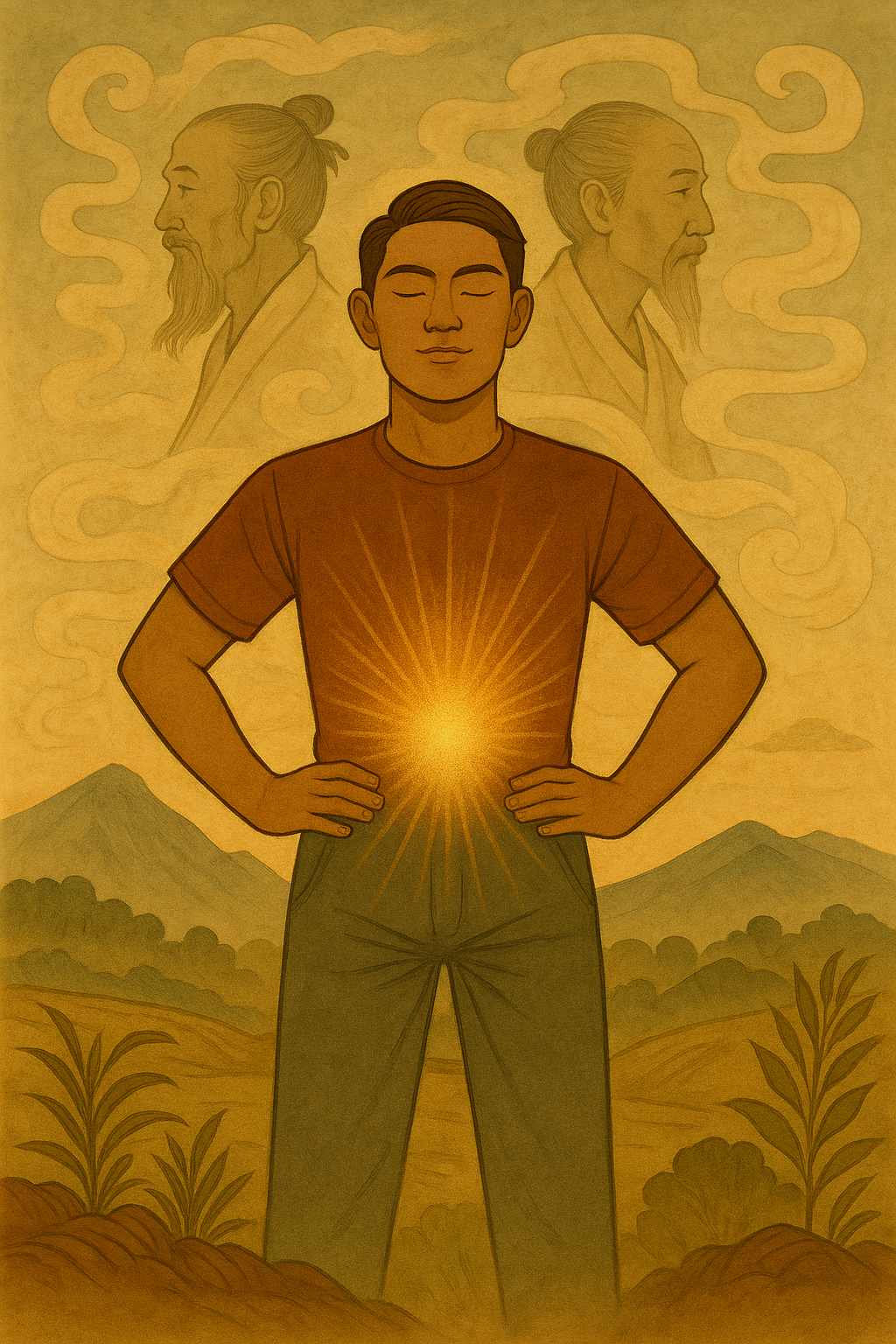
Jīng is sometimes described as coming in two forms: pre-natal and post-natal. Pre-natal jīng is inherited from your parents at conception—it’s your starting endowment. It determines your constitutional strength, your basic developmental patterns, and how you’ll move through the stages of life. Post-natal jīng, on the other hand, is something you accumulate and refine through daily life—primarily through food, breath, rest, and experience. These two aspects are interdependent: the pre-natal sets the limits, but the post-natal helps determine how fully those limits are explored or sustained.
The idea that we inherit something at birth that defines our baseline health and longevity maps reasonably well onto the idea of genetics. Our DNA sets certain parameters—height potential, predispositions, vulnerabilities. But the Chinese medicine concept of jīng adds something important to the idea of baseline inheritance found in DNA because it recognizes that life doesn’t stop at that inheritance. Life is not only what we receive at birth, no matter how potent a genetic marker may be. Our lives shape us. And what we experience, how we live, and what we absorb doesn’t just affect us—it becomes part of what we might pass forward.
Modern Science Catches Up to Ancient Knowledge
Modern research in epigenetics reflects something similar. We now understand that while genes provide a blueprint, their expression is not fixed. Diet, stress, trauma, environmental exposure, and social context all influence how genes are turned on or off—and these changes can be passed to future generations. In this sense, what Chinese medicine describes as post-natal jīng—the essence that is created through experience and stored in the body—has a contemporary parallel. The life you live is not only shaping your health; it may also be shaping your children's inheritance.
This is where jīng becomes more than just an abstract concept. It helps explain why some people seem to recover easily while others are more depleted. It offers insight into why certain illnesses run in families—not just genetically, but constitutionally. It also gives us a way to think about aging, fertility, and chronic fatigue that centers not on specific diseases but on the gradual ebb and flow of core vitality.
In clinic, we often recognize signs of jīng deficiency by their depth and persistence. People may come in with symptoms like fatigue that doesn’t improve with rest, premature graying or hair loss, developmental delays, fertility challenges, or difficulty recovering from major illness. Sometimes there are no obvious biomedical markers, but there is a sense that the system is running low. These are the cases where jīng becomes part of the conversation, not to pathologize, but to guide treatment and expectation.
Supporting jīng isn’t about quick fixes. There is no single herb or point that restores it overnight. Because jīng is so foundational, its cultivation requires time and attention. Rest is essential. Deep, nourishing sleep gives the Kidneys time to store and restore essence. Food plays a role too—particularly in how digestible and sustaining it is. Warm, cooked meals that are easy to assimilate are more helpful to jīng than raw or processed foods, especially for those already feeling depleted.
Emotionally, jīng is preserved when life is paced. Long periods of overwork, overstimulation, or chronic emotional strain can gradually consume essence, even if we appear to be functioning well on the surface. This doesn’t mean we need to avoid challenge, but that recovery must be part of the cycle. When people talk about burnout, adrenal fatigue, or “hitting a wall,” these may be contemporary ways of describing what Chinese medicine has long understood as the exhaustion of jīng.
Sexual activity is another traditional consideration. In the classical view, excessive ejaculation or unmoderated sexual activity can deplete jīng, especially in men. For women, reproduction itself draws on jīng, particularly during pregnancy and postpartum recovery. The prescritions around sexual conduct are not about instilling a kind of prudishness, shame, or abstinence, but about recognizing that the creation and expenditure of life force comes with a cost. In modern terms, we might say that all significant biological investment—whether through stress, reproduction, or effort—calls on the reserves. When those reserves are limited, they’re expenditure needs to be modest and they must be restored with care.
And while we often focus on how jīng is lost, it's equally important to consider how it can be protected and refined. Practices like meditation, breathwork, and certain forms of qìgōng or tai chi are traditionally said to “nourish jīng.” So does time spent in nature, time spent in stillness, and time spent doing things that restore rather than stimulate. There’s no need to mystify this. When life feels less like it’s draining you and more like it’s filling you back up, you’re likely supporting your jīng.
It’s also worth remembering that jīng is not static. Even if your inherited essence feels thin, the way you live can make a difference. Small, consistent choices—restoring instead of depleting, warming instead of cooling, nourishing instead of rushing—help strengthen the post-natal side of the equation. Over time, that strengthens the whole foundation.
The concept of jīng reminds us that we are not just our symptoms. We are the unfolding of a deeper story—one that includes our ancestry, our choices, and our circumstances. Some of what we carry was given to us. Some of it, we shape ourselves. And some of it, we will pass forward in the form of our genetic code should we have children but also as our tones, rhythms, habits, and resiliency we model for all the people we encounter. That’s what makes jīng such a vital idea - it is the base note of our existence that echoes out to all the people we encounter.